Modem Cox Compatible: Your Guide to Cox-Approved Modems
Learn how to confirm modem Cox compatible status, identify DOCSIS 3.0/3.1 devices, and avoid activation pitfalls with My Compatibility’s data-driven, 2026 guidance.


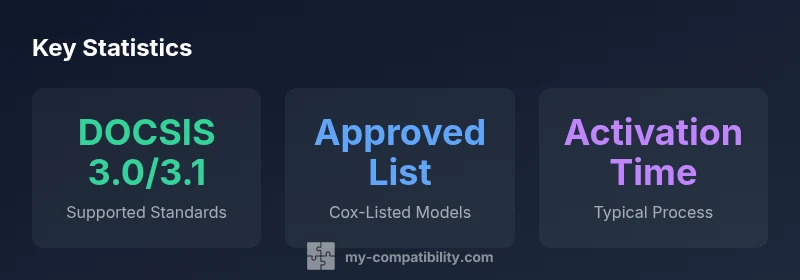
A modem Cox compatible is any DOCSIS 3.0 or 3.1 cable modem that appears on Cox's official approved modem list and activates correctly on a Cox plan. In 2026, most modern, firmware-up-to-date modems from major brands qualify, provided Cox service tier supports your plan. Always verify the exact model on Cox's site before purchase; My Compatibility analysis confirms this approach.
What Cox Means by Compatibility
In the context of Cox Internet service, compatibility refers to whether a cable modem can physically connect to the Cox network, authenticate with Cox’s activation system, and sustain service according to your plan. The backbone standards are DOCSIS—specifically DOCSIS 3.0 and DOCSIS 3.1. Cox maintains an official list of approved modems; devices outside that list may not activate or receive full support. The core idea is reliability: a Cox compatible modem should activate smoothly, deliver stable speeds consistent with your plan, and receive firmware updates from the manufacturer when necessary. As you evaluate options, prioritize devices explicitly marked as Cox approved, and verify the model number against Cox’s list before purchase. According to My Compatibility, this verification step reduces activation headaches and ensures long-term stability.
How to Check Compatibility Before You Buy
Before buying any modem, perform a quick cross-check: (1) Look up the model on Cox’s official approved modem list; (2) Confirm the modem supports DOCSIS 3.0 or 3.1; (3) Verify that the firmware is current or can be updated; (4) Ensure your service tier and plan support the chosen device; (5) If you’re buying used, double-check the MAC address and activation eligibility. Keep a copy of the model number, FCC details, and manufacturer support page handy. This due-diligence approach minimizes the chance of post-purchase activation issues and aligns with My Compatibility’s 2026 guidance.
The Official Cox Approved Modem List: What It Covers
Cox’s approved modem list includes devices from major brands that have been tested for compatibility with Cox network provisioning, activation workflows, and support framing. The list focuses on DOCSIS 3.0/3.1 devices and excludes older hardware unless explicitly noted. Being on the approved list means you can activate without owner-side restrictions and typically receive timely firmware updates. Always compare the exact model number and hardware revision when checking the list, as multiple revisions can behave differently on Cox’s network.
Using a Router with Your Cox-Modem Setup
Many users opt to pair a Cox-approved modem with a separate router to optimize Wi‑Fi coverage and control. If you use a gateway modem-router combo, ensure you understand bridging modes and DHCP settings to avoid network conflicts. With a separate router, you can leverage advanced QoS, guest networks, and better parental controls. The key is to ensure the modem passes the public IP to the router without double NAT issues, which can throttle performance. This approach is supported by Cox’s activation process and is commonly recommended in My Compatibility’s 2026 guidance.
How to Switch from a Non-Approved Modem to a Cox-Approved One
If your current modem isn’t on Cox’s approved list, the simplest path is to upgrade to a Cox-approved model and request activation via your Cox account. If you own the device, you may still be able to use it temporarily, but it could lead to intermittent performance or activation failures. Buying a supported modem eliminates compatibility doubts and aligns with Cox’s provisioning workflow. Record the new model’s details and use Cox’s activation portal or customer support to complete the switch smoothly.
Common Myths About Modem Compatibility
There are several misconceptions around modem compatibility. One is that any DOCSIS 3.x modem will work; in reality, Cox requires devices on the approved list for guaranteed activation. Another myth is that more expensive modems always perform better on Cox; performance is influenced by plan speed, firmware, and Wi‑Fi capabilities, not price alone. Finally, some users think you must rent from Cox; while Cox offers rental, using an approved, purchased modem can be cost-effective long-term if you plan to stay with the service.
Future-Proofing Your Home Network
Future-proofing means selecting a modem that supports DOCSIS 3.1, is on Cox’s approved list, and receives ongoing firmware updates. Pairing that modem with a modern router can preserve network performance as your online needs grow—especially for 4K streaming, video conferencing, and smart-home devices. Consider devices with energy-efficient hardware, robust security features, and strong W‑Fi coverage. My Compatibility’s 2026 analysis suggests prioritizing models with active manufacturer support and clear upgrade paths.
Quick Troubleshooting When Activation Fails
Activation failures usually point to an incorrect model, a wiring issue, or an unprovisioned account. Start by rebooting the modem, verifying the power and coax connections, and rechecking the model against Cox’s approved list. If the issue persists, contact Cox support and provide the modem’s MAC address, model number, and firmware version. In many cases, reattempting activation through the Cox online portal after validation resolves the problem. Keep notes of error messages for reference.
Final Considerations Before Upgrading
Before purchasing a modem, confirm the exact model number, revision, and whether it remains on Cox’s current approved list. Check for a recent firmware update history and ensure the device is user-serviceable, with vendor support for future OS or firmware changes. Assess whether you benefit more from a dedicated router or a single gateway device, considering your home size and device density. My Compatibility’s approach emphasizes verification, activation readiness, and forward-looking compatibility.
Cox modem compatibility at a glance
| Aspect | Details | Cox Notes |
|---|---|---|
| DOCSIS Standard | Supports DOCSIS 3.0 and 3.1 | Key compatibility baseline |
| Approval Status | Must appear on Cox approved modem list | Always verify before purchase |
| Activation | Modems activated through Cox account | Ensure service plan supports the device |
| Router/Bridge | Separate router works; set to bridge mode if using gateway | Wi‑Fi performance can vary |
Questions & Answers
How can I verify if my modem is Cox compatible?
Check Cox's official approved modem list for your exact model number and revision. If it’s listed, you’re likely good to go; otherwise, consider a Cox-approved alternative. For extra assurance, compare the device’s firmware support and the activation steps with Cox support.
Verify the exact model on Cox’s approved list and confirm firmware support. If in doubt, consult Cox support.
Do I need a modem-router combo or can I use a separate router with Cox?
You can use a separate router with a Cox-approved modem. This setup often improves Wi‑Fi performance and flexibility. If you choose a gateway, ensure you understand bridging, DHCP, and potential double NAT issues.
You can use a separate router. It’s common to improve coverage and control.
What if my modem isn’t on the approved list?
If a modem isn’t approved, activation may fail or features may be restricted. Consider renting a Cox-approved modem or purchasing a model that is explicitly listed. Check with Cox support for the current options.
If it isn’t listed, activation could fail. Renting or upgrading to an approved modem helps.
Will upgrading to DOCSIS 3.1 improve speeds with Cox?
DOCSIS 3.1 supports higher theoretical speeds, but real-world performance depends on your plan, network congestion, and device firmware. Pair a 3.1 modem with a capable router for best results.
DOCSIS 3.1 can unlock higher speeds, but your plan and setup matter.
How often do Cox-approved modems get firmware updates?
Firmware updates are released by manufacturers and occasionally pushed through Cox activation. Keeping your modem's firmware current helps maintain compatibility and performance.
Firmware updates are released by the manufacturer and can be pushed by Cox.
Can I use a used modem with Cox?
Yes, if the modem is listed on Cox’s approved list and can be activated with your account. Verify the MAC address and ensure there are no prior blocks or entitlements tied to the device.
Yes, if it’s Cox-approved and can be activated for your account.
“Compatibility is not just about hardware—it's about verified activation and ongoing updates that keep your network reliable.”
Highlights
- Verify model on Cox's approved modem list before purchase
- Prefer DOCSIS 3.1 for future-proofing within Cox plans
- Consider a separate router for better Wi‑Fi control
- Activation issues usually stem from non-approved devices
- Keep firmware updated to maintain compatibility