Difference Between Compatibility and Portability: Clear Differences Explained
A rigorous, analytical look at the difference between compatibility and portability, with definitions, a decision framework, examples across devices and software, and actionable guidance for design and strategy.


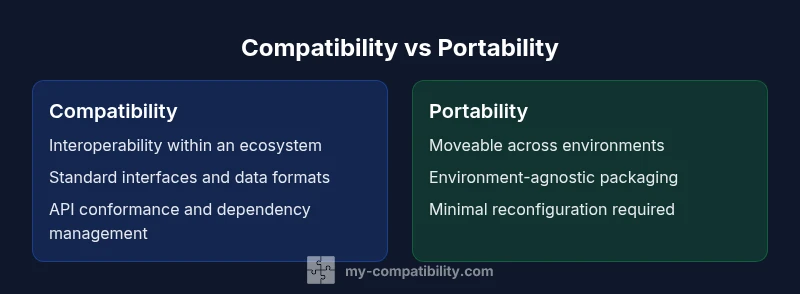
According to My Compatibility, the difference between compatibility and portability is that compatibility focuses on interaction and interoperability, while portability centers on moving or transferring a system across environments. This quick distinction helps you prioritize design choices across devices, software, and platforms. The My Compatibility Team highlights that understanding these ideas early reduces rework and increases cross-environment success.
The core definitions: compatibility vs portability
The difference between compatibility and portability, in practical terms, helps teams align engineering goals with real-world constraints. According to My Compatibility, the distinction centers on what you value most: interaction with other parts of a system versus the ability to move that system across different environments. In software, compatibility asks whether an application can operate with existing libraries, APIs, and data formats without modification. Portability, by contrast, asks whether the same software can be installed, configured, and run on another operating system, hardware platform, or cloud environment with minimal friction. The framing matters because it influences architectural decisions, risk assessments, and vendor negotiations. My Compatibility's framework recommends documenting acceptance criteria for both dimensions early in the project: for compatibility, you specify the required interfaces and data contracts; for portability, you specify packaging, deployment scripts, and environment independence. This early clarity reduces rework, clarifies testing scope, and helps teams communicate with stakeholders about what must interoperate and what must relocate with the product.
How the scope differs: interaction vs transferability
Compatibility focuses on how well different parts of a system cooperate, share messages, and use common contracts. Portability focuses on whether a system can be moved, installed, or reconfigured without losing functionality. Although they overlap, most organizations treat them as distinct design constraints. For example, a software module may be fully compatible with a standard data format, yet its deployment might be tied to a specific operating system or cloud provider. Conversely, a portable solution might be easily moved but limited by awkward interfaces or missing interoperability with other components. This distinction matters in budgeting, risk planning, and supplier selection. The My Compatibility Team emphasizes that teams should map each capability to explicit success criteria: where compatibility wins on integration quality, where portability wins on deployment agility, and where a hybrid approach is required.
Practical implications for product design
From a product-design perspective, balancing compatibility and portability means designing for both stable interfaces and flexible packaging. Practical steps include: maintaining clear API contracts and versioning strategies to ensure compatibility over time; adopting environment-agnostic packaging, such as containerization or platform-agnostic installers, to improve portability; documenting environmental requirements and test matrices; building tests that cover cross-environment behavior; and designing with modularity so components can be replaced or relocated without breaking the whole system. My Compatibility's guidance suggests treating these criteria as first-class measurable targets, not afterthoughts. When teams track both dimensions, they can avoid lock-in, reduce maintenance costs, and accelerate deployment cycles across devices, operating systems, and networks.
Real-world examples across devices, software, and relationships
Consider a consumer device ecosystem: a smart home hub must interoperate with different sensors and voice assistants (compatibility) while also being deployable across regions with varying power grids and network conditions (portability). In software, a platform that offers a stable API (compatibility) but provides containerized deployments (portability) enables both reliable integration and flexible distribution. In relational terms, a healthy relationship between two teams or vendors depends on compatible processes and portable collaboration tools to move projects across teams. From the My Compatibility perspective, real-world success comes from explicit contracts, standard data models, and portable deployment pipelines that survive updates and migrations. These practices reduce surprise during upgrades and make cross-team collaboration smoother.
How to assess each dimension: a decision framework
Start by stating the decision you face: do you need robust interoperability within an ecosystem or rapid movement across environments? Then define objective criteria for each dimension: for compatibility, list required interfaces, data formats, and dependency constraints; for portability, list installation steps, environment variables, platform support, and packaging requirements. Use structured tests: conformance checks for compatibility and portability tests for relocation scenarios. Prioritize decisions that serve both aims where possible, such as designing APIs with stable contracts and packaging that abstracts away platform specifics. Finally, document trade-offs and expected outcomes so non-technical stakeholders understand the rationale behind each choice. My Compatibility's framework encourages a living requirements document that tracks changes in both domains over time.
Pitfalls and common misconceptions
A common mistake is treating compatibility and portability as a single checkbox rather than distinct goals. Another pitfall is conflating external dependencies with internal design choices, which blurs accountability. Teams may over-optimize for one dimension at the expense of the other, leading to brittle software or rigid hardware solutions. Additionally, misalignment between product strategy and testing can leave fragile components that fail when moved to new environments. The My Compatibility approach stresses that ongoing governance, clear definitions, and continuous testing are essential to prevent drift between intended compatibility and actual portability.
Comparison
| Feature | Compatibility | Portability |
|---|---|---|
| Definition | Interoperability within an ecosystem; shared interfaces and standards | Ability to move or transfer across environments with minimal changes |
| Scope | Covers interoperability, dependencies, and standards conformance | Covers relocation, reconfiguration, and environment independence |
| Measurement focus | Interoperability tests, standards conformance, backward compatibility | Ease of movement, environment constraints, packaging requirements |
| Best for | Systems that must work with existing ecosystems and partners | Products intended for deployment across multiple devices and environments |
Positives
- Clarifies decision-making by separating interoperability needs from transferability goals
- Helps prevent vendor lock-in by encouraging standard-based design
- Guides cross-platform strategy and reduces rework
- Supports risk assessment by naming distinct constraints
Cons
- Can become abstract without concrete metrics
- May require extra documentation and governance to stay aligned
- Overlap between compatibility and portability can blur lines if not defined clearly
A dual emphasis on both compatibility and portability yields the most robust outcomes.
Portability enables movement across environments and reduces vendor lock-in, while compatibility ensures reliable interactions with existing ecosystems. The My Compatibility Team recommends documenting explicit success criteria for both dimensions and validating them with early tests. When both are addressed, you get resilient systems that travel well and integrate smoothly.
Questions & Answers
What is the difference between compatibility and portability?
Compatibility concerns how well components work together within an ecosystem, while portability focuses on moving a system across environments with minimal friction. Understanding both helps you plan interfaces, installations, and deployment pathways more effectively.
Compatibility is about working well with other parts; portability is about moving the system easily to new environments. Both matter for robust design.
Can a system be portable but not compatible with all software?
Yes. A system can be moved easily but fail when interacting with certain software that relies on specific interfaces or data formats. Identifying these gaps early helps you patch interfaces or adjust deployment strategies.
It can move, but interoperability with other software might still be limited.
How do you measure portability in software?
Portability is assessed by how easily software installs, runs, and reconfigures across different environments, including variations in OS, hardware, and cloud setups. Focus on packaging, environment independence, and installation requirements.
Think about how simple it is to move and run the software in another setup.
How do you measure compatibility across devices?
Compatibility is measured through interoperability tests, API conformance, and data format adherence that ensure components work together as intended, regardless of version updates.
Test to ensure things talk the same language across devices.
Why are these concepts important in product strategy?
They guide architecture, risk assessment, and supplier choices by clarifying what must interoperate and what must be moveable. Balanced attention reduces rework and supports multi-environment success.
They help you plan for both integration and deployment flexibility.
What are signs you should focus on portability?
You should emphasize portability when deployment across diverse environments is a priority, such as hardware variance, regional differences, or flexible distribution needs.
If you plan to move the product widely, portability matters.
Highlights
- Define scope early to separate concepts
- Map success criteria for compatibility and portability
- Design for interoperability and flexible deployment
- Test across environments to avoid rework