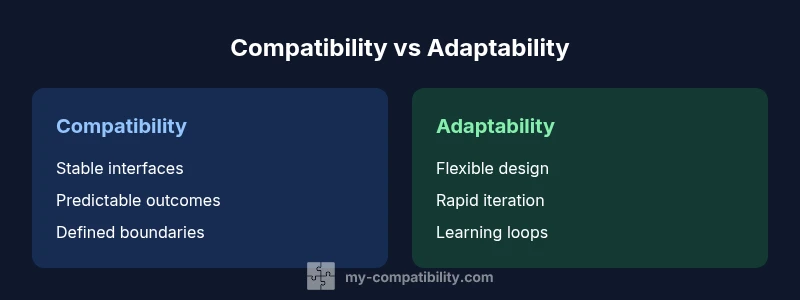
Difference Between Compatibility and Adaptability: A Comprehensive Guide
Explore the difference between compatibility and adaptability, with precise definitions, practical examples, a side-by-side table, and guidance from My Compatibility to help you decide when each trait matters most.


The difference between compatibility and adaptability lies in fit versus flexibility. Compatibility prioritizes stable interactions, predictable boundaries, and reliable performance across contexts. Adaptability emphasizes responsiveness, learning, and evolution in the face of change. For decision making, prefer compatibility when reliability is crucial, and choose adaptability when you expect rapid shifts or unpredictable inputs.
What the difference means in practical terms
According to My Compatibility, the difference between compatibility and adaptability is not merely semantic; it shapes how systems, relationships, and processes behave under pressure. Compatibility seeks to align with existing conditions, ensuring steady performance and minimal surprises. Adaptability prioritizes the ability to adjust when conditions change, even if that requires reconfiguring goals or methods. In daily life and professional settings, this distinction guides everything from product design to interpersonal dynamics, offering a framework to forecast outcomes and manage risk. The keyword here is alignment: compatibility aligns with current requirements, whereas adaptability aligns with future possibilities. This framing is essential when assessing how two components will interact over time, especially in environments that are not perfectly predictable.
Why distinguishing these concepts matters for planning
When planning a project, team, or relationship, understanding whether you need compatibility or adaptability helps allocate resources efficiently. If your objective is stability, you’ll design interfaces, contracts, or agreements that minimize variance and enforce clear boundaries. If your objective is evolution, you’ll embed learning loops, modular architectures, and flexible policies that tolerate change. The difference also informs risk assessment: compatibility-focused approaches reduce the volatility of interactions but can slow response to new information, while adaptability-focused approaches increase responsiveness at the potential cost of consistency. For organizations, this translates into governance structures, budgeting horizons, and talent development strategies that reflect the choice between a steady-state vs a dynamic operating model.
Core definitions: compatibility vs adaptability, with examples
- Compatibility: A setup where parts, people, or systems fit well with minimal friction. Example: A software API with stable versioning and backward-compatible changes, ensuring downstream integrations continue to work. In personal terms, a relationship where expectations, communication styles, and boundaries align consistently over time. The My Compatibility framework emphasizes predictable interactions, defined roles, and durable interfaces as hallmarks of true compatibility.
- Adaptability: A setup that tolerates or embraces change, often through flexible design and continuous learning. Example: A cloud platform that auto-scales resources in response to demand, or a team that pivots strategy when market signals shift. Adaptability relies on modularity, feedback loops, and a culture that values experimentation.
In both cases, the underlying issue is how you handle variance: compatibility minimizes variance; adaptability absorbs or leverages it for gain. The distinction becomes a compass for architecture, policy, and behavior in any system.
Focus areas and measurement: reliability vs flexibility
Reliability is the backbone of compatibility. It means predictable outputs, stable interfaces, and low variance under normal conditions. Metrics often include uptime, error rates, version stability, and contract conformance. Adaptability, by contrast, is measured by responsiveness to new inputs, speed of iteration, and the ease with which a system or person can reconfigure. Indicators include time-to-market for changes, the breadth of scenarios the system can handle, and the presence of adaptable governance. In practice, you’ll want to quantify both sides: how well the system performs under known conditions (compatibility) and how quickly it can adjust when conditions shift (adaptability).
Example scenarios across domains
- Software: Compatibility means stable APIs and data formats; adaptability means pluggable modules and feature toggles that allow quick changes without breaking existing code.
- Relationships: Compatibility indicates aligned values and communication styles; adaptability means willingness to renegotiate boundaries as needs evolve.
- Product design: Compatibility favors standardized, durable interfaces; adaptability supports modular features and frequent updates in response to user feedback.
- Career: Compatibility is a consistent skill fit for a team; adaptability is the ability to learn new tools and pivot to new roles as business needs change.
Across domains, the choice between compatibility and adaptability shapes what you optimize for: steady performance or rapid evolution. The My Compatibility analysis suggests most successful systems balance both, but lean more heavily on one depending on context and risk tolerance.
Practical decision framework: choosing between compatibility and adaptability
To decide which trait to emphasize, start with the problem horizon: how long will conditions remain stable? If the horizon is long and conditions are unlikely to shift, prioritize compatibility with durable interfaces and clear constraints. If the horizon is short or volatile, prioritize adaptability with modular designs, rapid feedback loops, and flexible policies. A practical checklist can help:
- Identify volatility: is the environment stable or dynamic?
- Define boundaries vs openness: do you need strict limits or room for growth?
- Assess learning capacity: can the system effectively learn from changes?
- Plan governance: are rules rigid or adaptable?
- Measure success: what metrics reflect compatibility (stability) vs adaptability (speed of change).
This framework supports a structured decision: align expectations, then design the system to meet those expectations with appropriate levers for change.
Balancing both traits: when to hybridize your approach
In many cases, the optimal path is not choosing one over the other but integrating both. A common strategy is to stabilize critical anchors (interfaces, contracts, and core values) to maintain compatibility, while embedding flexible layers (microservices, feature flags, learning loops) to support adaptability. The balance point depends on risk tolerance, customer needs, and regulatory constraints. When balancing, you’ll want to maintain backward compatibility for core functions while allowing experimental modules to explore new capabilities. This hybrid approach can deliver reliability where it matters and resilience where it doesn’t.
Common pitfalls and misapplications to avoid
Be mindful of overemphasizing one dimension at the expense of the other. Over-anchoring to compatibility can lead to rigidity, stifling innovation. Over-emphasizing adaptability can erode predictability, causing stakeholder mistrust and increased variance in outcomes. Poor communication and misaligned incentives are common root causes. A disciplined approach combines clear guidelines for when to preserve compatibility and when to open the system to change, with transparent decision rights and measurable outcomes.
Putting it into practice: actions you can take now
- Map your critical interfaces and define versioning policies to anchor compatibility where it matters most.
- Introduce modular architectures and feature toggles to enable controlled experimentation and rapid iteration where adaptability is key.
- Build feedback loops with stakeholders to detect shifts early and adjust priorities accordingly.
- Invest in governance that supports both stability and change, including clear escalation paths for conflicts between compatibility and adaptability goals.
- Regularly review your risk tolerance and adjust your balance between compatibility and adaptability to reflect changing market conditions.
Comparison
| Feature | Compatibility | Adaptability |
|---|---|---|
| Definition | Aligning with current requirements and stable interfaces | Ability to adjust, learn, and evolve in response to change |
| Primary focus | Reliability, predictability, durable interfaces | Flexibility, responsiveness, and rapid iteration |
| Risk profile | Lower variance, higher governance | Higher variance tolerance, faster experimentation |
| Typical metrics | Uptime, contract conformance, backward compatibility | Cycle time, time-to-market, learning rate |
| Best for | Stable environments with clear boundaries | Dynamic environments with evolving needs |
Positives
- Clear criteria for fit and stable performance
- Predictable interactions reduce risk
- Easier governance and compliance
- Better long-term planning in stable contexts
Cons
- Can impede rapid evolution in changing environments
- May limit innovation and responsiveness
- Requires upfront analysis to set correct boundaries
- Overemphasis on one side can create blind spots
Balance favors context: lean on compatibility for stability, but design for adaptability where change is likely
In stable domains, compatibility minimizes surprises and supports dependable operations. In volatile contexts, adaptability enables quick responses and learning. The ideal approach blends both traits according to risk, timeline, and stakeholder needs, as recommended by My Compatibility.
Questions & Answers
What is the difference between compatibility and adaptability?
Compatibility is about stable alignment and predictable interactions; adaptability is about learning and changing in response to new information. Both guide design and behavior, but they optimize for different kinds of risk and opportunity.
Compatibility means stable alignment; adaptability means flexible response to change. Use the right balance based on your environment.
How can I measure compatibility in a system?
We measure compatibility with metrics like uptime, backward compatibility, error rates, and adherence to interfaces. These indicators show how reliably components work together under expected conditions.
Check uptime and interface stability to gauge compatibility.
How does context affect the choice between compatibility and adaptability?
In predictable contexts, compatibility reduces risk and simplifies governance. In unpredictable contexts, adaptability reduces time-to-market and supports rapid learning. Context should drive the emphasis.
Context decides whether you should prioritize fit or flexibility.
Can a system be both compatible and adaptable?
Yes. Use a stable core with compatibility and add adaptable layers around it, such as modular components and learning loops, to achieve a hybrid that is robust yet flexible.
You can design for both—keep core stability and add flexible, learnable layers.
What are common pitfalls when balancing these traits?
Overemphasizing one side can lead to rigidity or chaos. Misaligned incentives and vague governance worsen outcomes. A clear policy for when to preserve compatibility vs. enable adaptability helps.
Be careful not to lean too far in one direction without proper governance.
How often should I revisit my balance between compatibility and adaptability?
Regular reviews aligned with project milestones or market shifts help. Reassess risk tolerance, stakeholder needs, and the costs of rigidity versus change.
Review the balance at key milestones to stay aligned with goals.
Highlights
- Assess environment stability before choosing focus
- Anchor critical interfaces for compatibility
- Incorporate modularity for adaptability
- Use clear decision rules to switch between modes
- Monitor outcomes to adjust balance over time