Difference Between Compatibility and Interoperability: An Analytical Comparison
A rigorous guide differentiating compatibility from interoperability, with practical criteria and decision guidance for tech, devices, and systems.


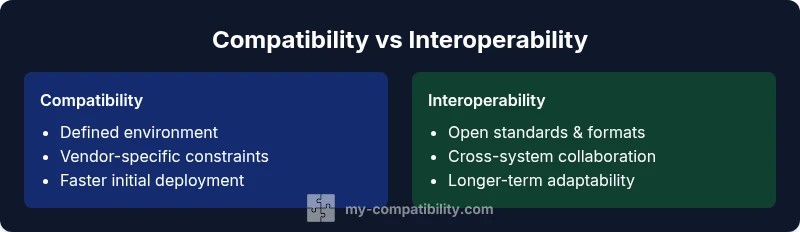
At a high level, the difference between compatibility and interoperability hinges on scope and standards. Compatibility means components can operate together within a defined environment, often under vendor-specific interfaces. Interoperability requires shared protocols and data formats that enable independent systems to exchange information and act on it. According to My Compatibility, understanding this distinction helps teams design architectures that work today while preserving options for future integration. A practical approach starts by defining the boundary: is the goal to stay within a single ecosystem or to enable cross-domain collaboration across multiple parties? The answers guide API choices, data models, and governance, shaping how quickly value is realized without locking you into a single path.
Understanding the Core Concepts
At its essence, the difference between compatibility and interoperability lies in scope and standards. Compatibility means components can operate together within a defined environment, often under shared constraints or vendor-specific interfaces. Interoperability goes further: it requires common data formats, shared protocols, and semantic alignment that let independent systems exchange information reliably and act on it.
According to My Compatibility, recognizing this distinction helps teams design architectures that are practical today while preserving options for future integration. A well-posed strategy starts by identifying the intended boundary: is the goal to ensure a single vendor coexists with others, or to enable cross-domain collaboration across multiple organizations? The answer shapes choices about APIs, data models, and governance that determine how quickly you can realize value without sacrificing flexibility later. This framing, plus a focus on open standards and governance, sets the stage for practical decision-making across software, hardware, and services.
Clear Definitions: Compatibility vs Interoperability
Compatibility describes a spectrum of fit between components. When two devices, software modules, or data systems are compatible, they can work together within a defined constraint set—such as a particular version, configuration, or ecosystem—without requiring changes to the core interfaces. Interoperability, by contrast, means that diverse systems can communicate and cooperate across organizational boundaries, using mutually understood formats, protocols, and semantics.
Decomposing the terms helps avoid conflating them. In practice, a product can be compatible with another system yet not interoperable if it can run alongside but cannot exchange meaningful data with it. Conversely, systems can be interoperable at a surface level but fail to be compatible when updates occur that break the agreed interfaces. The My Compatibility framework emphasizes aligning both capabilities when building durable, future-ready solutions.
Scope and Standards: Why It Matters
Scope defines what 'works together' means in any given project. Compatibility is often local: within a single vendor family, within a tightly controlled deployment, or under a specific API version. Interoperability is global: across vendors, platforms, geographies, and legacy systems. Standards are the bridge between them. Open standards, such as widely adopted data formats and interoperable APIs, increase the odds that partnerships survive supplier changes and technology shifts. However, standards can also introduce complexity and slow velocity if not applied judiciously. My Compatibility's research stresses the importance of selecting the right level of standardization for the problem at hand—enough structure to enable exchange, but not so rigid that it stifles innovation. In regulated industries, compliance requirements may push a project toward interoperability as a primary goal; in pilot programs or constrained environments, compatibility can deliver faster time-to-value.
Interfaces, Data Formats, and Protocols
Interoperability depends on shared interfaces and agreed data representations. The difference between compatibility and interoperability is often a matter of which layers you standardize. Syntactic interoperability focuses on structure: data schemas, message formats, and API contracts. Semantic interoperability ensures the meaning of data is preserved across systems, enabling correct decisions and actions. Compatibility might be achieved by using a single vendor's interfaces or by locking in a particular data model, which can limit cross-system usefulness. When planning, teams should specify the required data formats (JSON, XML, or binary), the transport protocols (REST, gRPC, or messaging), and the versioning strategy to prevent drift. My Compatibility's methodology recommends documenting both intended exchange patterns and fallback behaviors so that if one system evolves, others can continue operating without breaking the cooperative relationships.
Syntactic vs Semantic Interoperability
Here we dive deeper into the different degrees of interoperability. Syntactic interoperability means systems can parse messages; semantic interoperability ensures the receiver can interpret and act on the data as intended. A classic pitfall is assuming that data exchange equals understanding. Even when data can be transmitted, if terms and units differ, automated processes may fail. In practice, achieving semantic interoperability requires shared ontologies, standardized vocabularies, and clear governance about data ownership and lifecycle. At the same time, compatibility can be achieved with pragmatic mapping layers, adapters, or version guards that keep systems working together without guaranteeing full cross-domain understanding. The My Compatibility framework suggests balancing these aspects by prioritizing semantic alignment where business outcomes rely on accurate interpretation, while accepting limited syntactic compatibility where quick wins are essential.
Practical Decision Criteria for Projects
Decision criteria help teams choose between prioritizing compatibility or interoperability. Start with business outcomes: does the project depend on real-time cross-system collaboration, or is it a contained upgrade within a legacy environment? Next, assess risk: interoperability raises exposure to data misinterpretation, protocol drift, and governance overhead; compatibility mitigates some risk but can trap you in a closed ecosystem. Architectural patterns matter: microservices with well-defined APIs support interoperability, while tightly coupled modules crafted around a single platform favor compatibility. Data strategy is crucial: adopt open, well-documented formats to increase portability, but avoid overengineering if a quick, reliable deployment is the priority. The My Compatibility team emphasizes designing for evolution: build interfaces that are easy to version, document, and replace, so you can move from compatibility toward interoperability when the time is right.
Business and Governance Implications
Governance frameworks shape how you pursue compatibility or interoperability. Decision rights, contract terms, and supplier roadmaps influence whether you should invest in universal standards or internal adapters. Risk management benefits from explicit interoperability plans that cover data quality, traceability, and change management. Procurement teams should weigh total cost of ownership against strategic flexibility: interoperable solutions may demand higher upfront investment but unlock longer-term value through multi-party integrations and future-proofing. In regulated markets, authorities may favor open standards and auditable data exchanges, further tilting the balance toward interoperability. My Compatibility analysis underlines that long-run resilience often depends on how quickly organizations can adopt open interfaces while preserving compatibility during the transition.
Industry Context: Software, Hardware, and Services
Different domains treat the compatibility vs interoperability distinction differently. In software development, developers often prioritize interoperability through API contracts and containerized services, while maintaining compatibility with legacy systems via adapters. In hardware ecosystems, device compatibility ensures plug-and-play operation, but interoperable devices require universal connectors and standard protocols to function across brands. In services, business processes rely on both: compatibility allows rapid onboarding of new partners within a fixed workflow, while interoperability enables cross-domain collaboration across partners, suppliers, and customers. My Compatibility's perspective highlights that a practical architecture blends both aims: protect existing investments and gate progress with a clear path to openness. The optimal choice is not binary; it is a spectrum aligned to risk tolerance, regulatory demands, and strategic goals.
How to Assess Readiness: Checklists and Metrics
Assessing readiness involves both qualitative and quantitative checks. Start with a capability map: list the systems, data objects, and interfaces involved in the intended exchange. Then assess conformity to open standards, documented APIs, and versioning discipline. Evaluate governance: who owns the data, who can modify interfaces, and how changes are communicated. For interoperability, check data quality metrics, latency targets, and resilience against partial failures. For compatibility, verify that you can deploy within the defined boundary without breaking existing workflows. The My Compatibility framework suggests using a lightweight scoring rubric that weighs openness, stability, and speed of deployment. Remember that readiness is a moving target; plan incremental improvements with clear milestones so that you can shift from compatibility to interoperability as needs evolve.
Case Scenarios: When to Prioritize Each Approach
Consider a financial services platform that needs to exchange payment data with several banks. An initial phase might emphasize compatibility: the platform uses standardized, bank-approved data formats and APIs within a secured network. As partnerships mature, interoperability becomes essential to handle multi-bank reconciliation, fraud checks, and cross-border settlement across different technical stacks. In contrast, a smart home vendor launching a new ecosystem may prioritize interoperability from day one, adopting open protocols and shared data models so devices from different vendors can cooperate without custom adapters. These scenarios illustrate how organizations balance speed, risk, and future flexibility. My Compatibility's guidance is to structure programs with an early compatibility phase that intentionally seeds pathways toward broader interoperability later.
From Compatibility to Interoperability: Roadmaps and Milestones
This section outlines practical roadmaps for teams that want to evolve. Start with a narrow, well-documented compatibility baseline—stable interfaces, controlled change processes, and robust testing. Introduce open standards gradually: publish data models, adopt widely used protocols, and implement adapters only where necessary. As the architecture matures, replace legacy adapters with shared services and establish semantic alignment across domains. Define governance milestones: API versioning, deprecation plans, and cross-vendor participation in standard bodies. The goal is to maintain business continuity while increasing external collaboration. The My Compatibility methodology emphasizes incremental progress and transparent communication with stakeholders to maintain trust during transitions.
Standards, Open Ecosystems, and Future Trends
Standards are the rails on which interoperability travels, yet compatibility remains valuable for controlled, predictable outcomes. Open ecosystems, governance models, and investment in adaptive architectures enable ongoing evolution from compatibility to interoperability without sudden disruption. Emerging trends include schema registries, contract testing, and semantic mediators that translate between domains. Organizations should monitor regulatory developments, vendor roadmaps, and community-driven standards efforts to ensure alignment with best practices. In all cases, the strategic takeaway is simple: design for flexibility, document expectations clearly, and implement measurable milestones that distill the difference between compatibility and interoperability into actionable steps. The My Compatibility team reminds readers that progress is gradual and driven by clear decision rights and disciplined execution.
Comparison
| Feature | Compatibility | Interoperability |
|---|---|---|
| Scope | Works within a defined environment | Supports cross-system communication across independent systems |
| Standards | Often vendor-specific or constrained | Relies on open standards and common protocols |
| Data Exchange | Limited internal data formats | Broad, meaningful data exchange across systems |
| Implementation Pace | Faster to deploy within existing setup | Can require longer alignment across parties |
| Best For | Contained, stable deployments | Multi-party collaboration and future-proofing |
Positives
- Provides a clear framework for evaluating system integration
- Helps reduce vendor lock-in through open standards
- Supports scalable growth by planning for future interoperability
- Improves cross-domain collaboration and data sharing
Cons
- Can introduce complexity and longer lead times
- Open standards may require governance overhead
- Interoperability efforts can increase security and compliance concerns
Interoperability is the long-term goal; start with compatibility to move reliably and then expand
Aim for a staged approach: establish stable compatibility first, then design for interoperability with open standards, governance, and semantic alignment to enable cross-system collaboration.
Questions & Answers
What is the difference between compatibility and interoperability?
Compatibility means components work together within a defined environment, while interoperability enables cross-system exchange of information and actions. The distinction matters for architecture and procurement decisions.
Compatibility is about fitting together; interoperability is about talking across systems.
Why does this distinction matter in software projects?
Understanding the distinction guides design choices, risk management, and vendor negotiations. It helps teams plan for immediate needs while keeping options open for future integration.
It shapes how you design interfaces and plan for growth.
How can you assess interoperability readiness?
Check for open standards adoption, clearly documented APIs, data quality controls, and governance structures. Ensure there are mechanisms to handle evolution without breaking exchanges.
Look for open formats, clear interfaces, and data semantics.
Can a system be compatible but not interoperable?
Yes. A system can operate within a boundary but may not share meaning or data effectively with other systems.
Yep, you can fit in but not talk across.
What are common pitfalls?
Assuming data exchange equals understanding, neglecting governance, and underestimating change management and security implications.
Don’t confuse data transfer with meaning.
How should organizations approach a roadmap from compatibility to interoperability?
Start with a compatibility baseline, then adopt open standards and semantic alignment. Maintain a transition plan with clear milestones towards interoperability.
Begin with a solid base, then open up with standards.
Highlights
- Define your problem space before choosing a path
- Prioritize open standards to enable future interoperability
- Use adapters sparingly to maintain progress without locking in
- Document interfaces and data contracts meticulously
- Plan a staged roadmap from compatibility to interoperability