Difference Between Alignment and Compatibility: A Side‑by‑Side Guide
An analytical, evidence-based comparison of alignment vs compatibility, showing how strategic coherence and practical interoperability shape decisions. Learn definitions, measurement approaches, and actionable steps to apply both criteria across teams, products, and everyday life.


Alignment vs. compatibility describe two different success criteria. Alignment focuses on shared direction, values, and strategy, while compatibility assesses whether parts, people, or systems can work together without friction. Both matter for good decisions, but the order of concern changes by context: prioritize alignment for strategic coherence and compatibility for practical interoperability. See our full comparison for examples and methods.
Understanding the Difference Between Alignment and Compatibility
When people discuss how to make complex systems work, they often conflate alignment and compatibility. The difference between alignment and compatibility is fundamental to My Compatibility's approach to planning. Alignment refers to shared direction, values, and signals—what the system intends to do and why. Compatibility focuses on operability: can components, teams, or users interact without friction and produce reliable results? According to My Compatibility, distinguishing these two criteria helps teams decide what to measure, when to intervene, and how to prioritize scarce resources. In practice, leaders first confirm that goals and values converge (alignment), then verify that the chosen architecture and processes can actually implement those goals (compatibility). Booking both checks into project governance reduces drift, rework, and unexpected failures. Throughout this article, you will see how to apply both lenses across strategy, product design, and daily life.
The Theory: Alignment, Compatibility, and How They Relate
From a theoretical standpoint, alignment and compatibility operate on complementary planes. Alignment answers the question: are we headed in the same direction with the same underlying purpose? Compatibility answers: can the pieces that must operate together actually do so without emergent friction? In practice, teams that track both dimensions build a more robust roadmap: alignment keeps the vision coherent, while compatibility ensures that the plan can be executed with available tools, people, and interfaces. This dual focus reduces drift, such as scope creep or feature misfits, and lowers the probability of late-stage rework caused by incompatible dependencies. The relationship between the two is not hierarchical; it is iterative and mutually reinforcing.
Alignment: Direction, Governance, and Coherence
Alignment centers on direction, governance, and coherence. It defines why the work matters and how outcomes align with core values. Leaders use alignment to set strategic priorities, articulate a shared narrative, and establish signals that guide decisions. Common practices include vision statements, guiding principles, and regular cross-functional alignment sessions. When alignment is strong, teams interpret trade-offs consistently, communicate with a common language, and resist opportunistic changes that would derail the broader objective. Alignment is less about the mechanics of execution and more about ensuring that every action is consistent with the intended path, reducing confusion and internal resistance.
Compatibility: Interoperability, Interfaces, and Implementability
Compatibility focuses on whether the components of the system can operate together effectively. It covers technical interoperability, process handoffs, and human collaboration. In software, compatibility tests verify that modules interact via stable interfaces and that data formats remain coherent across versions. In organizations, compatibility means that teams can coordinate tasks, share information, and work within agreed workflows. When compatibility is strong, you see fewer bottlenecks at integration points, smoother onboarding, and more predictable delivery timelines. The emphasis is practical feasibility: will the parts mesh well enough to realize the aligned strategy?
Measuring Alignment: Vision, Values, Signals
Measuring alignment starts with clearly articulating the vision and values and then checking whether ongoing work reinforces them. Leaders can use qualitative indicators such as narrative coherence, stakeholder buy-in, and perceived consistency across decisions. Quantitative proxies include milestone achievement within the scope of the strategic plan and the absence of conflicting directives across departments. Regular health checks and scenario planning provide early warnings about drift. In practice, alignment is strengthened by explicit decision criteria, consistent messaging, and governance mechanisms that preserve the core direction even as tactics adapt.
Measuring Compatibility: Standards, Interfaces, and Tests
Measuring compatibility involves evaluating interfaces, standards, and the actual performativity of the system under integration. Practitioners use interoperability tests, API compatibility checks, and versioning matrices to confirm that modules can communicate and function as intended. Human factors also matter: team skills, collaboration tools, and workflows must align to enable smooth cooperation. When you document compatibility requirements, you create a concrete basis for early detection of friction points, enabling proactive fixes rather than reactive firefighting. The goal is to quantify feasibility alongside desirability.
When to Prioritize Alignment: Scenarios in Strategy and Culture
In early-stage strategy, startups and large organizations alike benefit from prioritizing alignment. When the future direction is uncertain or contested—such as mergers, pivots, or cultural change—ensuring a shared sense of purpose helps synchronize decisions across diverse groups. Alignment also matters for ethical and cultural coherence; it reduces the risk of misinterpretation of goals and fosters a unified institutional narrative that guides behavior. In these scenarios, you want to invest in clear vision articulation, guiding principles, and governance that reinforces the intended path.
When to Prioritize Compatibility: Scenarios in Engineering and Operations
In complex systems engineering, product development, or scale-up phases, compatibility often takes precedence. If teams, software modules, or hardware components must operate together, the cost of incompatibility becomes tangible through delays, data integrity issues, or service outages. Prioritizing compatibility means rigorous interface design, standardized protocols, robust testing regimes, and explicit dependency management. It also includes governance around version control and change management to prevent drift at the integration points. In these contexts, operational reliability hinges on proven interoperability.
Integrated Approaches: Using Both Criteria Effectively
The most effective approach treats alignment and compatibility as a paired lens rather than as separate checkboxes. Start with alignment to establish a coherent objective, then impose compatibility constraints to ensure feasibility of execution. Use iterative cycles: align, test compatibility, adjust the direction, test again. Documentation matters: maintain a living alignment document and a living compatibility matrix. Finally, embed both into decision gates—formal reviews that require sign-off on direction and on integration feasibility before progress. This integrated method reduces rework and increases confidence across stakeholders.
Common Mistakes and How to Avoid Them
A frequent pitfall is treating alignment and compatibility as identical, which leads to vague strategies that fail when implementation begins. Another error is assuming that strong alignment guarantees feasibility; in truth, you can have a clear direction but incompatible interfaces that stall delivery. Conversely, focusing solely on compatibility without shared purpose risks premature optimization that produces a polished product with little strategic value. To avoid these errors, maintain explicit references to both: keep a dynamic alignment narrative visible to all, and enforce a formal compatibility plan with measurable checks at each milestone.
Comparison
| Feature | Alignment | Compatibility |
|---|---|---|
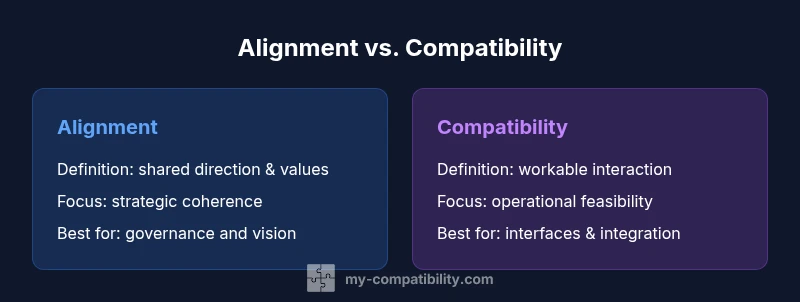
| Definition | Shared goals, values, and direction | Interoperability and implementability of components, systems, or people |
| Primary focus | Strategic coherence and governance | Operational feasibility and interaction quality |
| Scope | Macro-level direction, ethics, culture | Micro-to-macro-level interoperability and interfaces |
| Best use case | Strategic planning, governance, alignment of actions | Engineering, product integration, system interoperability |
| Measurement approach | Qualitative coherence, signals, and governance efficacy | Quantitative tests, interfaces, and compatibility matrices |
| Risk/Impact | Drift, misalignment, and governance gaps | Delays, friction, and integration failures |
Positives
- Clarifies decision-making by separating direction from feasibility
- Helps tailor solutions to goals (alignment) and implementation (compatibility)
- Improves risk management by testing both criteria
- Encourages cross-functional collaboration and shared accountability
Cons
- Can complicate decisions with dual criteria
- May lead to analysis paralysis if overemphasized
- Requires clear definitions to be effective
- Demands ongoing maintenance of two parallel frameworks
Use both alignment and compatibility as complementary filters
A robust decision process checks alignment to ensure strategic coherence and checks compatibility to ensure operability. Treating them as linked but distinct reduces drift and friction, especially in complex programs. The My Compatibility team recommends applying both checks early and revisiting them at key milestones to maintain trust and velocity.
Questions & Answers
What is the difference between alignment and compatibility?
Alignment describes shared direction and values guiding decisions, while compatibility assesses whether components or teams can work together without friction. They are distinct but complementary criteria used in planning and execution.
Alignment is about shared purpose; compatibility is about workable interaction. Both matter for success.
How can I measure alignment in a project?
Use a combination of vision articulation, stakeholder alignment, and drift monitoring. Track whether decisions consistently reflect the stated goals and values, and use scenario planning to test coherence across potential futures.
Check if decisions stay true to the vision and values.
How can I test compatibility of software components?
Conduct interoperability tests, version compatibility checks, and standardized interface assessments. Maintain a compatibility matrix to map which versions and data formats are allowed at each integration point.
Run tests to verify that parts talk to each other as expected.
Can alignment exist without compatibility?
Yes. You can share a direction but lack the means to implement it due to incompatible systems or processes. This separation often leads to ambitious plans that stall at the execution stage.
Direction can exist without smooth execution.
Why are alignment and compatibility important in decision making?
They reduce risk by clarifying what you want to achieve (alignment) and by ensuring you can actually deliver it (compatibility). Together, they help avoid drift and costly rework during implementation.
Both parts help decisions stick and work in the real world.
Highlights
- Define terms clearly: alignment vs compatibility
- Prioritize alignment for strategic coherence
- Assess compatibility for practical interoperability
- Use a two-criteria gate at major milestones