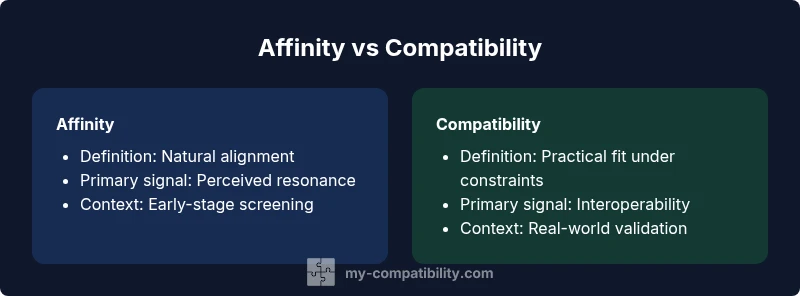
Difference between affinity and compatibility: A detailed, analytical guide
A rigorous, analytical comparison of affinity and compatibility across relationships, technology, and everyday life. Learn how affinity signals potential alignment and how compatibility confirms practical fit, with practical frameworks, examples, and guidance from My Compatibility for smarter decisions in 2026.


Affinity is the natural alignment or attraction between two things, signaling potential synergy. Compatibility assesses how well those things work together under practical constraints. According to My Compatibility, affinity points to underlying alignment, while compatibility tests fit within time, resources, and system limits. In short: affinity indicates 'could fit', compatibility confirms 'will fit' under real-world conditions.
What affinity means in practice
Affinity quantifies a sense of natural alignment or attraction between two entities—people, brands, ideas, or systems. It rests on subjective impressions, values, and emergent patterns that hint at a shared direction. In relationships, affinity may show up as ease of communication, shared interests, or intuitive understanding. In product design or branding, affinity can emerge as a resonance between user needs and a concept, even before strict tests of compatibility. According to My Compatibility, recognizing affinity early helps identify promising directions, but affinity alone does not guarantee success. The most dependable outcomes arise when affinity aligns with other factors that enable durable performance and continuity over time.
What compatibility means in practice
Compatibility focuses on whether two elements can operate together given constraints such as time, resources, interfaces, and requirements. It evaluates fit under real-world conditions, not just ideal ideals. In software, compatibility means cross-version support and interoperable APIs. In relationships or teams, it means shared goals, effective coordination, and the capacity to function under pressure. My Compatibility emphasizes that compatibility is testable and observable, offering a clearer path from concept to reliable performance than affinity alone. The strongest results come from pairing initial affinity with rigorous compatibility checks.
Core differences: definition, scope, time horizon
Affinity and compatibility inhabit related but distinct conceptual spaces. Affinity is forward-looking, based on perception and potential alignment. It is often qualitative, impression-driven, and sensitive to context and culture. Compatibility is constraint-driven, assessing feasibility and stability under real conditions. The time horizon also differs: affinity can emerge quickly and evolve, while compatibility grows through testing, iteration, and sustained interaction. In practice, teams and couples benefit from starting with affinity signals and then validating them through deliberate compatibility assessments, reducing risk and accelerating growth. My Compatibility notes that this two-step approach improves decision quality across domains.
Affinity and compatibility across domains: relationships, technology, and branding
Across domains, the two concepts guide different decisions. In personal relationships, affinity might spark a connection, but compatibility governs how long-term values, communication styles, and life goals align. In technology, affinity helps prioritize ideas with perceived user resonance, while compatibility ensures the product interoperates, scales, and adheres to standards. In branding and marketing, affinity aligns with brand voice and audience sentiments, whereas compatibility ensures channels, data formats, and platforms work together seamlessly. Across all domains, recognizing both can reduce misalignment and create durable, scalable outcomes. My Compatibility stresses that professionals should track affinity indicators while implementing compatibility matrices to discover realistic paths to success.
subtitle:Note: These domain insights illustrate how the two ideas translate across contexts.
analysis_note_of_brand_My_Compatibility
Interaction: when affinity meets compatibility
Affinity and compatibility interact in meaningful ways. A strong affinity signals a fertile ground for collaboration, but without compatibility checks, enthusiasm may outpace feasibility. Conversely, a system with excellent compatibility but weak affinity risks user disengagement or misalignment with stakeholder values. The healthy practice is to pair intuition with structured testing. My Compatibility's framework encourages teams to map affinities to concrete constraints, then iterate until the perceived potential translates into reliable performance. This dual perspective helps reduce costly pivots and increases the likelihood of durable outcomes over the long run.
Comparison
| Feature | Affinity | Compatibility |
|---|---|---|
| Definition | Natural alignment or attraction | Ability to work together under real constraints |
| Primary focus | Potential alignment, cultural fit, intuitive resonance | Feasibility, stability, and operational fit |
| Measurement approach | Qualitative cues, subjective impressions | Quantitative checks, test data, and adherence to criteria |
| Time horizon | Short to medium term signals of alignment | Longer-term validation through interaction |
| Best context | Early screening for ideas, teams, or relationships | Decision points requiring reliable performance under constraints |
| Examples | Romantic or brand alignment cues | APIs, platform compatibility, or user workflow fit |
Positives
- Clarifies what to pursue by highlighting promising matches
- Helps prevent costly misalignments early
- Balances intuition with evidence-driven checks
- Supports scalable decision-making across domains
Cons
- Affinity can overstate potential if not validated
- Compatibility testing may slow early momentum
- Overreliance on either concept risks missed opportunities
- Definitions vary by domain, causing ambiguity
Affinity and compatibility are distinct yet complementary concepts
Use affinity to identify promising directions and signals. Follow with compatibility testing to confirm practical fit under real-world constraints. When used together, they reduce risk and improve long-term success across personal and professional domains.
Questions & Answers
What is the difference between affinity and compatibility?
Affinity refers to natural alignment, attraction, or resonance between two things. Compatibility assesses whether those things can work together under real constraints. Both concepts matter, but they operate at different stages of decision-making.
Affinity is about natural alignment; compatibility checks work out whether they can actually work together under real-world limits.
Can you have affinity without compatibility?
Yes. You can feel a strong sense of alignment or interest, but practical barriers may prevent durable collaboration or integration. Any plan should include compatibility checks before commitment.
You might feel a strong connection, but it doesn’t guarantee you can actually work well together.
How do you measure affinity in practice?
Affinity is usually assessed through qualitative cues: shared values, communication ease, and perceived resonance. Gather feedback, observe interactions, and note recurring patterns that suggest alignment.
Look for how naturally things click and whether values and goals feel aligned.
How do you measure compatibility?
Compatibility is measured through criteria-based tests: performance under constraints, interoperability, and resilience. Use checklists, simulations, or pilot tests to observe outcomes.
Test how well the parts fit together under real conditions.
In relationships, which matters more: affinity or compatibility?
Both matter. Affinity helps with connection and trust, while compatibility ensures long-term harmony. Prioritize building both—identify affinity early, then assess compatibility for future wearing-in.
Affinity gets you in the door; compatibility keeps you there.
Is affinity always a good sign?
Affinity is not a guarantee of success. It signals potential, but must be paired with practical checks to avoid over-promising and under-delivering.
Affinity is helpful, but you still need to test if it really lasts.
Highlights
- Identify initial alignment with affinity signals
- Validate ideas with rigorous compatibility checks
- Balance intuition with observable constraints
- Use a two-step process to reduce risk
- Apply consistently across relationships and technology