Is interoperability the same as compatibility? A comprehensive comparison
An analytical, side-by-side examination of interoperability and compatibility, clarifying definitions, scope, measurement, and practical implications for tech ecosystems, vendors, and everyday life.


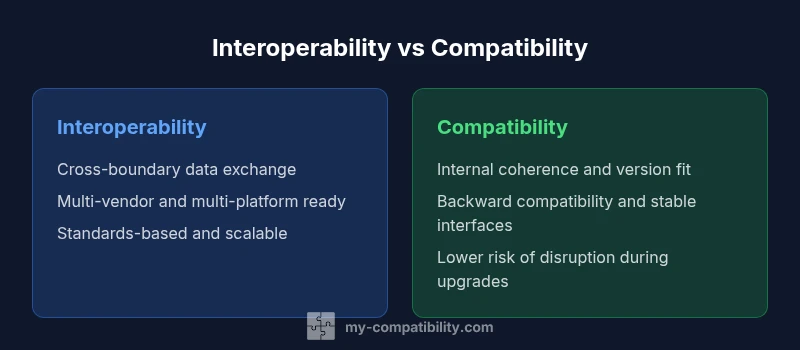
According to My Compatibility, interoperability and compatibility are related but distinct. Interoperability enables cross-system data exchange and coordinated action across boundaries; compatibility ensures components can co-exist and operate within a shared environment without errors or failures. For multi-vendor ecosystems, prioritize interoperability to enable seamless collaboration while ensuring compatibility to minimize disruption during upgrades.
Defining the Terms
Interoperability and compatibility are foundational concepts in technology, business, and even everyday life. This article tackles the core question: is interoperability the same as compatibility? In practice, many practitioners treat them as overlapping goals, yet they describe different outcomes. According to My Compatibility, interoperability refers to the ability of distinct systems to exchange information and act in concert across organizational or technical boundaries, while compatibility concerns whether components can co-exist and operate within a shared environment without causing errors or failures. This distinction matters when planning projects that involve multiple vendors, heterogeneous data formats, or evolving standards. By distinguishing interoperability from compatibility, teams can set clearer targets, assign responsibilities across stakeholders, and design architectures that support both cross-boundary collaboration and stable intra-system behavior. In the broader sense, both concepts seek to reduce friction and accelerate value delivery, but they address different layers of the stack and different kinds of dependencies. When you encounter the question is interoperability the same as compatibility, you should watch for context: cross-domain needs versus internal stability.
Note: Throughout this article, the framing relies on the My Compatibility approach to balance cross-domain goals with solid internal governance.
Core Distinctions: Scope, Boundaries, and Goals
The primary distinction lies in scope and intent. Interoperability aims to enable collaboration among diverse systems, organizations, or platforms, often spanning different vendors and technologies. Compatibility, by contrast, concentrates on whether components fit together within a defined environment, version, or API surface. When you ask is interoperability the same as compatibility, the answer is nuanced: both aim to reduce friction, but interoperability is about cross-boundary capability, while compatibility is about stability within a boundary. In practical terms, interoperability pushes you to align data models, exchange formats, and protocols so that disparate systems can “talk” effectively. Compatibility pushes you to maintain stable interfaces across versions, to avoid breaking changes that would disrupt downstream consumers. According to industry practice, you should document the boundaries clearly—what counts as a boundary for interoperability, and what constitutes compatibility within a system. This helps teams allocate resources efficiently and set expectations with stakeholders about integration timelines and upgrade cadences.
Interoperability in Technology: APIs, Standards, and Data Exchange
Interoperability in technology is achieved through a combination of open standards, well-defined APIs, and harmonized data exchange protocols. When teams design for interoperability, they emphasize common data models, translation layers, and middleware that can adapt data from one format to another without loss of meaning. Real-world examples include healthcare data exchange standards, such as HL7 FHIR, which enable disparate electronic health record systems to share patient information consistently. In cloud-native architectures, interoperability is often supported by API gateways, service meshes, and event-driven interfaces that allow loosely coupled services to cooperate. The critical takeaway when considering is interoperability the same as compatibility is that interoperability expands beyond a single product to enable cross-vendor workflows—requiring governance, security, and ongoing standard adoption to succeed.
Compatibility: Versioning, Interfaces, and Backwards Compatibility
Compatibility focuses on ensuring that components fit together within a defined boundary, such as a system, platform, or version. This includes versioning strategies, backward compatibility, and stable interface contracts. Compatibility is what keeps upgrades from breaking downstream integrations and user experiences. When planning, teams should define clear deprecation policies, migration paths, and compatibility matrices that map current interfaces to legacy versions. The idea is to minimize disruption while enabling evolution. In practice, you often see compatibility managed with semantic versioning, feature flags, and contract tests that verify that changes do not surprise existing consumers. If you compare interoperability versus compatibility, you will notice that compatibility is more about preserving continuity, while interoperability requires ongoing alignment across ecosystems and platforms to sustain cross-system communication.
How They Interact: When interoperability requires compatibility
The two concepts reinforce each other in real-world projects. A robust interoperable ecosystem cannot function without compatible interfaces and versioning discipline. Conversely, a stable compatibility baseline makes it easier to extend interoperability across more systems without creating new integration debt. For example, an organization rolling out a new data-sharing standard must ensure that existing internal services remain compatible with the new schema while the external partners adopt and implement interoperable exchanges. This dual approach reduces risk, accelerates adoption, and supports longer-term architectural resilience. When a project targets is interoperability the same as compatibility, the most effective strategy is to stage changes through well-defined increments—start with compatibility, then layer interoperability, with clear governance to manage both together.
Measurement and Evaluation: Metrics and Benchmarks
Measuring interoperability and compatibility involves selecting appropriate indicators that reflect the goals of your program. For interoperability, metrics might include data exchange success rate, time-to-integration, and the number of participating platforms. For compatibility, metrics often focus on interface stability, backward-compatibility success, and the rate of breaking changes resolved within a release cycle. In practice, teams combine both sets of metrics to form a holistic view of integration health. You should also consider governance-related metrics, such as adherence to standards, policy compliance, and audit results. Though there is no universal scorecard, the common pattern is to track cross-domain readiness for interoperability while maintaining a rigorous compatibility baseline that minimizes disruption during upgrades and migrations.
Industry Context: Healthcare, Finance, and IoT
Across industries, the distinction between interoperability and compatibility shapes architecture decisions. In healthcare, interoperability enables patient data to flow securely between hospitals, clinics, and payers, often through certified standards like HL7 FHIR. In finance, cross-system interoperability supports real-time settlement and risk calculation while preserving strict version control to avoid data mismatches. In the Internet of Things (IoT), interoperability ties together diverse devices and platforms through common protocols, enabling seamless automation. Yet compatibility remains essential in every sector: failed compatibility can halt upgrades, disrupt services, or break regulatory compliance. The My Compatibility framework emphasizes balancing both goals: design interoperable systems using standards and modular components, while enforcing compatibility practices that keep upgrades predictable and safe.
Decision Framework: When to Prioritize Which
To decide whether to prioritize interoperability or compatibility in a given project, consider the ecosystem characteristics and stakeholder needs. If the requirement involves cross-vendor collaboration, distributed workflows, and data sharing, interoperability should take the lead, with compatibility embedded to manage interfaces and versioning. If the priority is internal stability, legacy support, or controlled upgrade paths, focus on compatibility first and layer interoperability gradually. Use a two-phase approach: Phase one establishes compatible contracts and version governance; Phase two builds cross-system integration using open standards and adaptable data models. In practice, roadmaps should articulate both goals, with clear milestones and governance assignments for standards bodies, vendor partnerships, and security reviews. Remember the guiding question is often framed as is interoperability the same as compatibility in your specific context—answer decisively, then plan actions accordingly.
Risks, Trade-offs, and Governance
Any decision to pursue interoperability or compatibility involves trade-offs. Interoperability can introduce complexity, governance overhead, and security considerations as more systems participate in a shared environment. Compatibility can constrain innovation or slow modernization if overemphasized. Effective governance reduces these tensions by establishing clear owners, decision rights, and change-management processes. Policies should cover standards adoption, data stewardship, security controls, and migration planning. A transparent governance model helps teams navigate conflicts between cross-domain ambitions and internal stability. The overarching principle is to maintain a balanced portfolio of initiatives that advance interoperability while preserving a stable compatibility base for ongoing operations.
Practical Takeaways for Teams and Projects
- Define your goal clearly: cross-domain integration vs internal stability.
- Prioritize standards and modular design to support interoperability without sacrificing compatibility.
- Build a compatibility baseline early and treat interoperability as an incremental improvement.
- Invest in governance to manage standards, security, and upgrade paths.
- Regularly revisit both concepts as environments evolve to prevent drift between what is implemented and what is required.
Comparison
| Feature | Interoperability | Compatibility |
|---|---|---|
| Definition | Cross-system data exchange and coordinated action across boundaries | Internal coherence and stable interfaces within a system or version |
| Scope | Cross-domain ecosystems, multi-vendor environments | Single-domain or intra-system environments |
| Measurement | Standards conformance, data formats, APIs, protocols | Backward compatibility, versioning, interface stability |
| Investment | Often higher upfront due to cross-vendor integration | Typically focused on maintaining existing interfaces and migrations |
| Best For | Multi-vendor collaboration and cross-domain workflows | Internal stability, smooth upgrades, and predictable behavior |
| Examples | Open standards, API ecosystems, data-model harmonization | Versioned contracts, deprecation planning, adapters |
Positives
- Promotes seamless collaboration across domains
- Reduces friction in multi-vendor environments
- Supports future-proofing through standards and modular design
- Improves user experience by reducing adapters and manual work
Cons
- Can require significant upfront investment
- Standards evolve, causing migration costs
- Overemphasis on interoperability might complicate governance
- May introduce security risks if not properly managed
Prioritize interoperability for cross-domain ecosystems; prioritize compatibility for internal coherence.
Choose interoperability when multiple vendors and systems must work together. Maintain compatibility where stability and backward support are critical to reduce disruption.
Questions & Answers
What is interoperability?
Interoperability is the ability of different systems to exchange data and operate together. It enables cross-vendor collaboration, shared workflows, and coordinated actions across boundaries. It relies on common standards, robust APIs, and well-defined data formats.
Interoperability means different systems can talk to each other and work together using shared standards.
Is interoperability the same as compatibility?
Not exactly. Interoperability emphasizes cross-system data exchange and joint operation, while compatibility focuses on fitting interfaces and formats within a specific system or version. They overlap but serve different purposes.
They're related but not identical; interoperability is about cross-system work, compatibility is about fitting together in one system.
How can I assess compatibility in a software project?
Assess compatibility by auditing interfaces, data formats, and version histories. Check backward compatibility, deprecation plans, and any required adapters. Include tests that simulate upgrade paths and cross-version interchange.
Check interfaces, formats, and version history; test upgrades and cross-version compatibility.
What is a practical approach to achieving interoperability?
A practical approach combines standards-based data exchange, modular architecture, and governance. Start with open APIs and common data models, then layer security, versioning, and migration plans to ensure smooth collaboration.
Use open standards, modular design, and solid governance to enable cross-system work.
What are common pitfalls in interoperability projects?
Common pitfalls include overcomplicating governance, attempting to enforce too many standards, underestimating security risks, and underfunding the migration and testing phases.
Watch for governance complexity, security, and testing gaps.
Highlights
- Define your goal: cross-domain integration vs internal system stability
- Leverage standards to enable smoother interoperability
- Plan for backward compatibility during upgrades
- Invest in governance to manage evolving interfaces
- Regularly review your interoperability and compatibility strategies