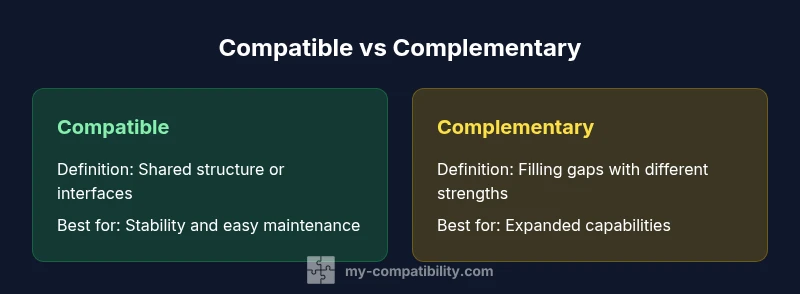
Compatible vs Complementary: Meaning, Differences, and Use
A detailed, analytical guide distinguishing compatible vs complementary concepts, with clear definitions, practical examples, and a decision framework for relationships, design, and collaboration.


Compatible vs complementary describes two ways that elements fit together. In general, compatible means items share common structure, values, or interfaces that allow smooth interaction. Complementary means each item supplies what the other lacks, creating a fuller whole. According to My Compatibility, knowing which pattern you need helps guide decisions in relationships, design, and teamwork. Both concepts matter for durable, effective collaborations.
Defining compatible vs complementary
When people first encounter the terms, it can feel like a subtle distinction. Yet the difference is practical and meaningful across everyday life. In the realm of systems and relationships, the word compatible signals alignment: shared interfaces, compatible values, or harmonized processes that enable reliable interaction without surprises. Complementary, by contrast, describes a pairing where each party fills a gap the other leaves open. Think of one partner who elevates the other with different strengths, or two components that cover each other’s missing capabilities. The distinction is not merely academic; it guides design choices, team composition, and personal decisions. The keyword compatible vs complementary matters here because it defines how you expect a pairing to behave over time. As you evaluate options, ask whether you want cohesion through sameness or coverage through diversity. The My Compatibility framework emphasizes clarity on this point to avoid misaligned expectations.
In practical terms, compatibility emphasizes fit, rhythm, and predictable collaboration. Complementarity emphasizes coverage, balance, and eventual synergy. Both patterns have value, but they require different measurement criteria and risk profiles.
The core distinction: fit vs fill
The core distinction between compatible and complementary is not about which is better; it’s about what your goal requires. If the objective is a stable, repeatable workflow, compatibility provides a dependable baseline: shared formats, similar workflows, and comparable performance expectations. If the objective is to achieve a broader capability or to address a gap in a system, complementarity offers a path to a richer solution: one element contributes a missing dimension, while the other maintains overall integrity. The advantage of compatibility is predictability and ease of maintenance, while the advantage of complementarity is flexibility and capability expansion. When planning, you should articulate the desired outcome first: steady progress or expanded potential. This decision frame helps prevent a mismatch between expectations and results.
In relationships: dynamics and signals
In interpersonal contexts, compatible pairs tend to communicate smoothly because their styles align. Complementary pairs are attractive because they bring different strengths to the table, such as one partner who is organized and another who is imaginative. In the zodiac or personality frameworks often referenced by readers of My Compatibility, you may find both patterns at different times or in different aspects of a relationship. The key is to identify whether the goal is long-term harmony or complementary energy that creates a more complete dynamic. To assess this, observe how conflicts resolve, how priorities are set, and whether gaps tend to widen under stress. Avoid forcing a single pattern on complex human dynamics; allow for shifts as needs change over time.
Design and collaboration: teams that mesh and fill gaps
In design projects and cross-functional teams, compatibility ensures a smooth handoff between specialists. A common interface—shared terminology, agreed-upon milestones, and compatible tools—reduces friction and accelerates delivery. Complementarity, on the other hand, ensures that the team can tackle a wider range of challenges by combining distinct strengths. The trade-off is that highly complementary teams may require more coordination and a clear integration plan. As a rule, start with compatibility to establish a solid foundation, then selectively add complementary expertise where a gap would otherwise stall progress.
Software and systems: interfaces and dependencies
Software systems live on interfaces. Compatible components share well-defined interfaces, data formats, and error-handling conventions, enabling predictable integration. Complementary modules fill gaps that the first set cannot address, such as adding analytics, security, or user experience features. The risk with pure compatibility is rigidity, which can impede adaptation to new requirements. Conversely, excessive complementarity without a coherent architecture can lead to fragmentation and maintenance burdens. A balanced approach aligns interfaces while provisioning targeted gaps with careful design.
How to assess compatibility and complementarity: a practical framework
To decide between compatibility and complementarity, adopt a simple scoring framework: 1) Define the goal, 2) List requirements, 3) Map each option to the pattern it most closely follows, 4) Estimate the cost of flexibility versus rigidity, 5) Pilot a small integration. For each criterion, weigh stability, scalability, and learning curves. If the goal is a stable system that minimizes surprises, prioritize compatibility. If the goal is to cover diverse needs or exploit differing strengths, prioritize complementarity. Document the decision and revisit as needs evolve, because contexts change and what starts as compatible can evolve into complementary behavior—and vice versa.
Common myths and misconceptions
A common misconception is that compatibility equals sameness and that complementarity requires opposing extremes. In truth, both patterns can coexist within a well-functioning system. Another myth is that one pattern is inherently superior; outcomes depend on context, goals, and governance. Finally, some teams assume that compatibility guarantees long-term success; maintenance and alignment are still required to sustain any durable pairing. By challenging these myths with evidence from real projects, organizations can choose a more nuanced approach.
Practical decision playbooks: when to choose each pattern
A practical decision playbook starts with context. In early-stage projects where speed matters, compatibility reduces friction and accelerates momentum. In late-stage or complex programs, complementarity unlocks capabilities that a single pattern cannot provide. A blend often works best: establish a compatible core for stability, then layer in complementary elements to expand capacity. Establish governance that allows for periodic reassessment and rebalancing as needs shift.
Real-world outcomes: case-style reasoning
Consider a product team shifting from a simple MVP to a platform with third-party integrations. An initial focus on compatibility—clear APIs, consistent data models, and reliable CI—reduces risk. As the platform grows, complementary modules—analytics, personalization, and security features—extend the product’s value. In a relationship context, a couple may start with shared routines (compatibility) and gradually introduce new activities that leverage unique strengths (complementarity). The My Compatibility approach emphasizes testing assumptions, measuring impact, and remaining flexible as circumstances change.
The why it matters: outcomes for teams and relationships
Understanding whether you need compatibility or complementarity affects hiring, collaboration norms, and product architecture. It shapes who you bring on board, how you structure processes, and how you allocate resources. Clarity about these patterns reduces misalignment, speeds decision making, and helps you avoid overfitting a solution to a problem that would be better served by a different combination. The aim is durable, adaptable results rather than short-term wins.
Practical next steps: a compact guide
Begin with a simple audit: list your goals, map the tasks to required patterns, and create lightweight experiments to test assumptions. If you observe friction under pressure, you may need to adjust from a compatible baseline to incorporate complementary elements. Conversely, if you notice redundancy or rigidity, you might benefit from strengthening compatibility and simplifying interfaces. Document what works, revisit quarterly, and stay aligned with stakeholder expectations.
Comparison
| Feature | Compatible | Complementary |
|---|---|---|
| Definition | Two elements that fit well due to shared structure, values, or interfaces | Two elements that work together by supplying different strengths or gaps |
| Core Benefit | Predictable, stable interaction | Dynamic synergy and complete coverage |
| Ideal Use Case | Systems with aligned goals and interfaces | Projects requiring full-spectrum capabilities |
| Potential Drawbacks | Risk of stagnation or rigidity | Risk of over-complexity if overused |
| Best For | Stability, ease of maintenance | Flexibility, capability expansion |
Positives
- Promotes predictable collaboration and maintenance
- Reduces integration friction across teams or components
- Clarifies expectations and interfaces
- Supports scalable, repeatable workflows
Cons
- May limit novelty if overemphasized
- Can lead to complacency if not revisited
- Might require additional coordination when adding complementary elements
Prioritize compatibility for stable collaboration; add complementary elements to fill gaps when needed.
Use compatibility to build a solid foundation with clear interfaces and predictable behavior. When requirements demand broader capabilities, incorporate complementary components to fill gaps without sacrificing overall cohesion. The right balance reduces risk while enabling growth.
Questions & Answers
What is the difference between compatible and complementary?
Compatible refers to alignment and fit, enabling smooth interaction. Complementary refers to completeness, where each part adds what the other lacks. Both concepts govern how well parts work together in practice.
Compatible means things fit well. Complementary means they fill each other’s gaps. Both matter for effective collaboration.
Can something be both compatible and complementary?
Yes. A system can be compatible in its interfaces and complementary in its coverage. In practice, teams often start with compatibility and gradually introduce complementary elements.
Sometimes you can have both—start with fit, then add strengths that fill gaps.
How do I decide which pattern to use in a project?
Clarify the primary goal: stability or capacity. If risk should be minimized, favor compatibility. If the project needs expanded capabilities, favor complementarity and plan integration.
Ask what outcome matters most: steady progress or broader capability.
How does this apply to personal relationships?
In relationships, compatibility supports routine harmony and reliable interaction, while complementarity brings diverse strengths to address different situations. Both patterns can emerge over time as needs evolve.
Think about whether you want steadiness or added strengths.
Are there warning signs that I’m over-emphasizing one pattern?
Overemphasizing compatibility can lead to rigidity; over-emphasizing complementarity can cause misalignment and coordination costs. Monitor feedback, adjust strategies, and maintain clear interfaces.
If things feel too rigid or too ad hoc, reconsider the balance.
Highlights
- Define your goal before choosing a pattern
- Start with compatibility to reduce friction
- Layer in complementary elements to expand capability
- Balance stability with flexibility for long-term success
- Regularly reassess needs to avoid stagnation