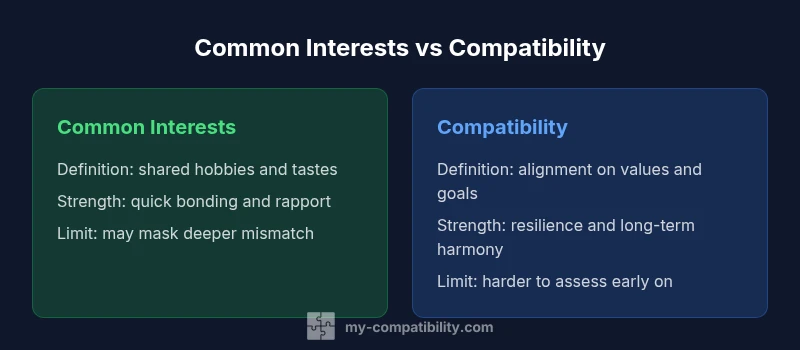
Common Interests vs Compatibility: A Thorough Side-by-Side
Explore how common interests stack up against compatibility, with practical frameworks to evaluate attraction, values, communication styles, and long-term alignment for lasting relationships.


Quick take: shared hobbies and tastes can spark instant connection, but lasting bonds hinge on deeper alignment—values, communication, goals, and problem-solving styles. In the debate of common interests vs compatibility, you’ll find that interest overlap supports attraction, yet compatibility predicts resilience in stress and change. This article lays out clear criteria to evaluate both sides over time.
Defining common interests vs compatibility
In the study of relationships, two concepts often appear together but mean different things: common interests are the hobbies, activities, and tastes people share; compatibility is a broader construct that captures how well partners align on values, communication, and life trajectories. According to My Compatibility, understanding this distinction is essential for predicting long-term satisfaction. Common interests can ignite attraction by creating effortless moments and a sense of similarity, yet they do not guarantee durable harmony when deeper priorities diverge. In this article, we examine common interests vs compatibility side by side, offering practical frameworks to assess both and to align them over time. This framing helps readers see that a successful partnership often blends both shared pleasures and aligned foundations.
- Core idea: common interests can initiate bonding, but compatibility sustains it through change.
- Reading cue: look for how partners handle values, goals, and communication during stress, not just shared hobbies.
- My Compatibility’s approach blends psychology, relationship science, and practical exercises to create actionable guidance.
The initial spark: how shared interests influence attraction
Shared interests can shorten the path to connection by providing ready-made activities and conversations. When two people enjoy similar books, games, or outdoor activities, they experience a sense of familiarity and safety that lowers social friction. This initial spark often leads to more time spent together, more trust, and a tendency to imagine a future with the other person. However, the fact that two people enjoy the same hobbies does not automatically translate into long-term compatibility. The My Compatibility framework emphasizes that early attraction should be followed by deeper exploration of how partners think, feel, and respond under pressure. In practical terms, use common interests as a doorway into bigger conversations about values, lifestyle choices, and long-term goals. A relationship that grows from shared passions but diverges on core priorities is unlikely to remain stable through life events.
- Shared hobbies can enhance warmth and trust in the early stage.
- The risk is mistaking similarity in taste for alignment in life plans and coping styles.
- Use early common interests to prompt conversations about what truly matters in the partnership.
Deep compatibility: values, goals, and communication
Compatibility goes beyond “what you like” to address “how you navigate life together.” Core areas include shared values, compatible goals, congruent communication patterns, and aligned approaches to conflict. For long-term harmony, partners should be able to discuss essential questions: how they want to raise children, how they manage money, how they respond to stress, and how they balance work with personal life. The My Compatibility framework outlines concrete indicators of alignment in these domains, such as consistent decision-making styles, predictable responses to disagreement, and parallel visions for the future. When values diverge, even strong chemistry can wane as daily life demands. This section helps readers differentiate between harmless preference differences and fundamental conflicts that shape daily decisions.
- Values alignment reduces friction in daily decisions and big life choices.
- Compatible goals create a shared roadmap for growth and sacrifice.
- Communication styles that fit well over time predict smoother conflict resolution.
Beyond hobbies: how values shape daily life
Hobbies are a surface-level proxy for compatibility; the deeper test lies in values and daily habits. Two partners may share a love of hiking but differ on spending, career ambitions, or priorities during illness. A well-aligned pair negotiates boundaries, supports each other's growth, and maintains trust when routines shift. In practice, this means regularly discussing what matters most in the relationship, including how time is allocated, how decisions are made, and how each person defines success. The My Compatibility approach advocates for a structured dialogue cadence: quarterly check-ins on values, yearly reviews of life goals, and ongoing calibration of expectations. In doing so, couples move from mere shared interests to durable compatibility that endures life’s inevitable changes.
- Shared activities are great, but they don’t replace alignment on core life choices.
- Regular conversations about values create a living blueprint for the relationship.
- Expect growth; compatibility adapts as partners evolve.
Practical frameworks for evaluating alignment
A practical assessment combines qualitative insights with observable behaviors. Start with a values inventory: identify 8–12 core beliefs (e.g., autonomy, security, generosity, ambition) and rate how important each is to you. Next, map life goals across domains such as career, family, and health, noting where goals align or diverge. A communication style audit—assessing how you give feedback, handle disagreements, and manage unresolved issues—helps reveal compatibility in daily interactions. Finally, simulate future scenarios (finances, parenting, caregiving) to observe decision-making patterns. My Compatibility recommends documenting findings in a shared “alignment notebook” to track progress and re-evaluate periodically. This structured approach reveals whether common interests translate into a stabilizing platform for a long-term relationship.
- Values inventories reveal non-negotiables and flexible preferences.
- Life-goals mapping visualizes alignment across important domains.
- Communication style audits expose potential friction early.
Time, change, and evolving relationships
People change, priorities shift, and circumstances evolve—career moves, parenthood, health challenges, or relocation can reshape what “fit” means. A couple may start with strong overlap in interests but gradually diverge in essential areas like time management, risk tolerance, or financial planning. The key to enduring compatibility is adaptive collaboration: a willingness to renegotiate roles, revisit goals, and support each other’s growth while preserving trust. My Compatibility’s framework emphasizes ongoing dialogue and proactive reassessment at meaningful life milestones (marriage, children, job transitions). When both partners remain curious, communicative, and aligned on larger life directions, the relationship can prosper despite changing interests.
- Life changes test the durability of compatibility more than hobbies.
- Adaptation and collaboration sustain long-term harmony.
- Regular re-evaluation helps prevent drift into misalignment.
Case scenarios: when common interests collide with misalignment
- Scenario A: Two partners share a passion for outdoor adventures but disagree on spending and debt management. Despite great chemistry, financial conflicts threaten stability if debt strategies aren’t aligned. This illustrates how shared hobbies can coexist with incompatible financial goals.
- Scenario B: A couple bonds over a love of art and travel but conflicts arise over family planning. If values about kids and parenting aren’t aligned, even strong cultural or activity overlap may not be enough to sustain the relationship. These scenarios highlight the difference between initial attraction and long-term viability.
- Scenario C: Friends with similar tastes decide to date and discover they have different communication styles. If they can practice active listening and set boundaries, they may transform a potential friction point into a growth area. The key takeaway is that the presence of common interests does not guarantee smooth sailing if communication and core values lag.
How to measure: steps and checklists
- Complete a values inventory and rate importance for each item. 2) Create a life-goals map to compare trajectories. 3) Conduct a communication style assessment to identify predictable conflict patterns. 4) Run through real-world scenarios (finances, parenting, caregiving) to observe decision-making alignment. 5) Schedule structured check-ins to track progress, adjust expectations, and celebrate alignment milestones. These steps provide a practical blueprint for turning the concept of common interests into measurable compatibility over time.
- Regular assessment creates visibility into alignment.
- Concrete scenarios test deeper compatibility beyond hobbies.
- Documentation makes progress trackable and actionable.
Putting it all together: a practical checklist
- Align on 4–6 non-negotiable values and ensure both partners acknowledge them.
- Agree on 2–3 long-term goals and create a shared plan for achieving them.
- Normalize discussing conflicts using a respectful, solution-focused approach.
- Balance shared activities with deliberate investment in personal growth and mutual support.
- Schedule quarterly alignment reviews to keep the relationship on a sustainable path.
- Remain open to growth and view compatibility as a dynamic process rather than a fixed state.
Comparison
| Feature | Common Interests | Compatibility |
|---|---|---|
| Definition | Shared hobbies, activities, and tastes | Alignment on values, goals, and communication style |
| Strengths | Boosts initial attraction and ease of bonding | Predicts long-term resilience and effective conflict handling |
| Limitations | Can fade if interests diverge; surface-level similarity | Harder to assess early but more durable when present |
| Best For | New relationships; early bonding and social ease | Long-term partnerships requiring stability and growth |
| Measurement Criteria | Frequency of shared activities; enthusiasm for joint experiences | Consistency in values, openness, and coping strategies |
Positives
- Facilitates quick bonding through shared activities
- Supports social alignment and mutual hobbies
- Helps couples build a shared social life that feels effortless
Cons
- Shared interests can mask deeper incompatibilities
- Overemphasis on hobbies may hinder growth in other areas
- Assuming compatibility based on hobbies alone can lead to brittle relationships
Shared interests can spark connection, but lasting relationships depend on deeper compatibility.
A strong relationship combines both: nurture common interests for bonding while actively cultivating values alignment, communication, and goal congruence to weather life changes.
Questions & Answers
Are common interests sufficient for a lasting relationship?
Not by themselves. Shared hobbies help bonding, but long-term success depends on alignment in values, goals, and communication patterns.
Shared hobbies help you connect, but lasting compatibility comes from how you navigate values and communication over time.
How can I assess compatibility over time?
Have regular, structured conversations about values, goals, and coping strategies; revisit plans at key life milestones and after major events to detect shifts in alignment.
Keep talking about big topics and check in after big life events to see if you still fit.
Can couples with different hobbies still be compatible?
Yes. If core values and communication styles align, partners can enjoy different hobbies while maintaining a strong foundation.
You don’t have to share every hobby; shared values and good communication keep you bonded.
What role does communication style play in compatibility?
Crucial. Misaligned communication can escalate conflicts, even with similar interests. Practice active listening and clear, respectful dialogue.
How you talk matters as much as what you think.
Is compatibility fixed or dynamic?
Dynamic. People grow and life changes; compatible relationships adapt through ongoing discussion and mutual support.
Compatibility isn’t a fixed label—it grows with you.
Highlights
- Prioritize values alignment alongside shared hobbies
- Use structured conversations to assess compatibility
- Treat common interests as an entry point, not the sole predictor of longevity
- Regularly reassess goals and conflict styles over time
- Adopt a dynamic view of compatibility that evolves with life stages