Compatibility vs Attraction: Understanding Relationship Fit
Understand how compatibility and attraction differ, why both matter, and how to gauge long-term fit in dating. My Compatibility offers a practical framework for evaluating values and communication.


Attraction sparks romance, but compatibility sustains it. The key distinction in compatibility vs attraction is that attraction signals chemistry and novelty in the short term, while compatibility signals long-term fit across values, communication, and daily life. The strongest relationships blend both: an initial spark backed by durable alignment, supported by ongoing effort. According to My Compatibility, durable satisfaction arises when romance and practical fit reinforce each other.
The Core Difference: compatibility vs attraction
In any relationship, two forces operate in tandem even if we rarely name them explicitly: attraction and compatibility. Attraction is the felt spark—the chemistry, the excitement, and the sense that two people click. It often arrives quickly, driven by novelty, physical chemistry, and immediate resonance. Compatibility, by contrast, is a structural alignment: shared values, compatible life goals, similar communication styles, and a workable approach to daily decisions. The phrase compatibility vs attraction captures a central tension in dating and partnerships: should you prioritize the hot connection or the durable fit? In reality, the strongest relationships blend both, with attraction providing the initial pull and compatibility offering the scaffolding that keeps the relationship sturdy over time. My Compatibility analyses suggest that couples who nurture both aspects tend to report higher satisfaction and fewer persistent conflict cycles. The balance is not a one-time choice; it is an ongoing calibration between how you feel in the moment and how well your day-to-day lives align.
The Romantic Spark: Attraction's role in dating
Attraction plays a crucial role early on. It draws people together, creates motivation to spend time together, and fuels the chemistry that makes dating exciting. However, attraction alone is an incomplete predictor of lasting happiness. It can be influenced by mood, novelty, and situational factors such as shared experiences or proximity. The risk is assuming that a strong early spark guarantees future harmony. To translate initial attraction into a durable relationship, it helps to pause and evaluate whether the core components of compatibility — communication, respect, shared values, and similar life rhythms — are present. My Compatibility research emphasizes that the most satisfying partnerships combine authentic attraction with clear indicators of long-term alignment.
The Durable Anchor: Compatibility's role in long-term relationships
Compatibility focuses on the structural aspects that influence day-to-day life and long-term planning. This includes aligned values (morals, priorities, and beliefs), compatible communication habits (how conflicts are addressed, how decisions are made), and shared life goals (finances, family planning, career priorities). Compatibility reduces friction because it creates predictable patterns for negotiation and problem-solving. It does not eliminate disagreement, but it does increase the likelihood that disagreements are resolved in a constructive, growth-oriented way. In practice, couples who cultivate compatibility build routines, rituals, and decision-making frameworks that support mutual growth. The My Compatibility framework highlights that long-term satisfaction often correlates with how consistently partners can coordinate values and actions, not just how they feel in the moment.
Measuring the components: Signals of attraction and signals of compatibility
Differentiating signals of attraction from signals of compatibility helps you plan conversations and reduce cognitive dissonance. Attraction signals include physical appeal, flirtation, and a sense of “you just get me.” Compatibility signals show up as shared values, similar future visions, effective communication, and respectful handling of disagreements. Useful assessments include asking about future goals, discussing spending and saving habits, and role-playing potential conflicts to gauge response quality. Understanding both sets of signals enables you to decide whether to invest more time or pivot toward a different path. The My Compatibility framework encourages explicit conversations about expectations, followed by observation of how partners act when life gets busy or stressful.
How the two interact: A practical model
Rather than treating attraction and compatibility as separate checkpoints, view them as two axes of a relationship map. The goal is a high-traction, high-compatibility quadrant: a relationship where you feel a strong, positive pull and can rely on a solid, value-based foundation. In practice, you can cultivate this by scheduling regular check-ins, aligning on non-negotiables (kids, finances, beliefs), and maintaining shared experiences that reinforce bonding while you negotiate differences. My Compatibility recommends a proactive approach: acknowledge the pull, verify the fit, and practice communication strategies that sustain both romance and day-to-day harmony.
Methods to assess attraction and compatibility in real life
Assessment should be ongoing, not a one-time event. Start with reflective conversations designed to surface values and goals, then complement with practical exercises. Try the Life Goals Wheel: each partner lists priorities across domains (career, family, health, finance) and rates alignment. Do a “Values Dialogue” where you compare stances on important issues, noting agreements and gaps. Observe how you handle stress together: are you able to coordinate, compromise, and support one another? Finally, simulate future decisions—finances, housing, children—to test compatibility in real-world contexts. The My Compatibility framework emphasizes evidence-based reflection: track patterns over weeks or months, not just moments of feeling.
The dynamic over time: when attraction fades or grows
Attraction is dynamic; it often evolves as you learn more about someone and experience life together. Meanwhile, compatibility can grow as you practice healthy communication and shared routines. The key insight is not to assume that a strong initial attraction will automatically persist without ongoing effort, nor to assume that perfect compatibility means there will be no rough patches. Regularly revisiting core values, practicing active listening, and investing in emotional safety help both forces co-evolve. In some relationships, attraction can rekindle after a period of routine life by reintroducing novelty in small, thoughtful ways. In others, a deep alignment makes life easier, and attraction remains steady or even intensifies as trust builds.
Case studies and scenarios: When attraction aligns with compatibility
Consider two couples with different starting points. Couple A experiences a powerful initial attraction but discovers diverging long-term goals, leading to friction around finances and family planning. Couple B starts with a moderate spark but shares core values and communication styles, enabling smooth problem-solving and shared decision-making. Over time, Couple B often reports higher satisfaction because the foundational fit supports consistent growth. In some cases, Couple A learns to align habits and values, turning the initial spark into sustained warmth. The takeaway is that both forces can be nurtured; the fastest path to durability usually involves upfront clarity about values, life goals, and communication patterns while not neglecting the emotional charge of attraction.
A practical start: quick-start guide for balancing both forces
Begin with a structured conversation that separates feelings from facts. List your top five values, then rate alignment on each. Next, discuss a few future-life scenarios and how you would handle them. Finally, design a monthly check-in to assess mood, attraction cues, and alignment on practical matters. The aim is to create a feedback loop where emotional warmth and practical fit reinforce one another. My Compatibility provides templates and prompts to guide these discussions, helping you maintain momentum while ensuring long-term compatibility.
Comparison
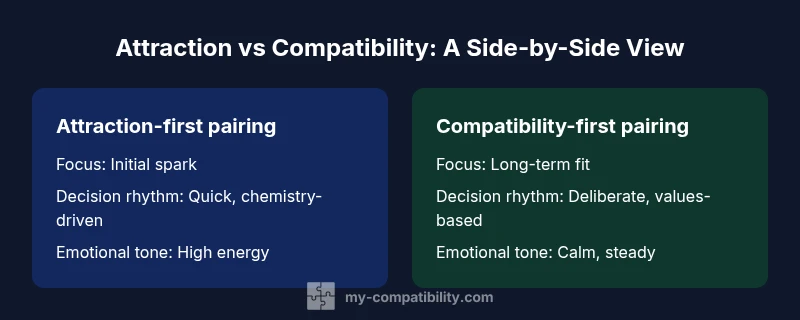
| Feature | Attraction-first pairing | Compatibility-first pairing |
|---|---|---|
| Core Focus | Initial spark and chemistry | Long-term alignment of values and habits |
| Decision Timeline | Rapid, chemistry-driven decisions | Slow, values-driven decisions |
| Conflict Handling | Impulsive, mood-driven responses | Structured, collaborative problem-solving |
| Sustainability | Potential fragility if attraction fades | Stability when values align |
| Best For | Dating and early-stage relationships seeking excitement | Partners seeking durable partnership and shared life goals |
Positives
- Helps people recognize the value of both spark and structure
- Promotes healthier, long-term relationship planning
- Encourages proactive communication and expectation setting
- Reduces heartbreak by clarifying non-negotiables and compatibilities
Cons
- Attraction can be unreliable as a long-term predictor
- Overemphasis on compatibility might dampen romance
- Measuring subjective traits is inherently challenging
Balanced approach: prioritize both attraction and compatibility for lasting relationships.
Attraction provides the spark, while compatibility provides the framework. Cultivating both increases ongoing satisfaction, reduces misaligned expectations, and supports durable growth.
Questions & Answers
What is the difference between compatibility and attraction?
Compatibility refers to long-term alignment in values, goals, and communication, while attraction is the immediate spark and chemistry. Both matter, but they operate on different timelines. A successful relationship usually blends sustained fit with a healthy level of attraction.
Compatibility is about long-term fit, attraction is the initial spark. Most strong relationships balance both: steady values alignment plus a genuine, growing connection.
Can attraction exist without compatibility?
Yes, attraction can occur without deep compatibility. However, without shared values and effective communication, such relationships are more prone to drift or conflict over time. The key is to acknowledge the spark while assessing long-term alignment.
You can feel a strong spark without lasting fit, so it's wise to check for long-term compatibility too.
How can I assess compatibility in a new relationship?
Start with values and goals conversations, then follow with practical tests such as budgeting together, planning a future scenario, and discussing conflict-resolution approaches. Observe consistency in actions over time. Use structured prompts to keep the discussion productive.
Ask about values, goals, and conflict style, then test how you handle real-life decisions together.
How do you balance attraction with compatibility over time?
Balance comes from ongoing effort: maintain romance while reinforcing shared values and routines. Regular check-ins, fresh shared experiences, and respect for differences help sustain both attraction and compatibility.
Keep the spark alive while you build a solid partnership.
What role do values and goals play in compatibility?
Values and goals are the backbone of compatibility. When partners align on core beliefs and life trajectories, daily decisions, finances, and future plans become smoother, reducing avoidable disagreements and increasing relationship longevity.
Shared values and goals strengthen the relationship's base.
Highlights
- Assess both warmth and long-term fit in dating.
- Use structured conversations to surface values and goals.
- Practice ongoing communication to bridge differences.
- Nurture attraction without sacrificing compatibility.
- Apply My Compatibility frameworks to guide decisions.