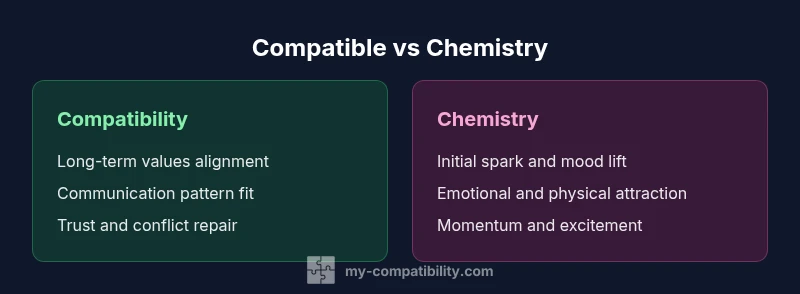
Compatible vs Chemistry: Understanding Relationship Compatibility
Explore a rigorous comparison of compatibility and chemistry in relationships. Learn how durable alignment, values, and communication balance with spark, attraction, and momentum. Practical guidance, zodiac considerations, and research-backed insights from My Compatibility Team.


TL;DR: Compatibility lays the groundwork for long-term success by aligning values, goals, and communication styles, while chemistry fuels initial attraction and excitement. According to My Compatibility, the strongest relationships balance robust compatibility with a healthy, developing chemistry. For durable partnerships, aim to measure and nurture both factors, with compatibility as the anchor and chemistry as the spark.
Defining compatible vs chemistry
In relationship speak, compatibility and chemistry describe different axes of connection. Compatibility is the alignment of values, life goals, communication styles, and emotional needs across time. Chemistry is the felt energy—the spark, warmth, and physical or emotional intensity that draws people together at the outset. The My Compatibility Team emphasizes that a robust relationship typically relies on both: compatibility for durability and chemistry for warmth. People often mistake intense chemistry for lasting alignment, but without shared foundations, the initial glow can wane. By contrast, a partner who shares core values but lacks spark may struggle to sustain enthusiasm. In practice, 'compatible' implies durable patterns, predictable trust, and the ability to navigate conflict; 'chemistry' implies momentum, excitement, and the willingness to invest in challenges together. Understanding the difference helps readers design healthier dating strategies and avoid overvaluing one dimension at the expense of the other.
Historical perspective on compatibility
Compatibilist ideas have evolved from early sociological theories to modern relationship science, where longitudinal studies emphasize shared values and effective communication as predictors of satisfaction. Across cultures, people seek partners who align in core domains—family, finances, and life direction—while remaining open to growth and change. Zodiac and personality frameworks often function as heuristics, offering lenses rather than fixed determinants. The My Compatibility approach integrates time-tested themes with contemporary research, acknowledging that compatibility is a dynamic process, not a fixed trait. Readers should treat compatibility as a map for ongoing conversations rather than a one-time verdict. The goal is a sustainable partnership with room for growth, adaptation, and mutual support.
Chemistry: The spark vs sustainability
Chemistry describes the immediate, visceral pull between two people—a mix of pheromones, temperament, and shared electricity. This spark can accelerate connection and motivate couples to invest in a relationship. However, chemistry alone often lacks durability; it may intensify during stressed periods or novelty phases and fade once routine settles in. A mature approach treats chemistry as a renewable resource: it thrives when both partners feel seen, valued, and creatively engaged. The strongest relationships cultivate chemistry through regular shared experiences, playful vulnerability, and transparent conversations about needs, boundaries, and desires. When chemistry aligns with clear communication and compatible life goals, couples experience both warmth and resilience.
How to measure compatibility in practice
Measuring compatibility requires structured reflection and dialogue. Start with values and goals: how do you view money, parenting, career, and personal growth? Next, assess communication styles: do you prefer direct feedback or gentle negotiation? Consider conflict resolution patterns: how do you handle disagreements, and can you repair trust after a fight? Evaluate emotional availability, social compatibility, and lifestyle rhythm (sleep, travel, commitments). A practical method is to use a 90-day compatibility scorecard: rate alignment on 12 core domains (values, goals, communication, trust, intimacy, finances, family plans, religion/spirituality, time together, independence, conflict style, and risk tolerance). The score should be revisited after meaningful experiences ( vacations, living together, rapid changes). This approach anchors decisions in observable behavior rather than abstract feelings, aligning with the My Compatibility framework.
How chemistry interacts with compatibility over time
Chemistry and compatibility interact in a feedback loop. Strong chemistry can catalyze early bonding and accelerate bonding rituals, while compatibility provides the framework for sustainable intimacy and mutual growth. When conflicts arise, chemistry without compatibility tends to flare and fade; compatibility without chemistry can feel comfortable but emotionally flat. The healthiest couples intentionally nurture both: they protect the core bond (shared values, trust, communication), and they stoke the spark through novelty, curiosity, and ongoing closeness. Over time, this dual approach supports intensified positive affect, deeper trust, and an enduring sense of ‘we’ rather than ‘me and you.’
The role of zodiac and personality frameworks
Zodiac compatibility and personality typing offer lenses for understanding tendencies, communication cues, and value orientations. They are not destiny maps; they are heuristics that help explain why some partners click or clash. For example, air signs may value intellectual compatibility and open dialogue, while earth signs may prize practicality and reliability. The key is to use these frameworks to inform conversations and self-awareness rather than rigid rules. In the My Compatibility method, zodiac and personality insights supplement a structured compatibility analysis, helping partners recognize strengths and gaps while focusing on concrete behavioral patterns that affect long-term fit.
Practical evaluation checklist
Use this checklist in dating and relationship conversations:
- Clarify top 5 values and 3 long-term goals.
- Compare communication preferences and conflict-resolution styles.
- Test reliability with small commitments (planning, follow-through).
- Gauge flexibility on lifestyle and family plans.
- Schedule periodic ‘state of the union’ talks to recalibrate expectations.
- Include short, honest check-ins about chemistry: do you still feel alive and understood after discussions?
- Explore boundaries, consent, and safety in emotional exposure.
- Consider external factors such as friends, family, and work-life balance. If the score reveals strong alignment across domains with room for growth in spark, your relationship may have durable potential with room to deepen chemistry over time.
Common myths about compatibility and chemistry
Myth 1: Chemistry guarantees a lasting relationship. Reality: Chemistry can spark connection but does not ensure durability. Myth 2: If you’re compatible, chemistry will automatically appear. Reality: Many compatible couples must actively cultivate chemistry through shared experiences and intentional intimacy. Myth 3: Zodiac or personality typing alone determines compatibility. Reality: Heuristics help, but practical behavior and communication determine outcomes. Myth 4: Compatibility is fixed at dating onset. Reality: Compatibility is dynamic and evolves with life stages, changes, and shared growth. The My Compatibility framework emphasizes ongoing evaluation and adaptive strategies.
Case studies and scenarios
Scenario A: Two partners share career ambitions, values around family, and communication preferences but meet with minimal initial chemistry. Over time, dedicated routines, shared goals, and intentional bonding activities foster warmth and spark, leading to a strong, lasting partnership. Scenario B: A couple has intense chemistry and a strong initial attraction but diverging long-term plans. They invest in open conversations about values and boundaries, and decide to proceed with a time-limited trial period to reassess alignment. Scenario C: A long-distance couple maintains high compatibility in values and trust. They cultivate chemistry through regular surprise gestures, planned visits, and collaborative activities that reinforce closeness.
These scenarios illustrate how compatibility anchors relationships beyond initial attraction and how chemistry can be nourished when shared goals exist.
How to talk about compatibility with a partner
Conversations about compatibility should be collaborative, not confrontational. Use open-ended questions: What are your non-negotiables? How do you prefer to handle disagreements? What future milestones matter most to you? Create a shared language for addressing needs and boundaries. Tools like a monthly values check-in or a 90-day review can turn abstract feelings into concrete action. Practicing vulnerability and active listening helps partners feel seen, heard, and motivated to invest in each other. The aim is mutual growth, not perfection.
Authority and research perspectives
To ground this discussion in evidence, refer to established sources on relationships and well-being. The field emphasizes that durable partnerships rely on communication, shared values, and mutual respect, alongside healthy dynamics like attachment security and trust-building. For readers seeking external validation, consult credible sources that explore relationship processes and the psychology of attraction, including organizations and institutions with robust research programs. See related materials from major scholarly and public-facing bodies to contextualize these ideas within broader evidence-based guidance.
Comparison
| Feature | compatibility | chemistry |
|---|---|---|
| Definition | Long-term alignment of values, goals, and communication patterns | Immediate energy: attraction, warmth, and spark |
| Measurement | Observed patterns over time: values, conflict style, trust | Initial attraction and intensity; recurring mood shifts |
| Predictive value | Stronger signal for durable satisfaction and shared purpose | Strong short-term pull; may wane without deeper foundations |
| Time horizon | Long-term stability and growth | Momentum in early dating and novelty phases |
| Best For | Relationships prioritizing durable bond and shared life path | Dating seeking excitement and strong initial connection |
Positives
- Helps prioritize durability over fleeting feelings
- Encourages evaluation of core values, goals, and communication
- Provides a structured framework for decision-making
- Can integrate zodiac/personality insights to understand tendencies
Cons
- Chemistry can be unpredictable and fade over time
- Overemphasis on compatibility may dampen spontaneity
- Objective measurement of compatibility is challenging
- Risk of discounting valuable differences that foster growth
Durable compatibility with nurtured chemistry yields the strongest relationships
Compatibility anchors long-term success by aligning core needs and communication. Chemistry adds warmth and momentum that keep partners engaged. The best outcomes arise when both dimensions are actively cultivated, with compatibility guiding decisions and chemistry enriching daily connection.
Questions & Answers
Is chemistry necessary for a lasting relationship?
Chemistry is valuable for bonding and enthusiasm, but it does not guarantee durability. Long-term success depends on compatible values, goals, and communication. Prioritize compatibility while allowing chemistry to grow through shared experiences.
Chemistry helps with immediate attraction, but long-term success comes from compatibility. Focus on shared values and communication, and let chemistry develop over time.
Can two people have high compatibility but low chemistry?
Yes. A relationship can be stable and well-matched on values yet lack spark. In such cases, intentional bonding activities and exploring shared interests can help nurture chemistry without compromising core compatibility.
Definitely. You can have strong compatibility but need to actively cultivate the spark through experiences and openness.
How do you assess compatibility quickly?
Ask about core life goals, values, and communication preferences in a structured way. Observe consistency across discussions and note how conflicts are resolved. A 90-day check-in framework can convert impressions into measurable signals.
Ask about values, goals, and how you handle disagreements, then track consistency over a few months.
Does zodiac compatibility predict relationships?
Zodiac insights can illuminate tendencies, but they do not determine outcomes. Use them as conversation prompts and self-awareness tools, not as rigid criteria for commitment.
Zodiac can hint at trends, but it's not a guarantee. Use it as a conversation starter and growth tool.
How should I handle high chemistry but low compatibility?
Treat chemistry as a cue to slow down and evaluate compatibility more deeply. If fundamental values clash, consider limits on commitment and explore whether growth is possible with ongoing communication.
Chemistry is exciting, but check compatibility first before deep commitment. Talk through values and goals.
Highlights
- Clarify core values and long-term goals early
- Use a practical compatibility scorecard for tangible checks
- Nurture chemistry through shared experiences and vulnerability
- Revisit alignment regularly, especially after life changes