How to Assess Long-Term Compatibility: A Practical Guide
Learn a structured, evidence-based process to assess long-term compatibility. Explore values, goals, and communication with practical exercises and a decision framework.


To assess long-term compatibility, measure alignment on core values, life goals, and communication style. Start with a values check, then test conflict resolution, decision-making, and future planning. Use time-bound exercises and objective metrics to observe behavior under stress, change, and routine pressures. Document observations and review results together for a clear read on sustainability.
Why Long-Term Compatibility Matters
How you approach relationships over time matters as much as initial chemistry. When you learn how to assess long term compatibility, you move beyond fleeting sparks to durable alignment. This process isn't about predicting perfect harmony; it's about identifying predictable patterns, shared commitments, and constructive ways to handle stress, change, and everyday trade-offs. According to My Compatibility, long-term compatibility hinges on clear communication, evolving goals, and mutual support during transitions. By investing in a structured approach, couples can reduce misalignment, accelerate healthy growth, and create a shared trajectory that feels both exciting and stabilizing over years.
Great compatibility isn't a single moment—it emerges through repeated, deliberate practice. You’ll test how you discuss sensitive topics, plan milestones, and adapt when plans shift. The method described here emphasizes practical exercises, transparent reporting, and a bias for action, so you can gauge durability without waiting for a crisis. The aim is not to eliminate conflict but to normalize it as a productive signal of deeper alignment. This distinction is essential for anyone serious about building a life together.
The most robust compatibility work recognizes that people change. A solid foundation accommodates growth in career, family, finances, and personal development. With this mindset, you can identify non-negotiables, define flexible boundaries, and craft a shared vision that withstands weathering over time. This is the heart of how to assess long term compatibility: transform abstract hopes into testable, repeatable practices that reveal true readiness for lasting partnership.
noteLocaleSeparatorUaa
Tools & Materials
- Quiet, distraction-free space(Ensure at least 60 minutes without interruptions)
- Printable values & goals worksheet(Template to map alignment of core beliefs and milestones)
- Conflict-resolution scenario cards(Pre-built prompts to simulate disagreements)
- Notebook or digital note-taking device(For documenting observations and reflections)
- Timer(Helpful to enforce time-bound exercises)
Steps
Estimated time: 2-3 hours
- 1
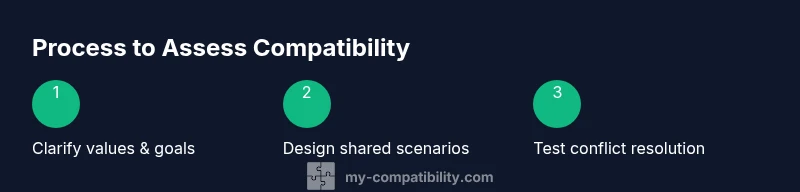
Clarify your core values and life goals
Each person documents their top 5 values and 3–5 long-term goals. Compare lists to identify overlaps, tensions, and non-negotiables. This step sets the baseline for all subsequent exercises and ensures you’re evaluating from a shared starting point.
Tip: Do this independently first, then discuss to avoid anchoring each other’s answers. - 2
Map your partner’s values and goals
Share and annotate each other’s lists, noting where values align and where they diverge. Discuss why the differences exist and how they might affect daily decisions and long-term plans.
Tip: Ask open-ended questions and summarize what you hear to confirm understanding. - 3
Design a shared future scenario
Create a written scenario that includes career changes, family planning, finances, and lifestyle choices. Both partners propose actions to reach the scenario’s milestones within a realistic timeframe.
Tip: Include at least one stressor (job loss, relocation, illness) to test resilience. - 4
Run a guided conflict-resolution drill
Choose a past disagreement or a potential future clash and practice a structured resolution. Switch roles to experience each other’s perspective, and document the outcome and feelings after the exercise.
Tip: Use neutral language and time-box the discussion to maintain safety. - 5
Initiate a structured trial period
Agree on a defined trial window (e.g., 4–8 weeks) with specific milestones (weekly check-ins, budget alignment, planning sessions). Review progress against goals and values at the end of the period.
Tip: Set concrete milestones and neutral criteria for success or adjustment. - 6
Review results and decide next steps
Compile observations from all exercises, quantify key indicators (communication quality, alignment of goals, conflict handling), and decide whether to continue toward long-term commitment, seek counseling, or part ways.
Tip: Document both wins and concerns; schedule a joint debrief to finalize the plan.
Questions & Answers
What does long-term compatibility really mean?
It means the degree to which two people share core values, goals, and the ability to navigate change together over years. It’s about durability, not perfection.
Long-term compatibility is about shared values and the ability to adapt together over time.
How long should I trial compatibility before deciding?
There isn’t a universal rule. A structured trial period with milestones—months rather than weeks—helps you observe growth and adjust expectations.
A structured trial with clear milestones helps you observe patterns over time.
Can zodiac signs influence compatibility?
Zodiac can offer insights into personality patterns, but real compatibility hinges on communication, shared values, and how you handle change.
Zodiac insights can help, but lasting compatibility depends on communication and shared goals.
What if our values conflict on a core issue?
Identify non-negotiables and discuss whether compromise is possible or if a fundamental mismatch makes long-term alignment unlikely.
If core values clash, assess whether you can respectfully navigate the difference or if it’s a deal-breaker.
Is counseling worth it for improving compatibility?
Therapy or counseling can accelerate learning, improve communication, and provide structured tools for testing and aligning goals.
Counseling can offer proven tools to improve how you communicate and align goals.
Watch Video
Highlights
- Identify non-negotiables early
- Use structured tests to reveal true compatibility
- Balance optimism with observable data
- Document observations for clear decisions