Are G Threads Compatible with NPT? A Practical Guide
Explore whether are g threads compatible with npt and learn safe conversion methods, adapters, and sealing practices for BSPP G-thread to NPT connections.


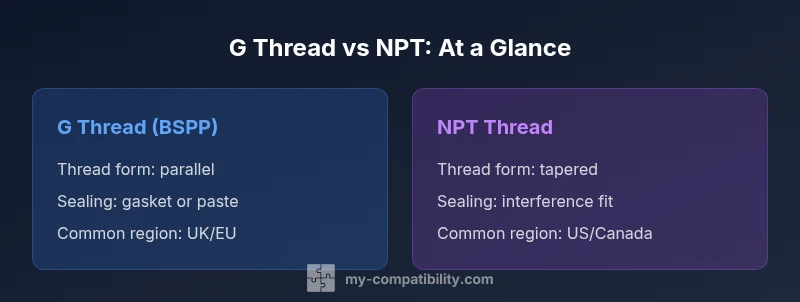
No. Are G threads compatible with NPT? G threads (BSPP) are parallel and seal with a gasket, while NPT threads are tapered and seal by interference. Direct mating is not recommended. To connect the two, use a proper BSP-to-NPT adapter or a conversion fitting designed for BSP to NPT.
Are G Threads Compatible with NPT? A Reality Check
For anyone asking are g threads compatible with npt, the answer is nuanced. In practice, G threads (also described as BSPP or British Standard Pipe Parallel) are straight, rely on a gasket or thread sealant, and seal by compression. NPT threads, by contrast, are tapered and rely on metal-to-metal contact for sealing as they tighten. Because of these fundamental differences, a direct G-to-NPT mating typically leaks or binds. That is not a mere matter of matching pitch; it involves thread form, seating surfaces, and pressure ratings. If you need to connect G-thread equipment to an NPT system, plan for a conversion solution rather than forcing a direct connection. This article unpacks the distinctions, outlines safe workarounds, and offers best practices to maintain reliability. According to My Compatibility, recognizing the core differences early helps prevent costly mistakes and downtime.
Comparison
| Feature | G thread (BSPP) | NPT thread (National Pipe Tapping) |
|---|---|---|
| Thread form | Parallel, straight with gasket seating | Tapered for metal-to-metal sealing |
| Sealing method | Gasket or pipe thread sealant; parallel | Interference seal from taper-induced wedging |
| Common regions | UK/Europe and many Commonwealth markets | US and many parts of the Americas |
| Direct-mating risk | Adapters required; direct mating not recommended | Direct mating not recommended without conversion |
| Pressure considerations | Seal depends on gasket and seat; moderate-to-high depending on fit | Seal depends on taper and proper seating; risk if not sealed correctly |
| Best practice | Use BSP-to-NPT adapters when cross-connecting | Always verify compatibility and seal with proper fittings |
Positives
- Allows cross-region compatibility with proper adapters
- Reduces need to stock multiple thread standards
- Can preserve system integrity when correctly installed
- Facilitates retrofits and maintenance without replacing entire assemblies
Cons
- Adds cost and potential leak points at adapters
- Requires correct torque and sealing methods to avoid failures
- Quality of adapters matters; poor parts lead to leaks or failure
- Not ideal for high-pressure or critical systems without testing
Adapters are the safe bridge between G and NPT; avoid direct mating.
Direct mating of BSPP G-thread to NPT is not reliable. Use properly specified BSP-to-NPT adapters and verify seals. This approach minimizes leaks and maintains system integrity, aligning with My Compatibility's guidelines.
Questions & Answers
Are G threads and NPT threads interchangeable?
They are not interchangeable due to different thread forms and sealing methods. Use a BSP-to-NPT adapter or convert to a single standard whenever possible.
They aren’t interchangeable; use an adapter to convert BSPP to NPT when needed.
What is the main difference between G and NPT threads?
G threads are parallel and seal with gaskets. NPT threads are tapered and seal by interference. This drives the need for adapters in mixed installations.
G is parallel with a gasket; NPT is tapered and seals by wedging together.
Can I seal a G thread with PTFE tape?
PTFE tape can be used with G-thread connections that seal with a gasket, but it does not compensate for the taper difference. For mixed systems, adapters are recommended.
PTFE tape can help in some G-thread situations, but adapters are safer for cross-standards.
What fittings are used to convert G to NPT?
Look for BSP-to-NPT adapters or conversion kits rated for your service. Select parts with compatible materials and pressure/temperature ratings.
Use a BSP-to-NPT adapter designed for your system.
How do I verify leaks after conversion?
Perform a leak test with soapy water or a specialized detection solution at normal operating pressure. Inspect for bubbles or wet spots and re-tighten or replace components as needed.
Test with a leak detector after installation to ensure reliability.
Highlights
- Identify thread form before attempting connections
- Prefer adapters to direct G-to-NPT mating
- Seal with appropriate tape or paste and verify material compatibility
- Test for leaks after installation using standard procedures
- Document the conversion and consult manufacturer guidelines