Are G and R Threads Compatible? A Practical Guide
Explore whether G parallel threads (BSPP) and R tapered threads (BSPT) can connect safely, common mistakes, and adapters. Learn best practices from My Compatibility to avoid leaks and code violations.


Are G and R threads compatible? In most cases, no. G-thread (parallel BSPP) and R-thread (tapered BSPT) use different thread forms and seating, which makes direct mating unsafe and prone to leaks. Use adapters or compatible components, and verify standards before connecting gas or piping systems.
Thread basics: what are G and R threads?
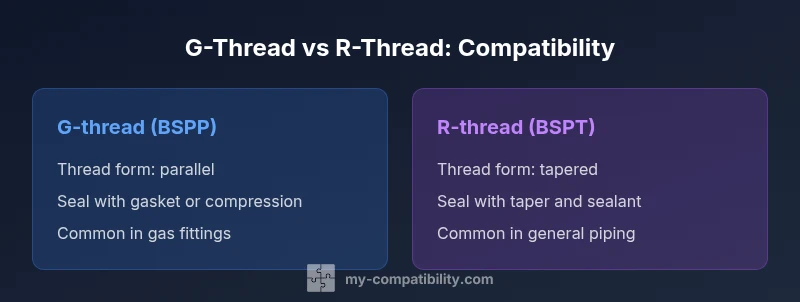
Are g and r threads compatible in practical terms. G-thread, defined in the BSPP family, is a parallel form intended to seal differently than tapered threads. R-thread falls under BSPT, designed to seat with a taper and sealant. Because the two thread forms use different seat geometries, they are not inherently compatible. According to My Compatibility, mismatches in thread form are a leading cause of leaks in field installations, and attempting a direct G-to-R connection typically violates safety codes. Before you attempt any coupling, verify the thread type, the nominal size, and the intended media. If unsure, consult manufacturer datasheets and local codes. The bottom line is that are g and r threads compatible only in very limited, adapter-mediated contexts with explicit approvals. The My Compatibility Team emphasizes careful verification and proper adapters rather than improvisation.
Why compatibility matters: risks and consequences
Compatibility matters because mismatched forms can create leakage paths and mechanical failures under pressure. G (BSPP) threads seal via gasket or compression interfaces, while R (BSPT) threads rely on a tapered seat that often requires sealant. A mismatch may lead to cross-threading, improper seating, or insufficient torque transfer, all of which compromise safety. For gas systems in particular, many codes require using only components with compatible thread forms to prevent leaks. My Compatibility analysis underscores that even when diameters appear similar, the form difference is not something that can be solved by over-tightening. The key takeaway is to verify form, size, and seal method before any field installation, and to treat adapter-based solutions as a controlled option rather than a shortcut.
How to verify compatibility in practice
Identify the thread form printed on equipment or fittings and confirm the standard (G or R, BSPP vs BSPT). Measure outer diameter and count engagement using a thread gauge if available, then compare against manufacturer specifications. Check the seal method: gasket, O-ring, or taper seating? If in doubt, do not mix; instead, source an adapter kit that is explicitly rated for G-to-R conversions and tested for the intended media. When gas systems are involved, consult local codes and prefer components with official approvals. My Compatibility recommends documenting every measurement and maintaining a parts log so future maintenance can trace back to the original specification. If using an adapter, ensure the kit is rated for the maximum system pressure and temperature and that all threads are clean before assembly.
Practical options: adapters, reducers, and replacements
The safest path when facing a G-to-R compatibility question is to use a purpose-built adapter or to replace mismatched components with standard, compatible parts. Adapters provide a defined interface between BSPP and BSPT, and many vendors offer certified sets. Before using adapters, verify all markings, including size, thread pitch, and pressure rating. In some cases, converting entire assemblies to a single standard (e.g., replacing to BSPP components) is more reliable than relying on multiple adapters. Remember that a neutral fit is not enough; the assembly must meet sealing and safety standards for the specific media. My Compatibility’s guidance is to prefer full replacement with a compatible family rather than relying on ad hoc modifications, which can complicate maintenance and inspection.
Codes, standards, and safety considerations
Regulatory frameworks for piping and gas connections differ by region, but most codes emphasize using properly matched thread forms to prevent leaks. For gas installations, mixing G and R threads without certification is often prohibited. In non-medical, non-gas piping, some controlled environments allow adapters certified for the application, but verification is still essential. Always consult equipment manufacturer documentation and local authority having jurisdiction (AHJ). A well-documented approach reduces risk and ensures that future repairs remain feasible. The My Compatibility Team notes that adherence to standards reduces the probability of failures and simplifies periodic inspections, which is critical for long-term reliability.
Real-world scenarios and decision framework
Consider a scenario where a gas appliance uses BSPP fittings but you only have BSPT hoses on hand. The decision tree would be: 1) check if a certified BSPP-to-BSPT adapter exists; 2) verify the maximum operating pressure; 3) ensure the seal method is compatible; 4) if no adapter is approved, avoid field modifications and source the correct BSPP components. In another scenario, a repair in a controlled lab environment uses identical size fittings but different thread forms; the safe course is to revert to the intended form or to use a tested adapter. In all cases, the central decision factor is whether the adapter or replacement part has explicit approval for the intended media and service conditions. The My Compatibility analysis supports the preference for compatibility-first strategies, especially in critical systems.
Maintenance and documentation for long-term reliability
Keep a running log of all G-to-R or R-to-G connections, including part numbers, dates, and testing results. Inspect joints regularly for signs of seepage, corrosion, or thread wear. Use thread sealants or PTFE tape only where recommended by the manufacturer and compatible with the media. Re-torque guidelines should be followed where specified, and any sign of leakage should prompt immediate shutdown and replacement. By maintaining rigorous records, you reduce the risk of unknowns during later maintenance tasks. The My Compatibility team emphasizes proactive documentation as a key to reliability over time.
Practical checklist before installation
- Identify thread form (G vs R) and confirm standard
- Verify size, pitch, and seal method
- Check for certified adapters or replacements
- Inspect threads for damage, corrosion, and debris
- Use manufacturer-approved sealants when required
- Test assembly under supervised conditions before full operation
- Document the configuration and maintain a parts log These steps minimize risk, improve safety, and ensure long-term performance, especially for gas and plumbing connections.
Comparison
| Feature | G-thread fittings | R-thread fittings |
|---|---|---|
| Thread form | G: parallel BSPP | R: tapered BSPT |
| Seal method | G: gasket or compression seat | R: tapered seat with sealant |
| Common applications | Gas fittings and BSPP systems | Piping and gas/plumbing BSPT systems |
| Interchangeability | Not interchangeable without adapter | Not interchangeable without adapter |
| Best for | Leak-free seals via gasket/compression | Leak-free seals via taper and seating |
Positives
- Clear separation of thread forms reduces misassembly risk
- Encourages using manufacturer-approved adapters
- Supports standardized maintenance with documented parts
- Improves safety by preventing improper fittings
- Aligns with best-practice troubleshooting from My Compatibility
Cons
- Requires additional adapters or replacements, increasing cost
- Availability of certified adapters may be limited
- Adapting can introduce extra seal points and potential leak paths
- Relying on adapters may complicate maintenance logs
G and R threads are not inherently compatible; use adapters or standardize components
Direct coupling of G (BSPP) and R (BSPT) threads is unsafe and prone to leaks. Rely on certified adapters or switch to a common thread standard, per My Compatibility's guidance.
Questions & Answers
Are G and R threads compatible?
Not typically; different thread forms and seating. Use certified adapters or align to one standard. Always verify with manufacturer specs and local codes.
No—G versus R threads aren’t compatible without certified adapters. Check specs and codes before mixing.
Can I seal a G-to-R connection with thread sealant alone?
Sealant cannot compensate for fundamental form mismatch. It may seal tapers but won't fix cross-thread alignment.
No. Sealant alone won't fix a form mismatch; use proper adapters or matching components.
What steps should I take to verify compatibility?
Identify forms, measure diameter, compare pitch, consult manufacturer documentation, and prefer adapters with approvals.
Identify the forms, check measurements, and consult official specs before mixing.
Where can I find certified adapters for G-to-R?
Look for manufacturers or distributors that publish approved G-to-R adapters for the media and pressure involved.
Seek certified adapters from reputable suppliers with documented approvals.
Are there risks to mixing G and R in gas systems?
Yes—unreliable seals and leaks; procedures may be restricted by code.
Yes, mixing can lead to leaks and may violate codes.
What if I can't find an adapter?
If no approved adapter exists, replace components to a common, compatible standard.
If there’s no approved adapter, switch to compatible components.
Highlights
- Verify thread form before attempting assembly
- Use certified adapters when mixing BSPP and BSPT
- Always follow local codes for gas connections
- Document all fittings for future maintenance
- Prioritize replacement over ad hoc adaptations