BSP vs NPT Compatibility: A Practical Pipe Thread Guide
Explore BSP vs NPT compatibility, definitions, differences, and adapters. Learn how to identify thread types, sealing methods, and best practices to avoid leaks in plumbing, pneumatics, and hydraulics.


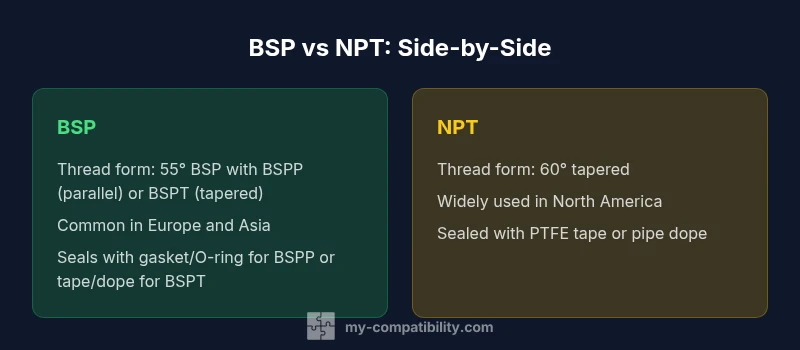
bsp vs npt compatibility is about how two common pipe thread standards differ in form and sealing. bsp uses 55-degree threads with bspp (parallel) or bspt (tapered), while npt uses a 60-degree tapered thread. Direct mating is not recommended; use a purpose-made adapter and correct sealant to avoid leaks. Understanding bsp vs npt compatibility helps prevent cross-thread damage and unreliable seals in both plumbing and pneumatic systems.
What BSP and NPT Mean
BSP (British Standard Pipe) and NPT (National Pipe Thread) are two foundational threading systems used to connect pipes, fittings, and equipment. In practice, they define how threads mate, how a seal is formed, and how components are sourced. The key to bsp vs npt compatibility is recognizing that these standards come from different design philosophies and regional practices. According to My Compatibility, standard definitions matter because a mismatch can lead to leaks, misalignment, and failure in both plumbing and pneumatic applications. BSP threads may be parallel (BSPP) or tapered (BSPT); NPT is typically tapered. The result is that identical-looking threads can have incompatible forms. When you review a job, start by identifying whether the fitting is labeled BSP, NPT, or a variant, and then plan the sealing method accordingly.
Thread Forms and Profiles: Why They Don’t Align
BSP and NPT are built on different thread geometries. The BSP family uses a 55-degree thread angle, with BSPP representing straight threads and BSPT representing tapered threads. NPT employs a 60-degree profile with a taper toward the end of the thread. Even if two fittings appear to screw together, the mismatch in thread form can produce poor engagement, reduced sealing surface, and leaks. The practical takeaway is to verify the thread standard before assembly and avoid relying on appearance alone. My Compatibility analysis shows that relying on visuals or feel alone increases the risk of improper mating, particularly in hydraulic or gas lines where seal integrity matters.
Tapered vs Parallel: How to Recognize BSPT, BSPP, and NPT
Recognizing BSPT versus BSPP and differentiating them from NPT hinges on both form and use cases. BSPP is parallel—a straight thread that relies on a gasket or flange connection for sealing in many unions. BSPT is tapered, providing sealing by thread engagement. NPT is tapered and commonly uses thread sealants such as PTFE tape or pipe dope. A key point for bsp vs npt compatibility is that taper and thread pitch rarely align perfectly; adapters or reevaluations are usually necessary when retrofitting older equipment.
Sealing and Pressure: How to Prevent Leaks in Each Standard
Sealing strategies differ between BSP and NPT. For NPT, practice typically involves PTFE tape or pipe dope to fill gaps created by taper. BSPP connections often rely on a gasket or O-ring in unions designed for parallel threads, whereas BSPT uses sealants compatible with its taper. In any case, the goal is to achieve a leak-tight joint without compromising thread integrity. Always consult manufacturer recommendations and test joints under controlled pressure before putting systems into service.
Identification Techniques: Tags, Gauges, and Markings
Identifying whether a fitting is BSP or NPT begins at labeling and dimension checks. Look for markings on the part, measure the thread angle with a gauge, and compare the pitch to standard charts. A thread gauge can help distinguish 55-degree BSP from 60-degree NPT. When in doubt, check documentation or contact the supplier. Accurate identification is the foundation of bsp vs npt compatibility and reduces the likelihood of mismatched fittings in critical systems.
When Mixing Standards Is Necessary: Using Adapters
In scenarios where legacy equipment uses a different standard, a conversion strategy is often required. The preferred path is to install a purpose-built adapter that translates BSP to NPT (or vice versa), ensuring correct seal surfaces, orientation, and thread engagement. Do not force-fit mismatched threads, as this can cause cross-threading and leaks. My Compatibility emphasizes using adapters designed for the task and verifying performance with a controlled leak test after installation.
Choosing the Right Adapter: Practical Tips
Selecting the right adapter involves matching thread types (BSPP, BSPT, or NPT) and confirm whether the application requires male-to-female or female-to-male transitions. Consider the operating pressure, material compatibility, and the presence of seals (gaskets or O-rings) on the adapter. Attach with appropriate torque and use the recommended sealant or gasket to preserve seal integrity. Keep inventory of common adapters to simplify future maintenance.
Industry Practices: Plumbing, Automotive, and Industrial
Different industries prefer different standards. Domestic plumbing often favors BSP in many regions, while many North American hydraulic and pneumatic systems rely on NPT. Manufacturing facilities may use a mix, driven by legacy equipment and supplier availability. For bsp vs npt compatibility, the practical approach is to plan ahead: identify standards early, stock the right adapters, and validate each assembly with a leak test or pressure test.
Tools for Verification: Gauges, Tapes, and Tests
Use thread gauges and calipers to confirm thread type, angle, and pitch. For sealing verification, conduct a leak test using soap solution or inert gas/dye methods depending on the system. Record results and note any corrective actions, such as replacing fittings with properly rated BSPP to NPT adapters. Consistent testing helps avoid field failures and preserves system reliability.
Common Pitfalls and How to Avoid Them
Common mistakes include trying to force BSP and NPT threads together, ignoring taper differences, and neglecting proper sealing methods. Another pitfall is assuming identical diameter implies compatibility; thread pitch can differ, leading to poor engagement. Finally, overlooking the importance of operating pressure ratings can create unsafe conditions. A disciplined approach reduces the likelihood of such problems.
Variants to Consider: BSPP, BSPT, NPTF and Alternatives
Beyond the basic BSP and NPT, there are variants such as BSPP (parallel), BSPT (tapered), and NPTF (FIPT) designed for higher-precision or high-demand applications. In some regions, metric BSP exists, adding another layer of compatibility considerations. When choosing fittings, weigh the advantages of each variant against the system requirements and reduce risk with proven adapters when transitioning between standards.
Quick Reference Checklist for BSP vs NPT Compatibility
- Confirm thread standard on all components
- Determine whether threads are taper or parallel
- Decide on appropriate sealing method (gasket, O-ring, or sealant)
- Use proper adapters for cross-standard connections
- Test assemblies under controlled conditions before service
- Maintain a parts library with BSPP, BSPT, and NPT adapters
Comparison
| Feature | BSP | NPT |
|---|---|---|
| Thread form | 55° BSP with BSPP (parallel) or BSPT (tapered) | 60° NPT, tapered |
| Taper vs parallel | Both BSP variants exist (parallel or tapered) | NPT is tapered |
| Seal method | Gasket/O-ring on BSPP; tape/dope or gaskets on BSPT | PTFE tape or pipe dope for NPT |
| Common applications | Residential/plumbing with BSP in many regions | Industrial and hydraulic/pneumatic systems in North America |
| Risk of leakage when mis-mated | Moderate if properly paired with correct seal and adapter | High if forced without addressing taper and pitch |
| Availability and tooling | Widely available; many regional variants | Widely available in US-based manufacturing; standard tools for NPT |
| Best for | International plumbing projects; legacy regional work | Industrial and commercial systems with US standard practices |
Positives
- Clear signal of standards to prevent misfits
- Wide availability of BSP and NPT fittings
- Adapters enable cross-compatibility without replacing equipment
- Sealing options (PTFE tape, pipe dope) help manage leaks
- Guidance exists across industries for safe installation
Cons
- High risk of leaks when mixing standards without adapters
- Potential for cross-thread damage if forced
- Adapters add cost and potential failure points
- Some sizes or variants are less readily available in certain regions
BSP vs NPT: Plan with adapters when crossing standards
Choose adapters for cross-standard connections, verify thread type, and test for leaks under pressure. Maintain a small stock of BSPP, BSPT, and NPT adapters to minimize downtime.
Questions & Answers
Can BSP and NPT be threaded directly to each other without an adapter?
No. BSP and NPT use different thread forms and are not guaranteed to seal or thread correctly without an adapter. For safety and reliability, identify the thread standard first and install a proper BSP-to-NPT adapter or a combined fitting designed for both standards.
No—do not force BSP to NPT. Use a proper adapter and verify the seal.
What is the difference between BSPP, BSPT, and NPT?
BSPP is parallel with a 55-degree thread angle, BSPT is tapered, and NPT is a 60-degree tapered thread. They are not interchangeable; adapters are often required when connecting different standards.
BSPP is straight; BSPT and NPT are tapered.
How can I identify BSP vs NPT threads on a fitting?
Look for markings on the fitting, measure thread angle and pitch, and compare to standard charts. A thread gauge helps distinguish 55° BSP from 60° NPT.
Use a gauge to confirm the thread type.
Are there universal adapters to cross BSP to NPT?
Yes, adapters exist to translate BSP to NPT, but ensure correct gender, pitch, and sealing method. Always test for leaks after installation.
Adapters exist—choose the right one and test.
What sealants are appropriate for BSP and NPT connections?
NPT connections commonly use PTFE tape or pipe dope; BSPP unions may use gaskets or O-rings; BSPT often relies on compatible sealants. Follow manufacturer recommendations.
Use the recommended sealant; don’t mix methods.
What safety considerations exist when mixing standards?
Do not operate under pressure until you’ve verified seals with a leak test. Mixing standards increases leak risk and potential damage; use certified adapters and conduct testing.
Always test for leaks after assembly.
Highlights
- Identify thread standards before assembly
- Use adapters for cross-standard connections
- Seal appropriately based on thread type
- Test assemblies for leaks before service
- Maintain ready access to BSPP/BSPT/NPT adapters