Original toner vs compatible: A balanced comparison for printers
Explore original toner vs compatible cartridges across print quality, yields, warranty, and cost. This analytical guide helps you weigh reliability, supply, and environmental factors to choose the best toner option for your printer.


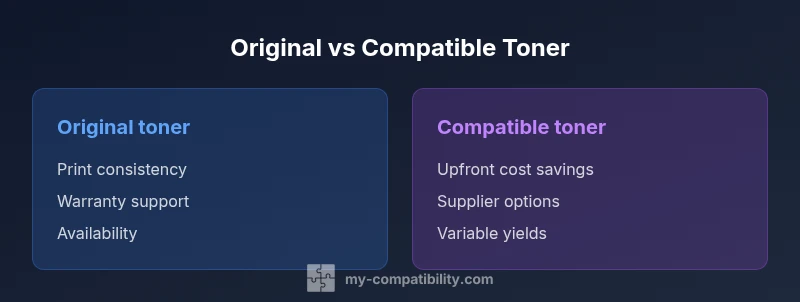
For many printers, compatible toner cartridges deliver print quality close to OEM originals at a lower upfront cost, making them a solid value. However, original toner often provides the most consistent yields and stronger warranty coverage. When deciding between original toner vs compatible, consider page yield, supplier reputation, and availability to determine the best balance of cost and reliability.
Scope and Definitions
When reviewing the topic of printer supplies, the phrase original toner vs compatible surfaces a core decision point that blends cost, reliability, and supply chain considerations. In this article we define terms so readers can compare apples to apples: Original toner cartridges are produced by the printer's OEM and designed to work with a specific model; compatible cartridges are third-party options engineered to fit the same printer but not manufactured by the OEM. Remanufactured cartridges fall in between, refurbished from used units.
According to My Compatibility, the choice between original toner vs compatible often hinges on your tolerance for risk and your budget. The My Compatibility team found that for many everyday office tasks, compatible cartridges from reputable brands deliver print quality and yields that are close enough to OEMs at a fraction of the upfront cost. We also emphasize that compatibility goes beyond the cartridge itself—firmware checks, drum and fuser compatibility, and supplier support all play important roles in performance.
wordCount”:210},"## How to judge toner compatibility
Determining whether a toner cartridge is truly compatible requires checking several criteria that printers care about: model numbers, chip compatibility, firmware interactions, and the ability to provide consistent yields. Start with the printer’s exact model and consult the manufacturer’s guidance. Then cross-check the cartridge part numbers with the supplier’s listing and read recent reviews for reliability. Be aware that some printers use dynamic warranty language or require locked features; in those cases, a proven supplier with a track record matters. Always verify the cartridge’s alignment with your device’s maintenance schedule and drum/fuser compatibility. In practice, the decision between original toner vs compatible hinges on the supplier’s quality controls and the printer’s firmware tolerance. The My Compatibility approach emphasizes a cautious, test-driven process to minimize surprises and protect uptime.
wordCount”:190},"## Print quality considerations
Print quality involves density, color accuracy, and image stability across pages. Original toner is designed to meet the printer’s calibration curves and reliability standards, which usually yields extremely stable results from the first page to the last. Compatible cartridges from reputable brands can approach OEM performance, especially when they use high-grade toners and consistent supply chains. However, batch-to-batch variation can be more noticeable with some brands, particularly in color-heavy tasks or graphics work. For most office documents, the difference between original toner vs compatible is often indistinguishable on ordinary paper when you choose a well-reviewed supplier. The key is to avoid budget lines that lack independent testing and quality assurance.
wordCount”:210},"## Page yield and cost of ownership
Yield and cost interplay define the long-term value. Original toner cartridges typically advertise fixed yields that align with official specifications, offering predictable performance in demanding workloads. Compatible cartridges can deliver similar results but may show wider variation across production lots. My Compatibility analysis shows that total cost of ownership can swing toward compatibles for mid-range printers when considering cartridge price and replacement frequency, especially in high-volume environments. For color jobs, expect occasional more frequent toner refreshes with certain third-party brands, which can alter the true cost per page. In contrast, high-quality OEM toners tend to maximize pages per cartridge in line with warranty expectations. The practical takeaway is to compare per-page costs from reputable suppliers and run a controlled test before committing to a full rollout.
wordCount”:230},"## Warranty, guarantees, and support
Warranty terms surrounding toner can be nuanced. OEM cartridges typically come with manufacturer-wide warranty coverage for their own units, but some printer makers reserve the right to limit warranty if third-party cartridges cause issues. Reputable compatible suppliers often offer their own guarantees on print quality and page yield, though these warranties may be narrower than OEM terms. It’s essential to read the warranty language for both the printer and the cartridge supplier before purchasing. In many cases, institutions can preserve warranty protections by using certified third-party cartridges from well-known brands and by maintaining appropriate service records. This section highlights that the choice between original toner vs compatible is partly a risk management decision based on your tolerance for potential warranty disputes.
wordCount”:210},"## Cartridge types: OEM, compatible, remanufactured
OEM or original cartridges come from the printer manufacturer and are designed to work as a closed system with guaranteed compatibility. Compatible cartridges are third-party products engineered to fit and operate with the same model while often offering substantial cost savings. Remanufactured cartridges use genuine shells refurbished with a renewed toner formulation and components; they can deliver solid performance when sourced from responsible refurbishers. Each type has tradeoffs: OEMs emphasize reliability and brand-backed support; compatibles emphasize price efficiency and broader supplier options; remanufactured cartridges balance cost with environmental concerns and sometimes longer procurement lead times. Your selection should reflect the printer model, workload, and the reliability you require for critical documents.
wordCount”:210},"## Environmental and procurement considerations
Environmental impact matters for sustainable procurement. Remanufactured and compatible cartridges can reduce plastic waste and landfill impact when handled through accredited recycling programs and reputable refurbishers. Some brands actively promote cartridge recycling and offer take-back schemes, contributing to a circular economy. Procurement strategies also influence risk and uptime: buying from authorized distributors or brands with strong quality controls reduces the likelihood of counterfeit or underperforming products. In the broader context, organizations can adopt a blended strategy—favor OEM for mission-critical tasks and rely on high-quality compatibles or remanufactured options for bulk printing—striking a balance between sustainability, cost, and workflow reliability.
wordCount”:190},"## Practical steps to choose
To apply a methodical approach when evaluating original toner vs compatible for your setup, start with a clear plan: 1) Confirm your printer model, firmware version, and any policy notes from the manufacturer. 2) Build a shortlist of reputable brands with documented compatibility and independent testing. 3) Compare estimated yields and cost per page using supplier documents rather than sticker prices. 4) Review warranty terms and support options provided by both OEM and third-party suppliers. 5) Execute a controlled pilot: print a representative mix of documents, check density, color fidelity, and nuisance issues like streaking, and compare results against OEM performance. 6) Document outcomes and schedule quarterly reviews to adjust orders based on observed print quality and reliability. This is the practical way to navigate the original toner vs compatible decision with confidence.
wordCount”:190},"## Common myths debunked
Myth 1: Only OEM cartridges deliver reliable results. Reality: many well-established compatible brands deliver performance that rivals OEMs for common office workloads. Myth 2: Using third-party cartridges voids all warranty. Reality: warranty terms vary; many printers maintain coverage if third-party cartridges are used properly and do not cause damages. Myth 3: All remanufactured cartridges are poor quality. Reality: remanufactured options from responsible refurbishers can offer solid yields and environmental benefits when product testing and quality controls are strong. Myth 4: Color accuracy cannot be preserved with compatibles. Reality: with reputable brands, color stability can meet professional standards, especially when calibration and printer profiles are applied.
wordCount”:210}],
comparisonTable
items: [
Comparison
| Feature | Original toner cartridge | Compatible toner cartridge |
|---|---|---|
| Print quality consistency | Excellent | Very good; varies by brand |
| Page yield consistency | High predictability | Moderate to high depending on supplier |
| Cost per page | Higher upfront cost | Lower upfront cost |
| Warranty coverage | Full OEM warranty with installation support | Supplier-based or limited warranty |
| Availability | Widely available through OEM channels | Broad but brand-dependent |
| Environmental impact | Recyclable through OEM programs | Remanufactured/compatible options vary by supplier |
Positives
- Lower upfront cost for compatible cartridges
- Wide supplier availability increases purchase options
- Many compatibles deliver comparable print quality when sourced from reputable brands
- Remanufactured options help reduce waste
Cons
- Print quality can vary by brand
- Warranty coverage may be limited or printer-specific
- Yield consistency may be less predictable
- Some printers may reject third-party cartridges
Original toner for reliability; compatible toners offer cost efficiency.
Original toner generally provides predictable performance and solid warranty coverage. Compatible cartridges can be a strong value, especially when sourced from reputable brands. The best choice depends on your printer model, workload, and how much risk you’re willing to accept regarding warranty and yield variability.
Questions & Answers
Is original toner always better than compatible toner?
Not always. OEM cartridges often deliver the most consistent results and warranty coverage, but high-quality compatibles can closely match OEM performance for many users. Your choice depends on your tolerance for risk and your printer model.
OEMs are usually the safest for consistency, but good-compatible brands can perform very well.
Do compatible cartridges void printer warranties?
Warranty implications vary by manufacturer. Some printers maintain coverage when third-party cartridges are used correctly, while others reserve rights to limit support if issues arise. Always verify terms before purchasing.
Check your printer’s policy and the cartridge supplier’s guarantees.
How can I ensure compatibility with my printer model?
Always confirm the exact model, firmware version, and cartridge part numbers. Read supplier listings, review customer feedback, and consult the printer’s official documentation. A quick test run helps validate compatibility.
Match the exact model and run a small test first.
Are remanufactured toners reliable?
Remanufactured cartridges can be reliable when sourced from reputable refurbishers with quality controls. They may require more testing to ensure consistent yields for your workload.
Remanufactured options can be great if you pick a trusted supplier.
What is the best practice for replacing toner cartridges in a busy office?
Plan replacements during low-usage windows, perform a test print after installation, calibrate if needed, and maintain a small inventory of backup units from trusted brands.
Have a quick changeover plan and test a print afterward.
How do I evaluate yield differences between OEM and compatible?
Check published page yields from credible vendors and perform a controlled test on a representative print batch. Track actual pages printed versus yields and adjust orders as needed.
Test yields on real workloads to see what you get in practice.
Highlights
- Assess your printer model's stance on third-party cartridges
- Compare yields and costs per page, not just price
- Prioritize supplier reputation and warranty terms
- Test a batch before full deployment to avoid disruption