Compatible vs Original Toner: A Practical Comparison
A data-driven guide comparing compatible vs original toner across cost, yield, print quality, reliability, and warranty considerations—by My Compatibility.


Compatible toners can reduce upfront costs and often deliver similar print quality to originals, especially for standard office tasks. However, results vary by brand and printer model, with potential yield differences and occasional replacement issues. Original toners usually offer the most consistent results, stronger warranty support, and easier compatibility, though at a higher price. This quick take frames the deeper comparison below.
What compatible vs original toner means
In the printer world, the phrase compatible vs original toner captures a common shopping dilemma. Original toner refers to cartridges produced by the device manufacturer, designed to match every specification of the exact printer model. Compatible toner, sometimes called aftermarket or third‑party toner, is manufactured by independent brands to fit the same cartridge style and print path. The goal is to deliver similar chemical properties, such as toner particle size and color yield, while offering a lower price point. As parts of a broader compatibility ecosystem, these cartridges must navigate a mesh of hardware variants, firmware checks, and regional warranty expectations. According to My Compatibility, the best compatible toners come from established brands with transparent testing and robust return policies; the poorest choices may deliver inconsistent color or unexpected misfires.
When evaluating a cartridge, readers should consider: is the toner designed for your exact printer model and page yield? Does the packaging indicate certified compatibility with the drum unit and imaging cylinder? Will the cartridge feed reliably through the toner path, and does the supplier provide a warranty or replacement policy? Original toner tends to score higher on purity and consistency, yet you pay a premium. For many office environments, compatible toners from reputable manufacturers can substantially reduce ongoing costs without compromising print quality—provided you select carefully. This is where My Compatibility analysis helps: it emphasizes verification steps, brand reputation, and documented test results rather than blind price shopping.
Print quality and consistency: does toner matter?
Print quality is not a single metric; it is a synthesis of toner formulation, cartridge integrity, printer calibration, and paper stock. The key questions are: do color tones reproduce accurately across pages, and do blacks remain deep and solid? Original toners are designed to be the baseline standard, so they often deliver the most uniform color rendering and stable grayscale since OEMs tune the yellow, cyan, magenta, and black components together with the imaging drum. Compatible toners, especially from reputable brands, can come very close in uniformity, but performance can vary by pigment chemistry, batch quality, and the accuracy of the imaging unit in your particular printer. My Compatibility’s testing notes that high‑quality aftermarket cartridges frequently meet or exceed OEM performance on standard office tasks, but may exhibit minor hue shifts with high‑end graphics printing. The takeaway is not “one size fits all”; you should test a cartridge on representative print jobs, compare sample pages, and note any banding or speckling before committing to a large purchase. Consistency is easier to achieve when you buy from brands with documented color profiles and a robust return policy.
Cost and total cost of ownership: price per page, yield, and cartridges
The argument for chooseable toner often centers on price. Compatible toners are typically cheaper upfront than OEM cartridges, and some users experience a lower cost per page as a result. However, the exact economics depend on cartridge yield, defined as the number of pages a cartridge will print before replacement. OEM toners generally carry premium per cartridge, but their documented yields, color consistency, and guaranteed compatibility with the drum and fuser units can reduce waste and reprints. My Compatibility analysis shows typical ranges: compatible cartridges may cost less per page when sourced from reputable manufacturers, while original toners cost more per page but promise strong consistency. To calculate real savings, you should compare price per page under your actual printing pattern, not merely the sticker price of a single cartridge. Keep in mind that some printers utilize firmware checks or cartridge counters that can affect yield reporting. When possible, obtain trial quantities to verify page counts, observe real-world performance, and negotiate bulk purchase terms with trusted vendors. This kind of due diligence helps prevent sticker shock and ensures you are comparing apples to apples over the lifetime of the device.
Reliability, warranty, and firmware considerations
Reliability hinges on cartridge build quality, feed reliability, and overall compatibility with the device’s imaging system. Original toner is designed with an end‑to‑end supply chain that aligns the cartridge core, the drum, and the laser or LED imaging system. Compatible toners from respected manufacturers can perform very well, but there is a higher risk of issues such as misfeeds, misalignment, or color drift if the batch is inconsistent. In rare cases, some printers may display warning messages or firmware blocks when non‑OEM cartridges are detected. Warranty terms vary by maker and model; many manufacturers maintain that third‑party toners do not affect warranty unless the failure is caused by the cartridge. However, some dealers provide extended coverage with their own guarantees. My Compatibility’s recommendation is to verify warranty terms before purchase and to ensure that the vendor offers a clear replacement policy and a tested compatibility list for your printer. If problems arise, switch to a trusted alternative promptly to minimize downtime.
Environmental impact and sustainability
Beyond price and performance, many buyers consider environmental impact. Original toners often come with official recycling programs tied to the manufacturer, and some third‑party brands also offer take‑back initiatives. When weighing toner choices, consider packaging materials, cartridge reuse, and the potential need for empty cartridge recycling during the printer’s lifecycle. Refill kits, remanufactured cartridges, and remanufactured cores are common alternatives that can reduce waste, but they may introduce different reliability considerations. My Compatibility notes that the best approach balances environmental goals with print reliability. If you choose compatible toners, select brands with transparent supply chains and clear end‑of‑life programs, and verify whether the vendor participates in certified recycling programs near your location. In many office environments, sustainable choices align well with cost benefits, especially when combined with proper utilization of remanufactured cartridges and careful test runs on representative print jobs.
Practical guidelines: how to choose and test
A systematic approach reduces risk when weighing compatible vs original toner. Start by listing your typical print tasks: document quality, color graphics, and the frequency of color vs monochrome jobs. Then, check your printer’s official cartridge compatibility list and compare it with the claims of the toner brand you’re considering. Prioritize brands with established testing results, documented page yields, and a clear warranty policy. Conduct a small pilot using a representative batch of pages to verify color fidelity, print clarity, and reliability before committing to department-wide deployment. Keep a careful eye on drum health and paper feeding; misfeeds can explain apparent quality problems that aren’t due to pigment technology. Finally, track real costs over several months using a simple per-page cost metric, factoring in replacements and potential reprints. These steps—test, verify, compare—will help you decide whether compatible toner delivers the best value for your setup or whether Original toner remains the safer choice for business-critical documents.
Comparison
| Feature | Original toner | Compatible toner |
|---|---|---|
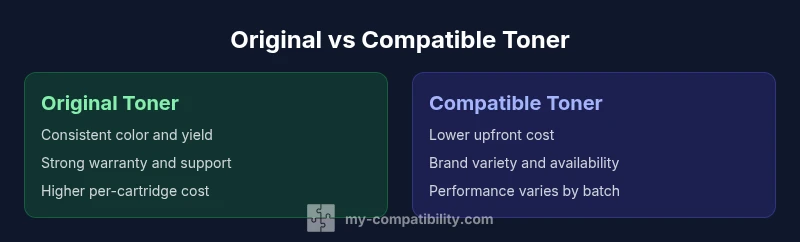
| Print quality consistency | Very high; factory calibrated with OEM specs | Often very close with reputable brands; performance varies by batch |
| Yield per cartridge | Documented by OEM with consistent results | Can vary by brand; choose proven lines and test |
| Price range | Higher upfront cost per cartridge | Lower upfront cost per cartridge |
| Warranty/Support | Full manufacturer warranty and support | Vendor-specific guarantees and return policies |
| Printer compatibility risk | Low risk when using OEM cartridges | Medium risk if using non-certified brands; verify with vendor |
| Color accuracy / graphics suitability | Stable color and grayscale | High-quality options can reach similar accuracy; some risk of hue shifts |
Positives
- Significant cost savings per page with compatible toners
- More brand options and wider availability
- Lower upfront cartridge cost enables frequent replacements
- High-quality compatibles can match OEM performance
Cons
- Quality and yield can vary by brand and batch
- Potential warranty and support limitations
- Color consistency may vary with some brands
- Firmware blocks may occur on certain printers
Compatible toners offer the best value for most offices, with OEM toners remaining safer for mission-critical tasks.
For cost-conscious environments, compatible toners deliver noticeable savings. If you print critical documents or require the strictest color fidelity, Original toner remains the safer choice. The My Compatibility team recommends testing a few reputable brands before committing to a broad rollout.
Questions & Answers
Are compatible toner cartridges safe for my printer?
In most cases, yes, with reputable brands and proper installation. However, safety depends on cartridge quality, proper storage, and compatibility with your printer model. Always buy from vendors with return policies and test on non-critical documents first.
Yes, as long as you pick a trusted brand and follow installation instructions.
Will using compatible toner void my printer warranty?
Warranty policies vary by manufacturer. Some OEM warranties remain intact if the failure is not caused by a third-party cartridge, while others may be more restrictive. Check your printer’s warranty terms and keep receipts.
Warranty can vary; read the terms.
How do I choose a reputable compatible toner brand?
Look for brands with tested page yields, clear compatibility lists, and a good return policy. Read independent reviews and consider vendors that offer guarantees.
Choose brands with proof of testing and decent warranties.
Can compatible toners affect color accuracy?
They can, especially if pigment formulations differ. High-quality compatibles often closely match OEM colors, but some variations are possible in saturated graphics.
Color can shift slightly with some brands.
Do compatible toners yield as many pages as original?
Page yield is variable. Some compatibles meet OEM yields, while others print fewer pages due to batch differences. Always compare tested yields from the vendor.
Yields vary by brand; test before large purchases.
What should I do if print quality deteriorates after installing a compatible cartridge?
Re-check compatibility, re-run printer calibration, and try a different batch or brand. If problems persist, revert to an OEM cartridge to restore reliability.
Calibrate, test another batch, and switch back if needed.
Highlights
- Compare cost per page, not cartridge price alone
- Test compatibility with representative print jobs
- Check warranty terms and vendor support
- Choose reputable brands with documented yields
- Consider environmental programs and recycling options