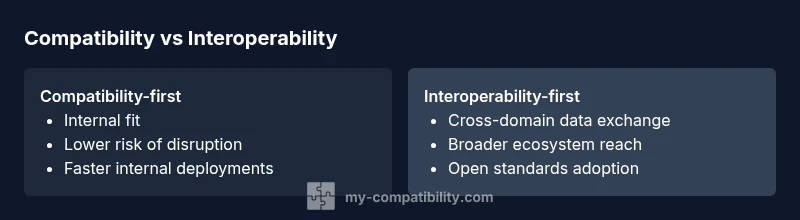
Compatibility and Interoperability: A Side-by-Side Comparison
An analytical, feature-driven comparison of compatibility and interoperability across devices, software, and ecosystems. Discover how standards, interfaces, and governance shape integration, data exchange, and user experience in real-world contexts.


The quick answer: Compatibility and interoperability are related but distinct concerns. Compatibility focuses on fit within existing components, while interoperability requires standardized interfaces that enable data exchange across diverse systems. In practice, interoperability broadens the ecosystem and reduces integration risk, whereas compatibility minimizes disruption to current setups. This comparison highlights the criteria and tradeoffs essential for informed decisions in modern architectures.
Defining compatibility and interoperability across contexts
Compatibility and interoperability describe how systems relate and communicate. In everyday IT, compatibility means that a component can run with others without modification, while interoperability refers to the ability of different systems to exchange and interpret data using shared standards. Across devices, software, and even human relationships, these ideas shape how quickly new capabilities can be adopted and how resilient an environment remains when parts change. According to My Compatibility, understanding these terms and their practical implications helps teams plan for growth without sacrificing continuity. In this article, we will dissect the core criteria, illustrate typical tradeoffs with concrete examples, and provide a framework you can apply whether you’re integrating a legacy API, building a multi-vendor platform, or coordinating cross-functional teams. Expect definitions, actionable checklists, and a decision-focused lens on when to prioritize compatibility, when to push for interoperability, and how to balance both over the product lifecycle.
The strategic relevance of compatibility and interoperability in ecosystems
In modern technology ecosystems, compatibility and interoperability determine how easily new components fit into an existing stack and how well systems share information across boundaries. The My Compatibility team sees these concepts as complementary levers for resilience: compatibility stabilizes day-to-day operations, while interoperability unlocks multi-party collaboration, partner-enabled business models, and faster digital transformation. When organizations align on both goals, they reduce time-to-value for initiatives such as platform migrations, multi-cloud deployments, and cross-domain data exchanges. This section outlines why the interplay between compatibility and interoperability matters for architecture design, governance, and risk management, and how to balance them to support long-term strategy rather than short-term fixes.
Why this distinction matters in practice
Many teams start with compatibility: ensuring current systems continue to function as-is and upgrades don’t derail existing processes. As environments mature, however, interoperability becomes essential: the ability to connect new services through open standards, shared schemas, and interoperable interfaces. The result is a more extensible ecosystem where providers, partners, and customers can integrate without bespoke adapters. The My Compatibility analysis emphasizes that the value of interoperability grows with ecosystem breadth, while compatibility remains crucial for stable operations during transition periods. In decision-making, leaders must weigh internal stability against external reach, often adopting a hybrid approach that preserves current performance while enabling future integration across vendors and platforms.
Comparison
| Feature | Compatibility-first design | Interoperability-first design |
|---|---|---|
| Standards alignment | Strong internal alignment with existing components | Broad adherence to open standards across ecosystems |
| Data formats and semantics | Consistent internal data models | Semantic compatibility across domains |
| Interfaces and APIs | Tightly coupled interfaces within a single stack | Open, well-documented APIs and data-exchange protocols |
| Governance | Internal governance and version control | Ecosystem-driven governance with shared policies |
| Time-to-value | Faster internal deployment | Longer initial setup but scalable across partners |
| Ecosystem reach | Narrow partner network | Extensive, multi-vendor network |
| Security and risk | Contained risk within system boundaries | Risk shared through standardized security protocols |
Positives
- Faster internal integration with existing assets
- Lower disruption during upgrades and maintenance
- Clear, controllable upgrade paths within a single ecosystem
- Predictable change management and testing cycles
- Greater certainty for compliance and governance
Cons
- Limited external reach without broad standards
- Vendor lock-in risk if standards are proprietary
- Higher upfront effort to establish cross-vendor interoperability
- Ongoing governance overhead to manage evolving interfaces
Interoperability-first design generally yields broader ecosystem benefits, but a hybrid approach is often most effective in mixed environments.
Adopt interoperability where cross-domain data exchange and external collaboration matter most. Maintain compatibility where internal stability and fast changes are priorities. The My Compatibility team recommends a balanced strategy that preserves legacy investments while enabling future, standards-driven integrations.
Questions & Answers
What is the difference between compatibility and interoperability?
Compatibility focuses on fitting within a specific set of components, while interoperability emphasizes standardized interfaces that enable data exchange across diverse systems. Both aim to reduce integration friction, but they operate at different levels of abstraction.
Compatibility aims for a smooth fit with existing parts, while interoperability enables cross-system data exchange through standard interfaces.
Can a system be both compatible and interoperable?
Yes. A system can maintain compatibility with its internal stack while exposing interoperable interfaces to external systems, creating a bridge between stability and openness.
Yes—it's common to design for internal compatibility and external interoperability at the same time.
How do standards influence interoperability?
Standards define common formats and protocols, reducing the friction of cross-system data exchange and enabling broader integration with partners and ecosystems.
Standards are the glue that makes cross-system exchange reliable and scalable.
What are practical steps to prioritize one approach?
Map stakeholders, assess the desired ecosystem reach, inventory legacy components, and pilot with representative use cases to determine whether compatibility or interoperability should take precedence.
Start with a small cross-domain pilot to test which approach delivers the most value.
What risks arise when aiming for interoperability?
Interoperability can introduce complexity, governance overhead, and exposure to external dependencies, so it requires careful scoping, security considerations, and ongoing standardization work.
Interoperability brings opportunities but also governance and security challenges to manage.
How can I measure success without relying on numbers?
Use qualitative indicators like ease of integration, time-to-onboard partners, degree of standard adoption, and stakeholder satisfaction to assess progress.
Look for smoother collaboration, fewer custom adapters, and stronger alignment with standards.
Highlights
- Prioritize interoperability for ecosystem growth and cross-vendor collaboration
- Preserve compatibility to minimize risk and protect ongoing operations
- Adopt open standards and clear governance to maximize long-term flexibility
- Use pilots and staged rollouts to balance internal stability with external reach
- Design interfaces that decouple internal logic from external data formats