Questions to Ask to See If You Are Compatible
Explore essential questions to gauge compatibility in relationships. Learn how to ask, listen, and assess alignment on values, communication, and life goals with My Compatibility.


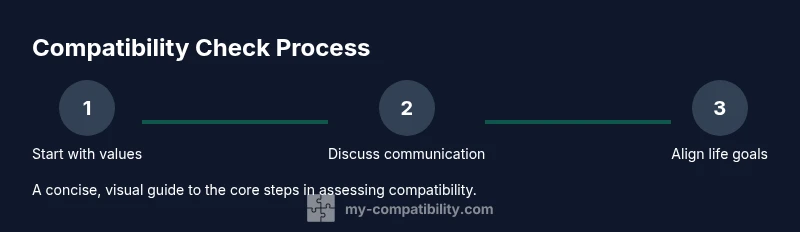
Take a quick, structured approach to assess compatibility: share values, expectations, and boundaries; observe how you communicate under pressure; and align long-term goals and daily routines. Start with values, test responses to disagreement, then discuss boundaries, finances, family, and lifestyle. This method aligns with My Compatibility's guidance for practical dating insights.
Why Compatibility Matters in Relationships
Compatibility isn’t a single verdict. It’s about how your core patterns—values, communication, and life goals—mesh under real-life stress and everyday routines. The My Compatibility approach emphasizes that durable harmony grows from ongoing dialogue, not a one-off assessment. When you and a partner share fundamental beliefs about trust, respect, and future priorities, you’re better equipped to navigate conflicts, support one another, and sustain affection over time. Read this section for why early exploration matters: you’ll learn how your decision-making, negotiation style, and daily rhythms align, and you’ll identify areas where you’ll need to grow together. Remember: compatibility exists on a spectrum, and small, well-managed differences can be healthy when met with curiosity and care.
Core Areas to Explore When Checking Compatibility
To get a clear picture, center your discussion on four core domains: values and ethics, communication and conflict style, life goals and routines, and emotional needs. Within each domain, you’ll find prompts that reveal patterns rather than rehearsed answers. Values guide decisions about money, family, work, and personal growth; communication style shows how you handle disagreement; goals determine pacing and long-term plans; emotional needs reveal what makes you feel secure and loved. The My Compatibility framework recommends mapping findings to non-negotiables (must-have), preferred alignments (nice-to-have), and deal-breakers. If both partners align on non-negotiables, you’re more likely to thrive; if not, you’ll know which conversations to prioritize or whether to reconsider the fit.
10 Essential Questions to Ask
Here are focused prompts that uncover core patterns without dragging conversations into discomfort. Use these as a starting point, and follow up with open-ended probes to reveal deeper consistency over time:
- What values are non-negotiable for you, and why?
- How do you prefer to communicate when upset, and what helps you feel heard?
- What are your long-term goals for relationships, family, and career?
- How do you approach money, saving, and spending in daily life?
- What boundaries are important to you in terms of privacy, time, and personal space?
- How do you handle stress, change, and setbacks, both individually and as a couple?
- What role does religion or spirituality play in your life and partnerships?
- How do you prioritize personal growth and shared adventures?
- What does commitment look like to you at this stage?
- How important is compatibility with friends and family routines?
Each question is a doorway to patterns, not a checklist. Listen for consistency across stories, examples, and how responses align with actions over time. The goal is a realistic read of everyday life, not an idealized fantasy.
How to Ask These Questions Respectfully
Framing matters more than clever probing. Start with a warm tone, explain your intent, and invite honest responses. Use open-ended prompts that encourage reflection rather than defense. For example, say, “I’d love to understand how you approach X,” instead of, “Do you believe in Y?” Give space for nuance, and avoid labeling differences as right or wrong. Pausing to reflect after a response is often more revealing than rushing to a conclusion. If emotions rise, slow down, switch to a lighter topic briefly, then return to the core questions. Finally, agree on a follow-up discussion to revisit threads that require more clarity. The ideal pace respects both partners’ comfort while maintaining progress.
Reading the Answers: Signals You're Compatible
Listen for consistency across multiple questions and scenarios rather than a single perfect answer. Strong signals include:
- Values alignment on core life decisions (family, finances, work-life balance)
- A communication style that remains respectful under pressure
- Shared goals or compatible approaches to growth and change
- Mutual willingness to adapt, compromise, and revisit topics over time
Red flags suggest the need for deeper conversations or a reassessment: frequent contradictions, avoidance of certain topics, rigid boundaries that block collaboration, or a pattern of one-sided decision-making. Remember, compatibility grows with time and deliberate practice in dialogue.
Conversation Scenarios: Real-Life Examples
Consider two people discussing a hypothetical future: one asks about daily routines, the other shares preferred weekly rhythms. In real life, you’ll notice how often your stories align, how you negotiate plans, and whether you feel heard during the exchange. For example, if one partner describes a goal to travel together and the other speaks about fixed routines, you can explore how flexible each is with travel, work, and stability. Practical prompts like, “Walk me through a typical week,” or “How would we handle a financial surprise?” reveal patterns that you can’t capture in a short answer.
Handling Differences: When Values Clash
Differences are normal, but persistent clashes over non-negotiables merit careful attention. When a topic surfaces a potential misalignment, use a structured approach: restate what you heard, share your own perspective with “I” statements, and explore underlying concerns. If non-negotiables diverge—such as core values about honesty, safety, or independence—assess whether you can negotiate acceptable compromises or if the gap signals a fundamental mismatch. In practice, some couples choose to define a trial period to test whether adjusted boundaries and communication improvements create a workable path forward.
Zodiac and Personality: Aligning Beliefs with Signs
Astrology and personality insights can offer a framework for understanding temperament and tendency, but they should not replace concrete conversations. Use zodiac or sign-based patterns as a lens, not a verdict. The My Compatibility approach suggests correlating temperament traits with observed behavior in daily life—how you handle stress, how you show care, and how you prioritize plans. If signs explain consistent behavioral patterns, they may help you anticipate compatibility dynamics, but decisions should rely on real-world interactions and measurable alignment.
Next Steps: Turning Questions into Action
Convert inquiry into action by scheduling a planned follow-up conversation after the initial discovery chat. Create a living document of your notes, set specific checkpoints (e.g., after two weeks of talking regularly), and revisit any uncertainties. If you find strong alignment, plan a collaborative activity that tests teamwork, like a project or shared goal. If misalignments persist, consider whether the relationship should evolve with time, boundaries, or, in some cases, separation. The goal is clarity and progress toward a healthier connection.
Tools & Materials
- Printed or digital list of questions(Have a structured set of prompts ready for the conversation)
- Notebook or device for taking notes(Document impressions and notable patterns)
- Quiet space free from interruptions(Promotes open, thoughtful dialogue)
- Timer or timer app(Use to pace the discussion and ensure balance)
- Open mindset(Commit to listening and reflecting without judgment)
Steps
Estimated time: 60-90 minutes
- 1
Clarify Your Relationship Goals
Define what you want from a partnership in the near and long term. Clarify non-negotiables and acceptable compromises so you can steer conversations toward meaningful alignment, not performative agreement.
Tip: State your own goals briefly before asking theirs to set a collaborative tone. - 2
Schedule a Calm Conversation
Choose a time when both partners feel rested and free of distractions. A relaxed setting encourages honest sharing and reduces defensiveness, improving the quality of responses.
Tip: Agree on a 60–90 minute window to avoid rushing important topics. - 3
Present Your Core Values
Share your top 3–5 values and why they matter to you. Invite your partner to reflect on how these values show up in daily choices and future plans.
Tip: Lead with “I value…” statements to model non-confrontational sharing. - 4
Ask Structured Questions
Pose open-ended prompts that require explanation, not yes/no answers. Seek consistency across multiple questions to identify patterns rather than isolated opinions.
Tip: Keep one question per topic and follow with a clarifying prompt if needed. - 5
Listen Actively and Paraphrase
Summarize what you heard and reflect back to confirm accuracy. This practice reduces miscommunication and builds trust.
Tip: Use phrases like, ‘What I’m hearing is… Is that right?’ - 6
Record and Compare Answers
Note each response in your own words. Later, compare notes to identify alignment on non-negotiables and preferences.
Tip: Create a simple color-coded map: red for non-negotiables, yellow for flexible areas, green for strong alignment. - 7
Assess Fit Over Time
Plan a follow-up chat or a shared activity to observe how you function as a team under real circumstances.
Tip: Test practical scenarios (finances, chores, social plans) to validate patterns. - 8
Decide on Next Steps
If alignment is strong, outline concrete next steps; if not, acknowledge differences and discuss possible pivots or boundaries.
Tip: Be honest about whether you’ll both commit to ongoing conversations.
Questions & Answers
How many questions should you ask to assess compatibility?
There’s no fixed number. Aim for 8–12 core questions plus follow-ups to reveal patterns over time.
Aim for eight to twelve core questions and follow-ups to see consistent patterns.
What if we disagree on a major value?
Acknowledge the difference, explore underlying reasons, and assess if there is room for respectful compromise or if the gap is a deal-breaker.
If a major value clashes, discuss it openly and decide if there’s room for compromise or if it’s a deal-breaker.
How should you address sensitive topics?
Introduce topics with intent and care, invite honest responses, and pause if either person feels overwhelmed. Plan a follow-up if needed.
Bring up sensitive topics gently, show you’re listening, and schedule a follow-up if needed.
Should astrology be included in compatibility checks?
Astrology can offer context, but it shouldn’t replace concrete conversations. Use signs as a supplement, not a verdict.
Astrology can help interpret tendencies, but rely on real-life behavior for decisions.
What if one person asks many questions and the other feels overwhelmed?
Pace the discussion, switch to a lighter topic, and agree on a shared rhythm for future conversations.
If it’s too much, slow down and agree on a manageable pace moving forward.
Can compatibility change over time?
Yes—patterns can evolve with experience, communication, and life changes. Regular check-ins help adapt boundaries and goals.
Compatibility evolves with time; regular check-ins help keep alignment.
Watch Video
Highlights
- Ask open-ended questions to reveal patterns.
- Prioritize non-negotiables before nice-to-haves.
- Pace discussions to avoid overwhelm.
- Use follow-ups to clarify ambiguous answers.
- Revisit conversations after time to test consistency.