i love him but we are not compatible: a practical guide to compatibility in love
If you love him but feel incompatible, this urgent troubleshooting guide helps you diagnose value gaps, communicate boundaries, and decide your next steps.


You’re likely facing a clash of core values and long-term goals, not a simple emotional mismatch. The quickest path is a focused, compassionate conversation to identify non-negotiables, set boundaries, and test alignment on essential life plans. If the two of you cannot reconcile those gaps after a structured discussion and trial period, seek counseling or consider a respectful separation.
i love him but we are not compatible
When you say i love him but we are not compatible, it’s often the signal that feelings are outpaced by the reality of life together. According to My Compatibility, love can endure best when core values, long-term goals, and personal boundaries align with daily life. This section explains why compatibility matters as much as chemistry, and how quick, honest conversations can lay the groundwork for either alignment or a respectful parting. In practical terms, compatibility means you can negotiate the big decisions and still feel seen. If you and your partner can't map a shared future without constant compromise, the relationship will strain under everyday choices. Read on to build a decision framework that respects both hearts and lives.
Core value mismatch: spotting the signs
Core values are the non-negotiables that shape major life decisions—finances, location, family plans, faith, and work-life balance. When partners diverge on these bases, even strong affection can’t fully compensate for friction in daily routines. Signs include repeated disagreements about where to live or how to raise children, divergent spending habits, or incompatible loyalties with families and friends. My Compatibility analysis notes that even small differences can snowball over time when there is no explicit renegotiation of expectations. If you notice persistent disagreement on these pillars, you’re likely looking at a value-based gap rather than a temporary mood.
Relationship goals vs relationship reality: how to assess compatibility
Take stock of your long-term goals side by side. List your top five non-negotiables for the coming five to ten years and compare them with your partner’s list. Look for alignment on critical axes—where you want to live, whether you want children, financial priorities, and how you envision daily support and partnership. Be honest about what you can and cannot compromise on. If the two lists diverge in areas that matter most to you, you are facing a structural incompatibility. Based on My Compatibility research, ongoing, unresolved value conflicts tend to erode relationship longevity, even when chemistry remains strong. This isn’t a failure of character; it’s a signal to reassess the path forward with clarity.
Conversation framework: how to talk about the gap with care
Structure conversations to reduce defensiveness. Start with concrete observations, then share how you feel using “I” statements, and finally name what you need next. For example: "I feel uncertain about our future plans when we disagree about money and location. I need us to agree on two non-negotiables by the end of this month." Set a timebox for discussions and agree to pause if emotions run high. Be prepared to listen actively, paraphrase what you hear, and refrain from blaming language. Consider writing down topics to cover so you don’t skip crucial points. This approach preserves dignity while identifying dealbreakers or points of compromise.
When to seek help and how to decide your next step
If conversations stall or you still can’t align on core issues after a structured effort, seek professional guidance. A couples therapist or relationship coach can provide neutral facilitation, teach new communication patterns, and help you test boundary-based experiments. If safety concerns exist, prioritize immediate support and protective steps. My Compatibility analysis shows that professional help often clarifies whether a couple can reframe goals together or must part ways with a clear plan. Use the results of your discussions to set a realistic decision window (e.g., a defined trial period) rather than leaving things unresolved indefinitely.
Realistic paths forward: options you can choose today
There are several constructive paths when you’re navigating incompatibility. You can (a) renegotiate boundaries and agree on a concrete plan to pursue shared goals, (b) reduce complexity by slowing the relationship—dating with stronger boundaries or a temporary pause, (c) pursue counseling to build new communication skills and explore whether alignment is possible, or (d) decide to end the romantic relationship respectfully if essential values remain unreconciled. Each option should come with a clear action plan, timelines, and check-ins to monitor progress. The aim is to avoid slow drift and create a conscious, compassionate outcome for both partners.
Steps
Estimated time: 1-2 hours
- 1
Clarify values and non-negotiables
Create a personal list of the top five non-negotiables for your life (e.g., where to live, parenting, finances, and religious or cultural practices). Share your list with your partner and compare the overlaps and gaps to understand the scale of the mismatch.
Tip: Write your list first, then swap with your partner and discuss without interruptions. - 2
Schedule a calm, structured conversation
Set aside dedicated time in a neutral setting. Present concrete examples of conflicts tied to values, and invite your partner to share their perspective without interruption. Agree on a time limit for the discussion and a plan to document outcomes.
Tip: Use a timer to keep conversations focused and respectful. - 3
Explore alignment on long-term goals
Discuss five core future scenarios (e.g., where to live, financial goals, family planning, career choices, and lifestyle). Evaluate which scenarios align and which require compromises or disengagement.
Tip: Ask yourself, ‘Can we realistically pursue these goals together?’ - 4
Experiment with boundary-setting and small tests
Try boundary-based experiments (e.g., agree on a trial period for living arrangements or budgeting) to see if new patterns reduce friction. Track whether conversations improve and whether you still feel hopeful about the relationship.
Tip: Document results weekly to observe genuine shifts. - 5
Seek professional guidance
If the issues persist, schedule sessions with a qualified relationship professional who can facilitate deeper conversations and teach practical skills for alignment.
Tip: Choose a therapist with experience in value-based relationship coaching. - 6
Decide next steps based on outcomes
Review the results of your discussions and tests. Decide whether you can re-align around core values or if a respectful separation with a practical plan is the healthier option.
Tip: Set a clear decision date and plan for how to communicate it.
Diagnosis: You love him but feel incompatible; recurring conflicts about future plans
Possible Causes
- highCore value misalignment on major life goals (e.g., family, location, finances)
- mediumDifferences in communication styles leading to misunderstandings
- lowDifferent tolerance for compromise and change
Fixes
- easyHave a structured discussion to identify non-negotiables and boundaries
- mediumAttempt couples counseling or guided chats to practice new communication patterns
- hardIf alignment cannot be reached after a trial period, consider separation with a plan
Questions & Answers
Should I stay in a relationship if I’m not compatible?
Not necessarily. If core values and goals are incompatible, staying often leads to ongoing frustration. Seek clarity through honest discussions and, if needed, professional guidance before deciding.
If you’re not compatible, explore options with a clear plan—consider counseling or a respectful separation.
What if we both love each other but can’t agree on the future?
Love is important, but long-term alignment matters too. Try value-based conversations, set trials, and assess whether you can live with the necessary compromises.
Love helps, but the future needs to fit both people’ s lives.
Can couples counseling fix value-based incompatibility?
Counseling can improve communication and help you explore options, but it may not resolve deep-seated value gaps. It’s a constructive step to understand possibilities.
Counseling can help you explore options and improve communication.
How long should a trial period last before deciding?
Set a concrete window (e.g., 4–8 weeks) to test changes and note progress. If alignment hasn’t improved, reassess your plan.
Give yourselves a defined trial window to see if things can improve.
What if the relationship has potential but requires major life changes?
Major changes are possible but require mutual commitment and a realistic plan. Discuss feasibility, resources, and timelines before proceeding.
If big changes are possible with effort, map them out together.
When is it healthier to end the relationship?
If core values remain incompatible after honest effort and external help, ending the relationship with care can preserve well-being for both partners.
Sometimes parting ways respectfully is the kindest option.
Watch Video
Highlights
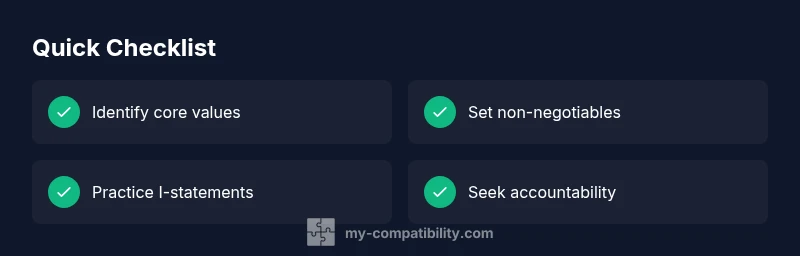
- Identify non-negotiables and boundaries
- Communicate clearly with I-statements
- Test compatibility with structured conversations
- Choose counseling if alignment seems possible, otherwise plan a respectful separation