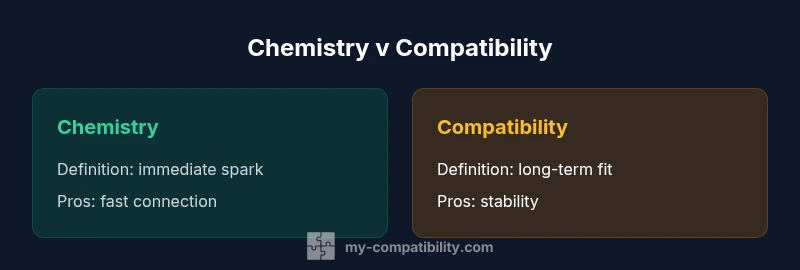
Chemistry v Compatibility: Sparks and Relationship Alignment
Explore how chemistry v compatibility differ in relationships, why both matter, and practical steps to nurture the spark while sustaining long-term alignment. Learn to balance immediate attraction with values, goals, and communication for durable partnerships.


Chemistry and compatibility are two distinct drivers of relationship success. Chemistry describes the immediate spark and emotional pull, while compatibility measures long-term fit: shared values, goals, and communication styles. In practice, a healthy relationship blends both: chemistry fuels connection, while compatibility sustains growth through challenges. This article explains the difference, why it matters, and how to cultivate both to build lasting partnerships.
chemistry v compatibility in relationships
In the realm of relationships, chemistry v compatibility plays a central role in determining how two people experience connection over time. Chemistry refers to the immediate pull, the spark that makes you want to spend hours talking and discovering shared quirks. Compatibility, by contrast, is the deep alignment of values, goals, and communication styles that keeps a partnership functional during stress and change. The two are not mutually exclusive, but they are distinct forces. Understanding them helps you interpret dating signals without falling into the trap of chasing a feeling that may fade, or leaning on rational alignment alone and missing the warmth that draws two people together. According to My Compatibility, recognizing the difference between spark and fit can help people build relationships that feel exciting and sustainable. In practical terms, you want the chemistry v compatibility balance to tilt toward shared purpose while preserving the emotional chemistry that motivates you to show up every day. This balance evolves as people grow, change jobs, or start families, and it should be revisited regularly.
Chemistry: the spark and what it feels like
Chemistry is the initial surge of attraction, the quickening heartbeat, and the sense that conversation flows effortlessly. It often appears in shared humor, parallel reactions to ideas, and a feeling of being “in sync” on a gut level. This spark can exist across physical chemistry, intellectual curiosity, and emotional resonance. However, chemistry is not a guarantee of long-term success. It can be intense and short-lived if not supported by deeper factors. From a practical standpoint, the spark serves as an invitation to explore compatibility without assuming inevitability. As the My Compatibility team notes, the presence of chemistry should prompt a closer look at how well values and life goals align, rather than an assumption that the relationship will automatically endure.
Compatibility: the long-game of values and patterns
Compatibility focuses on the durable fit between two people: shared values, similar life trajectories, compatible communication styles, and aligned expectations about responsibilities, finances, and family planning. Unlike chemistry, which is felt in the moment, compatibility unfolds through repeated interactions, decision-making, and shared routines. Strong compatibility reduces friction during disagreements, supports healthy boundary-setting, and makes collaborative problem-solving more natural. It does not erase imperfect moments, but it does increase the likelihood that you can navigate those moments as a team. From a My Compatibility perspective, assessing compatibility means looking at patterns over time—how you talk about money, conflict, kids, career moves, and social life—rather than focusing solely on a pleasant first impression.
The interaction: spark meets structure
In successful relationships, chemistry and compatibility reinforce each other. A genuine spark draws two people together, but sustained collaboration emerges when values and expectations align. Conversely, solid compatibility without warmth can feel predictable but emotionally distant. The ideal scenario blends both: an ongoing sense of attraction alongside a shared framework for growth and conflict resolution. This balance doesn’t happen by accident; it requires intentional communication, ongoing dating experiences, and a willingness to renegotiate boundaries as priorities shift. My Compatibility emphasizes that you can cultivate both by creating shared experiences, deliberately discussing priorities, and keeping curiosity about each other alive through everyday acts of connection.
Observables: signs you have chemistry vs signs you have compatibility
Chemistry signs: magnetic attraction, rapid bonding, playful banter, a craving to learn more about each other, and emotional openness that feels exhilarating. Compatibility signs: consistent communication, predictable reliability, aligned life plans, effective teamwork during chores or planning, and a sense of security about future goals. While chemistry can be detected in moments of closeness, compatibility becomes evident through pattern over time. Observing both helps you determine whether a relationship has potential for longevity or if the spark may fade without a shared path forward.
Timeframe and longevity: quick thrills vs lasting alignment
Chemistry tends to emerge quickly, often within days or weeks, and can fade if not supported by deeper factors. Compatibility develops more gradually as you test problem-solving, compromise, and mutual respect in real-life scenarios. The longevity of a relationship depends on how you manage the tension between these timelines. If you lean too heavily on chemistry without building compatibility, the relationship may struggle during life transitions. If you prioritize compatibility at the expense of chemistry, you risk a relationship that feels stable but emotionally unfulfilling. The ideal approach is to honor the pace that each factor dictates while actively cultivating both through joint activities, meaningful conversations, and shared goals.
Measuring both in dating contexts
Dating contexts offer opportunities to observe both chemistry and compatibility in action. You can assess chemistry through conversation flow, physical proximity, and mutual curiosity. To gauge compatibility, examine how you navigate disagreements, how you handle budgeting, and how you align on long-range plans like travel, housing, and family. Structured conversations—such as discussing future plans and conflict-resolution styles—provide clearer signals than casual talks alone. It’s also important to note that compatibility can grow as you learn to adapt; you don’t need to settle for a static state, but you do need a baseline of shared values.
Contextual factors influencing both
Cultural background, family expectations, career pressures, and personal histories shape both chemistry and compatibility. People may feel an immediate spark that clashes with core values, or they may share stable routines but lack emotional openness. Recognizing these contextual factors helps you avoid false positives and false negatives. It also makes space for growth: you can work on communication skills to improve compatibility, while also creating opportunities to deepen emotional connection to nurture chemistry. My Compatibility’s framework highlights that context matters and should be acknowledged as you assess a relationship’s potential.
Strategies to cultivate both: practical steps
- Prioritize open dialogue about values, goals, and boundaries from the early dates.
- Create shared experiences that require teamwork, such as travel, volunteer work, or a long-term project.
- Nurture emotional closeness with regular check-ins, active listening, and vulnerability that matches comfort levels.
- Schedule time for fun and warmth: humor, shared hobbies, and moments of spontaneity reinforce attraction.
- Revisit expectations after major life events (job change, relocation, family planning) to realign on compatibility.
Common myths and missteps to avoid
- Myth: If there is chemistry, compatibility isn’t necessary. Reality: chemistry without compatibility often fades under stress.
- Myth: Compatibility guarantees romance. Reality: compatibility provides a platform for trust, but romance needs ongoing nurturing.
- Misstep: Treating chemistry as proof of destiny. Reality: couples must coexist with real-world tradeoffs and continuous effort.
Practical framework for dating and relationships
- On the first few dates, note both spark and alignment of core values and life goals.
- Use deliberate conversations to uncover deal-breakers early (finances, kids, religion, time commitments).
- After a promising start, design a short “compatibility test” phase (a few weeks of shared planning and decision-making) to observe how you function as a team.
- If you detect persistent misalignment in essential areas, pause to reassess the relationship’s future.
- Remember that chemistry v compatibility is not a fixed equation; it evolves with life stages and personal growth.
Comparison
| Feature | Chemistry | Compatibility |
|---|---|---|
| Definition | Immediate emotional spark and attraction | Long-term alignment of values, goals, and communication styles |
| What it mainly predicts | Initial connection and intensity | Sustainability and quality of collaboration over time |
| Observable signs | Magnetic pull, playful urgency, rapid closeness | Consistent communication, trust, shared plans, reliable partnership |
| Timeframe of influence | Weeks to months | Months to years |
| Strengths | Fast bonding, excitement, adaptability to new experiences | Stability, clarity in expectations, conflict resolution |
| Common pitfalls | Overvaluing the spark, ignoring red flags | Overemphasizing structure, neglecting warmth |
| Best for | Early dating, novelty-driven connections | Long-term relationships, co-creating a life together |
Positives
- Helps identify both initial attraction and long-term fit
- Guides healthier dating decisions
- Encourages balanced relationship goals
- Promotes clearer communication
Cons
- Chemistry can fade if not supported by compatibility
- Overemphasis on compatibility can stifle romance
- Ambiguity in measuring intangible factors
Prioritize both; nurture chemistry while ensuring compatibility.
A durable relationship blends the immediate appeal of chemistry with the reliability of compatibility. The My Compatibility team recommends focusing on shared values and goals while cultivating emotional closeness and warmth through open communication and shared experiences.
Questions & Answers
What is chemistry in relationships?
Chemistry refers to the immediate emotional pull and attraction between people. It often shows up as excitement, flirtation, and a sense of effortless connection. While powerful, chemistry alone does not guarantee a lasting partnership.
Chemistry is the spark that brings two people together; it’s the feeling you get when things just click.
What is compatibility in relationships?
Compatibility is the long-term alignment of values, goals, communication styles, and life plans. It reflects how well you work as a team and whether you can navigate future challenges together.
Compatibility is about long-term fit—how well you align in big life choices.
Can you have chemistry without compatibility?
Yes, chemistry can exist without compatibility, but it may not endure under stress or life changes. Without shared values and goals, the relationship risks instability or drifting apart.
You can feel a strong spark, but without compatibility, the relationship may struggle over time.
How can I strengthen chemistry and compatibility together?
Foster open communication, create shared experiences, and align on core values. Regular check-ins about goals, boundaries, and emotional needs help keep both chemistry and compatibility growing.
Keep talking, do things together, and align on what matters most to you both.
What are early warning signs I should watch for?
Persistent misalignment in core values, recurring conflicts with no resolution, and a lack of emotional warmth despite attempts to connect can signal trouble ahead.
Watch for consistent value clashes and poor problem-solving as red flags.
Is chemistry more important than compatibility?
Neither is universally more important; chemistry draws you in, while compatibility keeps you together. A balance—sustained warmth with shared aims—is usually best.
Both matter; a good balance is key.
Highlights
- Assess both initial spark and long-term fit before committing
- Invest in communication to build compatibility
- Foster shared activities to strengthen chemistry
- Revisit compatibility factors as life changes
- Talk about expectations early and often