Check Love Compatibility by Name: A Practical Guide
Learn how to check love compatibility by name with three approachable methods, practical steps, and ethical guidelines. This educational guide from My Compatibility helps you reflect, discuss, and grow in relationships.


Check love compatibility by name using three approachable methods: numerology-inspired name values, sound-and-letter analysis, and personality cues drawn from shared name dynamics. This practice offers interesting, reflective insights rather than scientific forecasts, and should be treated as a fun, learning exercise to spark conversation and self-awareness. It complements other relationship signals rather than replacing them.
Why name-based love compatibility matters
In the realm of relationship introspection, many readers ask how to check love compatibility by name. The practice blends playful numerology, linguistic patterns, and personal storytelling to surface themes worth discussing with a partner. According to My Compatibility, name-based signals can illuminate preferences, communication styles, and the energetic dynamic a pair brings to daily interactions. They are a reflective tool, not a guarantee of success. When approached with curiosity, consent, and clear boundaries, exploring name dynamics can reveal strengths to lean into and blind spots to watch for. Use this method to spark meaningful dialogue about trust, needs, and compatibility signals, rather than to lock in a fate. In short, it’s a starting point for shared reflection, not a final verdict.
Three main approaches you can use
There isn't a single right way to check love compatibility by name. Most readers find value in combining three approachable methods, each offering a different lens:
-
Numerology-inspired name values: Map letters to numbers, sum the values for each name, and look for shared energy patterns (for example, totals that reduce to compatible digit pairs). This approach emphasizes rhythm, harmony, and how names may carry momentum into a relationship.
-
Sound-and-letter analysis: Consider how names sound when spoken aloud together, including alliteration, assonance, and the balance of vowels and consonants. Some couples perceive a pleasant cadence that reflects ease of communication, while mismatches can signal tension to monitor.
-
Personal narrative signals: Pay attention to stories, nicknames, and the symbolic meanings you attach to names. Shared narratives—such as memories invoked by a name or cultural associations—often reveal topics you’ll revisit, or avoid, in conflict or collaboration.
Across these methods, record observations in a simple worksheet and compare patterns across the two names. The goal isn't to predict the future but to surface discussion prompts, emotional cues, and practical conversations you can have with your partner.
How to interpret signals responsibly
Name-based signals are interpretive rather than predictive. Treat any findings as conversation starters, not divination. To keep things constructive:
-
Focus on patterns, not single data points. A name’s numeric vibe or phonetic feel is a cue, not a contract.
-
Check with the other person’s consent. Share your worksheet and invite them to contribute their own reflections.
-
Use cross-checks with real-world signals. Communication quality, shared values, and mutual respect remain the core drivers of relationship satisfaction.
-
Beware cultural differences. Some traditions emphasize numerology or naming rituals differently; respect varied meanings and avoid stereotyping.
By framing the exploration as a mutual, respectful exercise, you can gain useful perspective while preserving autonomy and trust. My Compatibility recommends periodic check-ins to see how perspectives evolve over time.
Cultural and ethical considerations
Names carry histories that are deeply tied to culture, religion, and personal identity. When you check love compatibility by name, do so with sensitivity:
-
Always obtain consent from the other person before analyzing or sharing results.
-
Avoid using name-based signals to pressure decisions or justify controlling behavior.
-
Acknowledge that many factors shape a relationship beyond names, including choice, communication, shared goals, and compatibility of life rhythms.
-
Respect privacy. Do not publish results that identify someone without permission.
By honoring context and consent, name-based compatibility becomes a respectful, reflective practice that supports healthy discussion rather than manipulation.
Practical examples and caveats
To illustrate, consider two hypothetical names and how you might discuss them:
-
Example A: Anna and Noah. Observers might notice a phonetic balance and a shared vowel pattern that invites calm dialogue. The takeaway is to discuss communication preferences and emotional availability.
-
Example B: Kai and Mira. If your worksheet highlights contrasts in consonant clusters or rhythm, the next step is to talk about how you handle stress, decision-making, and reliability.
Remember, results can mislead if you treat them as fixed facts. Use them to nurture curiosity and mutual understanding, not to shape outcomes unilaterally.
Integrating name-based insights with everyday dating
Name-based exploration can complement practical dating tools. Pair it with clear goals, open dialogue, and shared boundaries. Use the insights to:
-
Improve listening and empathy by noticing how partner names come up in conversations.
-
Build rituals that honor each person’s identity and preferences.
-
Create a joint reflection habit, such as a monthly check-in, to re-evaluate how name-derived signals align with real-life dynamics.
When you combine reflective techniques with ongoing respect and consent, name-based compatibility becomes a helpful feature in a broader toolkit for healthy relationships.
Tools & Materials
- Name-letters mapping chart (A-Z to 1-9)(Printable or digital, used for numerology-inspired steps)
- Name-letters worksheet(Template to record inputs and observations)
- Pen or keyboard(To record notes during analysis)
- Calculator or spreadsheet(For summing letter values and reducing digits)
- Notebook or digital note app(Optional for logging reflections and conversation prompts)
Steps
Estimated time: 20-30 minutes
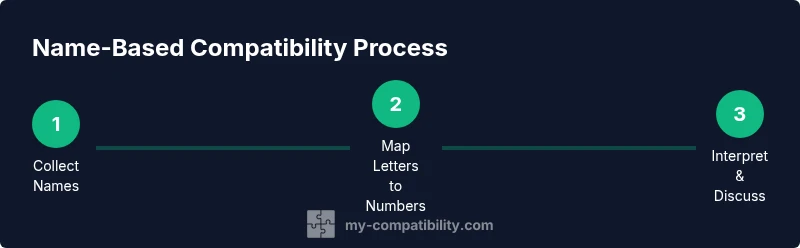
- 1
Collect names and consent
Gather both names to be analyzed and confirm explicit consent from the other person to engage in this exercise. Establish boundaries and agree that results are for discussion, not binding decisions.
Tip: Start with a light, curious tone and invite active participation from both people. - 2
Map letters to numbers
Using a standard numerology-style mapping, convert each name’s letters to numbers, then record the totals for each name on the worksheet. Be consistent with the mapping for both names.
Tip: Keep a copy of the mapping chart handy and double-check a few letters to avoid errors. - 3
Reduce totals and derive scores
Reduce each name’s total to a single-digit or a known pair, then create a name-energy pair score that you can compare. Note recurring digits or patterns across names.
Tip: Document both totals clearly and highlight any symmetry or contrasts. - 4
Cross-check with context
If you want an extra lens, compare the results with zodiac or personal narratives tied to the names. Use this as a supplementary perspective rather than a rule.
Tip: Respect cultural meaning and avoid stereotyping or overgeneralization. - 5
Interpret with a rubric
Apply a simple rubric (harmonized, neutral, or tension) to summarize the signals. Use this rubric to guide a calm, constructive discussion.
Tip: Keep the rubric flexible and invite input from your partner. - 6
Document results and plan next steps
Summarize the key takeaways in a shared note and schedule a follow-up conversation to revisit insights after real-life interactions.
Tip: Always close with mutual respect and clear, actionable communication goals.
Questions & Answers
Is name-based compatibility scientifically valid?
Name-based compatibility is not scientifically validated. It uses symbolism, numerology-inspired steps, and personal interpretation to prompt discussion. Treat the results as reflective prompts rather than predictive facts.
It's symbolic, not scientifically proven.
Which names should be analyzed?
Use the names both people prefer and consent to analyze. Avoid guessing or sharing others' names without permission.
Use both names with consent.
How long does the process take?
Typically 15-25 minutes, depending on how detailed you want the worksheet and discussion to be.
About 15 to 25 minutes.
Can name insights replace other compatibility measures?
No. They should augment conversations about shared values, communication, and respect rather than replace them.
Not a replacement; use as a supplementary signal.
What should I do if results conflict with reality?
Discuss openly and calmly. If concerns persist, consider broader relationship guidance or counseling as needed.
Turn results into a constructive discussion.
How can I keep this process respectful?
Always seek consent, avoid coercion, and keep results private unless both parties agree to share.
Respect privacy and boundaries.
Watch Video
Highlights
- Name signals are interpretive, not predictive.
- Use three approaches for a balanced view.
- Obtain consent before analyzing or sharing results.
- Pair name insights with real-life relationship traits.
- Keep expectations respectful and curious.