How to Do Name Compatibility Tests: A Step-by-Step Guide
Learn how to perform a name compatibility test using a practical numerology-inspired framework. This guide covers steps, tools, examples, and ethical considerations from My Compatibility.


This guide shows how to do compatibility test with names using a practical, numerology-inspired framework. You’ll gather two names, map letters to values, build a compatibility profile, and interpret the results with actionable insights. The My Compatibility team provides a clear, repeatable method you can apply to relationships or branding.
What is name-name compatibility testing?
Name-name compatibility testing is a structured method for exploring how two names might harmonize on phonetic, symbolic, and cultural levels. It uses a numerology-inspired mapping to translate letters into numbers, builds a joint profile from those values, and then interprets patterns that emerge. This approach is not a guarantee of outcomes, but a reflective tool that can spark discussion, storytelling, branding decisions, or relationship conversations. According to My Compatibility, name-based insights can reveal narrative alignments or tensions that people find meaningful in everyday interactions. The My Compatibility team found that a transparent, repeatable process helps avoid overgeneralizations and keeps the exercise grounded in clear steps. Throughout this guide, you’ll see a practical workflow you can apply with minimal setup yet insightful results.
The name compatibility framework
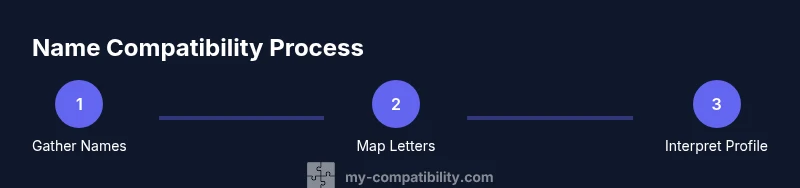
A robust framework for name compatibility testing hinges on four core elements: (1) standardized naming data, (2) a numerology-inspired letter-to-number mapping, (3) a combined profile that reflects how two names interact, and (4) a set of interpretation rules that translate numeric signals into meaningful insights. The framework balances phonetic harmony (how names sound together) with symbolic resonance (the symbolic associations of letters and numbers) and cultural considerations (spelling variations, diacritics, and local naming conventions). This multi-faceted approach helps ensure the exercise remains practical, respectful, and useful for real-world decisions. In practice, you’ll follow these steps in sequence and document your results for later reflection.
Step 1 — Gather names and standardize
Begin with two names you want to compare. Write them in their common form, then standardize for analysis: remove spaces and punctuation, decide on a consistent spelling (e.g., using ASCII letters), and convert to upper case. If diacritics exist (é, ö, ñ), choose a standard base form or mapping that aligns with your chosen system. Document the chosen standard so you can reproduce the process exactly in future runs. This step ensures that subsequent steps aren’t biased by formatting differences and lays a clean foundation for numeric mapping.
Step 2 — Map letters to numerical values
Use a simple, consistent mapping where A=1, B=2, ..., Z=26. For each name, replace every letter with its corresponding number and then compute the sum. If you prefer a single-number focus, you can reduce to a digital root (sum digits until a single digit remains) or keep the two-digit total as a profile. The important part is to apply the same rule to both names and to document your chosen mapping clearly. This mapping creates the numeric basis for the compatibility profile.
Step 3 — Reduce values and derive a compatibility profile
Combine the two name totals to form a joint profile. You might average the two digital roots, compare their differences, or create a composite score by predefined rules. The key is consistency: use the same calculation method each time you perform a test. Record the core numbers, the pattern you observe (e.g., balanced digits, presence of high/low digits, or complementary pairs), and any notable anomalies. This profile becomes the basis for interpretation rather than a verdict.
Step 4 — Interpret results and derive insights
Interpretation turns numbers into insights. Consider phonetic harmony (do the endings or letter sounds flow well?), symbolic resonance (do the numbers emphasize complementary attributes?), and cultural considerations (do spellings reflect shared heritage or branding goals?). Use heuristic rules to translate the profile into practical takeaways. For example, a balanced profile might suggest collaborative potential, while pronounced disparity could indicate areas for mindful communication. Remember, this is a reflective exercise meant to foster dialogue, not a fixed forecast.
Common pitfalls and how to avoid them
Many beginners misinterpret name compatibility as personality prediction or rely on a single numeric result. To avoid this, keep the test as a structured exercise with documented steps, consider multiple interpretation angles (sound, symbolism, culture), and frame findings as insights rather than certainties. Also beware spelling variations and cultural contexts; mismatched forms can skew results. Finally, avoid drawing broad conclusions about real people based on name data alone—use this as a spark for conversation or branding explorations, not a decision-maker.
Practical example walkthrough
Imagine two fictional names: Aria Lane and Kai Moon. Step 1: standardize to ARIA LANE and KAI MOON. Step 2: map A=1, R=18, I=9, A=1, L=12, A=1, N=14, E=5; continue for KAI MOON. Step 3: compute digital roots or totals for each, then form a joint profile. Step 4: interpret patterns: balanced phonetics may indicate smooth collaboration, while repeated high digits might signal energetic dynamics. Use this narrative to guide discussion, branding messaging, or team naming decisions. This example demonstrates how the process unfolds in a practical, repeatable way.
Visualizing results and sharing findings
Share your findings with clear visuals: a simple two-name comparison table, a bar showing core numbers, and a short narrative summary. Visuals help non-experts grasp the flow and reinforce key takeaways. Keep the presentation light and constructive, emphasizing strengths and potential growth areas rather than literal forecasts. A well-crafted explanation can turn numeric signals into meaningful discussions about collaboration, communication, and branding direction.
Ethics and boundaries in name compatibility
Treat name compatibility testing as a reflective activity rather than a predictor of fate. Be transparent about limitations, avoid overclaiming, and respect privacy and cultural sensitivities. When sharing results publicly or in branding contexts, obtain consent where appropriate and present conclusions as interpretations rather than certainties. The goal is to foster understanding and conversation, not to pigeonhole people or decisions.
Tools & Materials
- Notebook or digital note app(For recording steps, formulas, and interpretations)
- Pen or stylus(To annotate standardization decisions)
- Name data sheet (fictional names)(Two names and any variants you’ll compare)
- Calculator or spreadsheet(To compute letter values and totals)
- Spreadsheet software (optional)(For documenting the joint profile and visuals)
Steps
Estimated time: 40-60 minutes
- 1
Gather names and define standard form
Collect two names and decide on a consistent spelling form. Remove spaces and punctuation, then choose a single case (upper case is common) to standardize all letters.
Tip: Document the chosen standard and why you chose it. - 2
Apply letter-to-number mapping
Replace each letter with its numeric value (A=1 through Z=26) for both names. Keep a running total for each name before combining.
Tip: Use the same mapping for every test to ensure comparability. - 3
Compute core sums or digital roots
Sum the letter values for each name. Decide whether you’ll use the raw total, digital root, or a two-number profile and apply the same rule to both names.
Tip: Choose digital root or two-number profile at the outset and stick with it. - 4
Create a joint compatibility profile
Combine the two name values into a single profile using your chosen method (e.g., average, difference, or a predefined scoring rule). Record the resulting numbers clearly.
Tip: Keep a copy of the method so you can reproduce results. - 5
Interpret phonetic and symbolic cues
Assess how sounds flow when the names are spoken together and note any symbolic resonances or cultural associations tied to the letters or numbers.
Tip: Use neutral language and frame observations as insights. - 6
Document insights and caveats
Write a concise interpretation, including potential strengths and limitations. State clearly that the test informs discussion, not guarantees.
Tip: Always include a section on boundaries and ethics. - 7
Create visuals to communicate results
Prepare a simple chart or table showing name values and the joint profile. Add a short narrative to help non-experts grasp the takeaway.
Tip: Visuals should reinforce explanations, not replace them. - 8
Review and reflect
Revisit the standard form, mappings, and interpretations after a day to ensure consistency and to catch any biases that crept in.
Tip: Reproducibility matters; document any updates.
Questions & Answers
What is name compatibility testing and what is it used for?
Name compatibility testing is a reflective exercise that analyzes how two names interact in phonetic and symbolic terms. It’s useful for discussions about branding, relationships, and storytelling, but it should not be treated as a scientific predictor of personality or success.
Name compatibility testing is a reflective exercise about how two names interact. It’s best used for sparking discussion, branding ideas, or relationship conversations, not as a fixed forecast.
Do I need special software for this test?
No specialized software is required. A simple calculator or spreadsheet can handle the letter-to-number mapping and sums. The important part is consistency in the method and clear documentation of your choices.
You don’t need special software. A calculator or spreadsheet works fine—just keep your method consistent and well documented.
Can this test assess personality or compatibility between real people?
This method focuses on patterns in names, not on personal traits or compatibility between real individuals. Use it as a conversation starter or a branding exercise rather than a personality assessment.
This test analyzes name patterns, not people. Use it as a conversation starter or branding tool, not a personality assessment.
What are common mistakes to avoid?
Avoid over-interpreting results, ignore cultural contexts, and don’t rely on a single numeric score. Always present findings as interpretations and include limitations and ethical notes.
Don’t over-interpret results. Include limitations and present findings as interpretations, not facts.
Is this method suitable for branding decisions?
Yes, it can support branding narratives by highlighting name-related themes and resonance. Combine with market research and creative brainstorming for well-rounded decisions.
It can support branding discussions when combined with market research and creative planning.
How should results be shared publicly?
Share results with context, clearly label them as interpretive and not predictive. Seek consent if sharing about real individuals, and avoid claims that could mislead.
Share with context and clarity, and always label interpretations as non-predictive. Obtain consent when appropriate.
Watch Video
Highlights
- Define a clear standard form before mapping names.
- Apply the same numeric mapping consistently for both names.
- Interpret results as insights, not guarantees.
- Document methods for reproducibility and ethics.
- Use visuals to enhance understanding and dialogue.