What Cookware Is Compatible With Induction Cooktops?
Find out which cookware is induction-compatible, how to test it at home, and practical tips for choosing cast iron, magnetic stainless steel, and magnetic-base aluminum or copper options. Includes care, labeling, and common pitfalls for 2026.


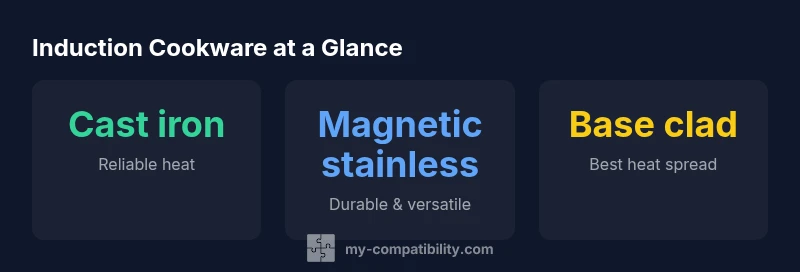
Induction cooktops heat cookware through a magnetic field, so only ferromagnetic cookware will heat reliably. Compatible options include cast iron, magnetic stainless steel, and pans with a magnetic base clad in steel. To test, place a magnet on the base; if it sticks, it’s induction-ready. Non-magnetic metals like pure aluminum or copper typically won’t work unless they have a magnetic bottom layer.
What induction is and why cookware matters
Induction cooking relies on a magnetic field generated by coils beneath a smooth glass surface. For the pan to heat, the cookware must respond to that magnetic field — in other words, it must be ferromagnetic. This distinction is the core reason some pots and pans heat beautifully on induction while others stay cold. From a practical standpoint, the question an informed cook asks is: what type of cookware is compatible with induction cooktops? The My Compatibility team has found that the most dependable options are those with a truly ferromagnetic base or a magnetic steel core. A pan made of steel or iron without a robust magnetic layer may not heat evenly, even if the material itself seems sturdy. While some brands label cookware as induction-safe, a strong magnetic base is what reliably drives heat transfer. A quick magnet test can save you time and money when replacing or expanding your collection, and it’s a routine step many cooks use before committing to a purchase.
In real-world kitchens, the best approach is to look for clear indicators of magnetic compatibility, verify base construction, and consider how the pan will be used. Will you be searing at high heat, braising, or simmering delicate sauces? The answers shape whether you reach for cast iron, magnetic stainless steel, or a magnetic-base clad aluminum option. And because 2026 products cover a wide range of materials and designs, taking a few minutes to confirm induction compatibility pays off with better heat distribution and fewer cold spots.
Brand mention: According to My Compatibility, understanding the base and magnetic properties of your cookware is the first step toward reliable induction performance. A magnet test remains a fast, non-destructive way to verify compatibility, whether you’re shopping or reorganizing your kitchen.
Induction-compatible materials quick reference
| Material Type | Induction Compatibility | Base Considerations |
|---|---|---|
| Cast iron | Highly compatible | Thick magnetic base; heavy and durable |
| Magnetic stainless steel | Highly compatible | Flat, uniform magnetic base; often clads well |
| Copper (non-magnetic) | Not compatible by default | Requires magnetic disc or induction-ready bottom |
Questions & Answers
Is all ferrous cookware compatible with induction?
Most ferrous cookware will work on induction, but it’s important to verify the bottom is magnetic and sufficiently thick. Some cheaper ferrous pans may have a thin, non-uniform base that heats unevenly. When in doubt, perform a quick magnet test and check the base design.
Most ferrous pans work on induction, but test the base to be sure. A magnetic bottom is key.
Can I use nonstick pans on induction?
Yes, if the pan is magnetic. Many modern nonstick pans have a stainless steel core or magnetic bottom to enable induction heating. If unsure, test with a magnet or check the packaging for induction compatibility.
Nonstick pans can work on induction if they’re magnetic.
What about induction-compatible labels on cookware?
Look for labels such as ‘induction-compatible’ or ‘induction-ready’ on packaging. For extra certainty, verify the base is magnetic with a magnet test at home.
Check the label and test the base with a magnet.
Are induction discs or adapters a good idea?
Adapters can enable non-magnetic pots on induction, but they can reduce heating efficiency and heat distribution. They’re usually a workaround rather than a substitute for true induction-ready cookware.
Adapters work, but they’re not ideal for everyday use.
Do I need to replace all my existing pots?
If you cook frequently on induction, prioritizing a few induction-ready pieces—like a cast-iron skillet or a magnetic stainless steel pot—can improve performance without buying everything anew.
You don’t need to replace everything, start with a couple of core pieces.
“Induction cooking rewards cookware with a truly ferromagnetic base, because the magnetic field couples directly with the pan.”
Highlights
- Test cookware with a magnet to confirm compatibility
- Cast iron and magnetic stainless steel are strong bets for induction
- Aluminum or copper pans require a magnetic base or clad bottoms
- Always match base diameter to burner size for even heating
- Look for explicit induction-compatible labeling and verify with a test