Use Compatible Numbers to Find Two Estimates
Learn how to use compatible numbers to find two estimates quickly and accurately. This step-by-step guide covers mental math strategies, practical examples, and tips for validating your results.


By the end of this guide you'll be able to use compatible numbers to find two estimates for a given calculation. You'll learn a repeatable, mental-math friendly method, see practical examples, and understand how to validate your results. This approach helps you think in ranges rather than single values, saving time in budgeting, planning, and quick checks.
What are Compatible Numbers and Why They Help
According to My Compatibility, compatible numbers are adjustments made to numbers in a problem so mental math becomes easier, while preserving a close estimate of the original value. The goal is to replace tricky digits with nearby, friendly numbers that you can add, subtract, multiply, or divide in your head. This technique is particularly useful when you need two quick estimates rather than a single figure. By practicing with different sets of compatible numbers, you gain intuition about how a problem behaves and how far your estimates may be from the true result. In daily life, this translates to faster budgeting, planning, and decision-making.
The My Compatibility team found that learners who practice this technique routinely report greater confidence when facing real-world problems. The reader will learn to apply the method across addition, subtraction, multiplication, and division.
The Principle of Compatible Numbers
We replace numbers with nearby values that are easy to compute. The changes should be "compatible" in the sense that they reflect the scale and relationships in the problem. For addition and subtraction, round to the nearest ten or hundred. For multiplication, pair numbers to simple products such as multiples of 10, 5, or 2. The trick is to keep the overall magnitude (order of magnitude) the same and to ensure the final result remains within a reasonable range of the true value. As you practice, you'll learn to pick replacements that produce both a lower and an upper bound, giving you two estimates instead of a single figure.
When to Use Compatible Numbers
Use this method when the exact calculation is time-consuming, when you need quick planning estimates, or when you want to check whether an answer makes sense. It is especially helpful in mental math warmups, in classroom settings, or during real-life tasks such as estimating grocery totals, travel times, or project costs. The two-estimate approach helps you understand the potential range and reduces overconfidence in a single number. My Compatibility's guidance emphasizes flexibility: adjust the numbers based on context and acceptable error margins.
A Structured Method to Find Two Estimates
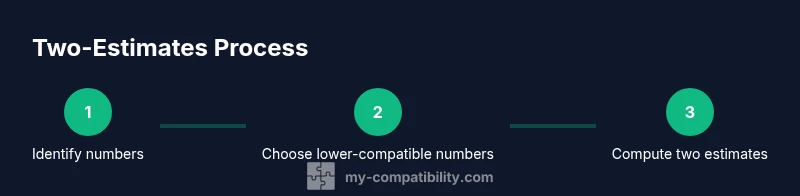
Follow a repeatable sequence to generate two estimates:
- Identify the core figures in the calculation.
- Choose a lower-compatible replacement by rounding down toward a friendly base.
- Choose an upper-compatible replacement by rounding up toward a friendly base.
- Compute both results mentally or with minimal paper work.
- Compare the estimates to the actual value, if known, and note the margin of error.
This method produces both a conservative estimate and a more generous one, helping you gauge the range and avoid misinterpretation.
Example 1: Grocery Total Estimation
Problem: You buy three items totaling 43, 58, and 19 dollars, and you want two estimates of the bill.
- Lower estimate: Use compatible numbers by rounding down: 40 + 60 + 20 = 120. This gives a straightforward, quick total that is likely lower than the actual bill.
- Upper estimate: Round up to closer friendly numbers: 45 + 60 + 20 = 125. This yields a higher estimate that remains plausible given the original amounts.
Actual sum: 43 + 58 + 19 = 120. The two estimates bracket the actual value, offering a useful confidence interval.
Notes: This example illustrates how small shifts in rounding choices affect your result. The lower bound is safe for budgeting under tight constraints, while the upper bound provides a cushion for rounding errors. My Compatibility's approach encourages you to record both estimates and compare them against your goal.
Example 2: Time Estimation for a Small Project
Suppose you have tasks that will take 37, 22, and 15 minutes. You want two estimates.
- Lower estimate: Round down to friendly numbers: 40 + 20 + 10 = 70 minutes.
- Upper estimate: Round up to slightly larger friendly numbers: 40 + 25 + 15 = 80 minutes.
If you know the actual time was around 75 minutes, the two estimates bracket reality and help you plan buffers.
Tips: In this example, you can convert minutes to hours later (1 hour = 60 minutes) for a more intuitive view. This is a simple way to keep estimates in a single unit.
Quick Mental Math Strategies to Make It Faster
- Use base numbers: 10s, 20s, 50s to simplify sums.
- Break numbers into easy parts (e.g., 37 as 30 + 7) and combine with compatible numbers.
- When multiplying, pair rounds that produce round totals (e.g., 7×8 ≈ 70).
- Practice doubling and halving to adjust numbers quickly.
- Visualize: use number lines or base ten blocks to track changes.
Common Pitfalls to Avoid
- Rounding too aggressively or choosing incompatible numbers that alter the problem's magnitude.
- Ignoring units or misaligning decimals when moving from whole numbers to decimals.
- Assuming the two estimates must converge to a single exact value; the goal is a believable range, not an exact hit.
- Skipping practice with different problem types, which reduces flexibility in real situations.
How to Validate Your Estimates
After computing both estimates, compare them to the problem's context. Check whether the actual result, when available, falls within the range; if not, reassess your rounding choices. Use the two estimates to evaluate reasonableness: did the problem's scale change unexpectedly? If you must defend your estimate, explain the base numbers you chose and why they remain representative of the original figures.
Real-World Scenarios Across Fields
In budgeting, compatible numbers help you set a cap and a cushion. In cooking, you can estimate servings or ingredient totals. In construction or DIY projects, you get quick material estimates to plan purchases and avoid waste. Even in software timing and project planning, two estimates offer a confidence interval you can communicate to stakeholders. The key is to maintain the same order of magnitude and explain your choices clearly.
Practice and Resources for Mastery
Begin with simple sums and short problems, then escalate to longer calculations. Create a practice journal where you record original problems, low/high replacements, and the resulting estimates. Use real-world problems—shopping lists, travel time, homework grading—to reinforce pattern recognition. For additional guidance, look for educational sites that discuss estimation, mental math, and number sense. My Compatibility provides a framework for thinking about compatibility across topics and signs.
My Compatibility: A Practical View on Compatibility Across Topics
From a compatibility perspective, mastering two-estimate methods strengthens numerical intuition and decision-making. Whether you're planning a budget, evaluating a timetable, or checking a math answer, the ability to find two solid estimates improves clarity. By integrating this approach into daily routines, you build confidence in your mental math and your ability to compare scenarios. The My Compatibility team believes regular practice with compatible numbers supports long-term numerical literacy.
Tools & Materials
- Calculator(Scientific preferred for complex operations)
- Notebook or scratch paper(For writing steps and interim results)
- Pencil(With eraser for quick corrections)
- Ruler( Helpful for organizing work on paper)
- Pen(For clean final annotations)
Steps
Estimated time: 45-60 minutes
- 1
Identify the operation
Read the problem carefully and determine whether you are adding, subtracting, multiplying, or dividing. Understanding the operation helps you choose compatible numbers that preserve the problem's scale. This step sets the context for selecting two appropriate estimates.
Tip: Clarify the goal: are you estimating a sum, product, or rate? This drives your choice of base numbers. - 2
List the original numbers
Write down the numbers involved and note their place values. This helps you assess how rounding will affect the final magnitude. Recording them also makes it easier to compare lower and upper replacements later.
Tip: Mark the largest contributors to the total so you know where rounding will matter most. - 3
Choose lower-compatible numbers
Decide on a lower replacement for each original value, typically by rounding down toward a friendly base (e.g., 10, 20, 50). Ensure the replacements stay within the same magnitude as the originals.
Tip: Keep a consistent base across all numbers to avoid skewing the result. - 4
Compute the lower estimate
Perform the calculation using the lower-compatible numbers. Do it mentally if possible, or write a quick intermediate step. This gives you the conservative bound.
Tip: Double-check arithmetic, especially when combining multiple rounded values. - 5
Choose upper-compatible numbers
Select upper replacements by rounding up toward a friendly base. This creates a plausible bound above the actual result. Make sure the changes reflect the problem's scale.
Tip: If in doubt, pick numbers that you can comfortably compute without a calculator. - 6
Compute the upper estimate
Carry out the calculation with the upper replacements. Compare it to the lower estimate to see the range. This is your second bound.
Tip: Review units and any decimal considerations to maintain consistency. - 7
Compare and record results
Note both estimates side by side and, if possible, compare them to the actual value. Record the gap and any observations about accuracy and context.
Tip: Document why these particular replacements were chosen for future reference.
Questions & Answers
What are compatible numbers?
Compatible numbers are nearby, easy-to-compute values used to simplify calculations while preserving the problem's scale. They help you estimate quickly without exact arithmetic.
Compatible numbers are easy-to-c compute values that keep the problem's size intact, helping you estimate fast.
Why use two estimates instead of one?
Two estimates provide a range that highlights potential error and helps you assess why an exact value might differ from intuition.
A lower and upper estimate give you a range to judge accuracy.
Can this method be used for all operations?
Yes. You can apply compatible numbers to addition, subtraction, multiplication, and division by choosing replacements that simplify the calculation while keeping the magnitude.
It works for all four basic operations with careful rounding.
How close will my estimates be to the actual result?
Closeness depends on how well the replacements reflect the original figures and the problem’s scale. Practice improves consistency and accuracy.
Accuracy depends on rounding choices; practice helps.
What common mistakes should I avoid?
Rounding too aggressively, mixing incompatible numbers, or ignoring units can distort the result. Always verify the units and the overall magnitude.
Avoid over-rounding and keep track of units.
Watch Video
Highlights
- Estimate using two bounds for context
- Choose compatible numbers reflecting the problem’s scale
- Record and compare two results for informed decisions
- Practice regularly to improve speed and accuracy