How to Solve Compatible Numbers: A Step-by-Step Guide
Learn how to solve compatible numbers with a clear, step-by-step method. Use friendly nearby values to simplify mental math, improve speed, and verify results across addition, subtraction, and multiplication.


Learn how to solve compatible numbers by replacing difficult values with nearby friendly ones, then adjust the result. This step-by-step approach speeds up mental math and keeps accuracy for addition, subtraction, and multiplication. Use estimation first, then refine with the exact adjustments to arrive at the correct answer.
What are compatible numbers and when to use them
Compatible numbers are nearby values that are easy to compute mentally, often rounded to the nearest ten or hundred or chosen to form a simple base for the operation. The idea is to temporarily rewrite a problem using these friendly numbers, perform the calculation quickly, and then compensate for the changes you made. This technique is especially useful for estimation and quick checks in everyday math, homework, and testing situations. When you ask how to solve compatible numbers, you’re seeking mental math shortcuts that preserve accuracy while boosting speed. According to My Compatibility, adopting this approach helps learners build confidence and fluency with arithmetic. The core principle is simple: replace hard numbers with easy substitutes, perform the math, then undo the substitutions to get the exact result. This workflow applies to addition, subtraction, multiplication, and even division in many practical contexts. By practicing, you’ll recognize patterns and choose friendly numbers more instinctively, turning complex problems into a sequence of simple steps that feel almost effortless.
Core techniques for solving with compatible numbers
There are several reliable strategies to employ when using compatible numbers. The first is rounding to a nearby ten or hundred to create base numbers that are obviously easy to add or subtract. The second is choosing complementary adjustments that cancel each other out or that keep the overall change predictable. The third technique is reverse adjustment: after calculating with the friendly numbers, add or subtract the total adjustments you made to land on the correct answer. Finally, always perform a quick verification by estimating the result or using a reverse operation to check consistency. When you learn how to solve compatible numbers, you’ll notice that most problems become a matter of identifying a friendly base and applying a small, trackable correction. Practice with varied scenarios to improve speed and accuracy across operations.
Mental math tricks and examples
Mental math thrives on pattern recognition. Try these samples to see the method in action:
- Addition example: 47 + 68. Round to 50 + 70 = 120. The total adjustment is +3 and +2 = +5, so subtract 5 to get 115. This confirms the exact sum without long column work.
- Subtraction example: 132 − 59. Round to 130 − 60 = 70. You’ve subtracted 2 too much, so add 1 to correct the result to 73. Practicing this helps you gauge how far off your estimate is and refine quickly.
- Multiplication example: 24 × 7. Round to 25 × 7 = 175, then subtract 1 × 7 = 7 to correct for the extra 1 in 25. The result is 168, which matches the exact product. These tricks emphasize keeping track of adjustments to preserve accuracy.
- Mental check: For multiplication by tens, use distributive property with friendly numbers, like 46 × 8 ≈ (40 + 6) × 8 = 320 + 48 = 368. Quick recalculation confirms the feasibility of the shortcut.
Step-by-step practice problem: basic addition
Let’s walk through a complete example to solidify the process. Solve 57 + 68 using compatible numbers.
- Identify friendly targets: choose 60 + 70 for easy rounding.
- Compute with friendly numbers: 60 + 70 = 130.
- Track adjustments: you added +3 to the first addend and +2 to the second, totaling +5.
- Correct the result: 130 − 5 = 125.
- Verify quickly: estimate 60 + 70 = 130, actual sum is 125, difference is 5, which is reasonable given the adjustments.
- Conclude with confidence: the exact sum is 125, confirmed by reverse adjustments.
Common pitfalls and how to avoid them
When using compatible numbers, it’s easy to overcorrect or forget to reverse adjustments. Always write down the changes you made and keep a running total of adjustments. Avoid rounding in a way that changes the problem’s structure (e.g., altering signs unexpectedly). Don’t rely solely on brute-force mental math; combine rounding with structured reverse checks for reliability.
Building your own compatible-number practice set
Tools & Materials
- Notebook or digital notes(For recording steps and adjustments during practice)
- Pencil or stylus(To write and erase adjustments as you work)
- Timer(Optional for timed practice to build speed)
- Practice worksheets(Varied problems to apply techniques)
- Calculator (optional)(Use only for verification, not required for mental rounds)
- Reference sheet(Quick guides on round numbers and distributive property)
Steps
Estimated time: 15-20 minutes
- 1
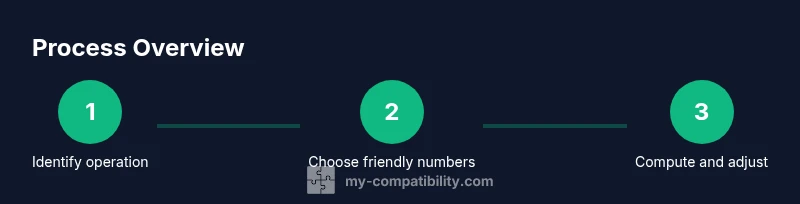
Identify target operation and goal
Read the problem carefully and decide what operation is involved (addition, subtraction, multiplication). Ask yourself: is the goal a rough estimate or exact value? This sets the direction for choosing compatible numbers.
Tip: Clarify whether you’re aiming for speed or precision before you start. - 2
Choose friendly nearby numbers
Select numbers that are easy to compute mentally, typically by rounding to the nearest ten or hundred or choosing complements that balance out. The core idea is to simplify the arithmetic while keeping track of the changes you make.
Tip: Prefer round-up or round-down pairs that make the base operation straightforward. - 3
Compute with the friendly numbers
Perform the calculation using the chosen friendly numbers. In addition/subtraction, add or subtract the rounded values; in multiplication, use distributive reasoning if helpful.
Tip: Keep the base calculation simple; avoid overcomplicating the base step. - 4
Account for adjustments
Sum all adjustments you introduced when replacing original numbers with friendly ones. This total tells you how far the initial result must be corrected.
Tip: Keep a running tally of changes to avoid missing any adjustment. - 5
Reverse the adjustments to get the final answer
Apply the opposite of your total adjustments to the base result to obtain the final answer. This is the key step that preserves accuracy.
Tip: Double-check by re-running the adjustments in reverse. - 6
Verify with a quick check
Estimate the result independently or use a reverse operation to confirm consistency. If there’s a mismatch, re-examine steps for missed adjustments.
Tip: A fast check prevents small errors from becoming big mistakes.
Questions & Answers
What are compatible numbers and why are they useful?
Compatible numbers are nearby values that make arithmetic easier to perform mentally. They are useful because they let you estimate quickly, check work more reliably, and build mental math fluency. The technique emphasizes speed without sacrificing accuracy when used with proper adjustments.
Compatible numbers are nearby, easier values that help you estimate and check quickly, improving mental math accuracy.
When should I use compatible numbers instead of exact calculation?
Use compatible numbers when you need a quick estimate, when time is limited, or when you want a sanity check on a more complex calculation. They’re especially helpful in day-to-day math tasks and tests that expect rapid reasoning.
Use them for quick estimates or sanity checks when you’re short on time.
Can compatible numbers be used for subtraction and division as well?
Yes. For subtraction, adjust both numbers to friendly values and reverse the changes. For division, approximate by friendly multiples or rounding the divisor to a nearby base, then adjust the quotient accordingly.
Yes, the idea works for subtraction and division with careful tracking of adjustments.
How do I verify that my final answer is correct?
Use a quick mental check by estimating the result using friendlier numbers, or reverse the adjustments to see if you land on the initial problem’s result. If the quick check agrees, you’re likely correct.
Estimate again with friendly numbers or reverse the steps to confirm.
What mistakes are common when using compatible numbers?
Common errors include forgetting to reverse adjustments, adding adjustments twice, or choosing friendly numbers that change the operation’s nature (e.g., changing signs). Always document adjustments and verify with a secondary check.
Be careful with adjustments and always verify with a second check.
Watch Video
Highlights
- Learn to replace hard numbers with friendly nearby values
- Track all adjustments, then reverse them to get the exact result
- Use quick checks to verify accuracy and build confidence
- Apply these steps to addition, subtraction, and multiplication
- Practice with varied problems to improve speed and fluency