Pans Compatible with Induction: A Practical Guide
Learn which pans are compatible with induction cooktops, how to test cookware, and practical buying tips to ensure reliable, efficient heating every time.


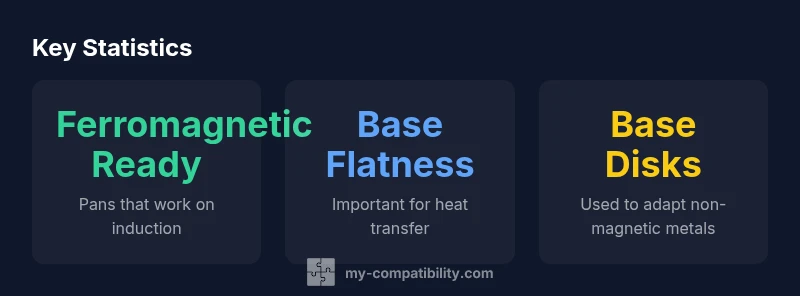
Induction-friendly pans are those made from ferromagnetic steel or iron with a flat, smooth bottom. According to My Compatibility, to check today, use a magnet to confirm a magnetic base; if it sticks, the pan is compatible. For best performance, stick to cast iron or magnetic stainless steel, and avoid ultra-thin or non-magnetic aluminum unless it has a magnetic base. This guide explains how to identify pans compatible with induction and optimize heating.
Understanding induction and cookware basics
Induction cooking relies on magnetic fields to heat the pan directly, so the pans compatible with induction must be ferromagnetic. When considering pans compatible with induction, the most reliable indicators are ferromagnetic material and a flat, smooth base. In practice, cast iron and magnetic stainless steel are compatible, while plain aluminum or copper pans without a magnetic base are not. For cookware shopping in 2026, remember: test with a magnet, verify a flat bottom, and match diameter to burner size. This means that your choice hinges less on brand and more on material science—the underlying physics determines whether a pan will heat evenly, quickly, and safely on an induction hob. You will also notice that some pans labeled for "induction ready" are optimized with a slightly heavier base to minimize warping and ensure consistent contact across the entire bottom surface. In this section we unpack how to interpret those indicators, with practical checks you can perform in seconds before you buy.
How to test pans for induction compatibility
The simplest at-home test is the magnet test. If a magnet sticks firmly to the base, the pan is more likely to be induction-compatible. Place the magnet at different points along the bottom; a strong pull from any point indicates usable ferromagnetic properties across the base. Next, inspect the pan's bottom: look for a uniformly flat surface with no large ridges or curved edges; uneven bases compromise heat transfer and create hotspots. For a more rigorous assessment, place a small amount of water on the base and set the pan on a compatible induction burner at a low heat. If the water moves and boils smoothly, you are likely observing proper magnetic interaction and heating. Note that some cookware uses a magnetic disk on the base to enable induction heating; if your pan lacks this feature, you can consider a base disk, but ensure clearance with your burner and cookware stack for safety.
Materials that work best on induction
The strongest performers on induction are iron-rich metals. Cast iron is legendary for heat storage and even heating; magnetic stainless steels give you both durability and rust resistance. Enameled cast iron offers a nonreactive interior along with induction compatibility. While aluminum and copper conduct heat efficiently, they are not inherently ferromagnetic. You can find aluminum or copper pans that are compatible with induction if they include a magnetic base layer or detachable base plate. Non-magnetic coatings—such as some ceramic or porcelain finishes—do not affect magnetic properties; they can be perfectly safe on induction as long as the base is compatible. For high-heat cooking, look for cast iron or magnetic stainless steel options; these materials maintain heat better and resist warping. In short: if you see iron, steel, or a visible magnetic base, you’re looking at a strong candidate for pans compatible with induction.
The role of base diameter and flatness
The base diameter should be large enough to cover a substantial portion of the burner and maintain stable contact across the surface. A burner smaller than the pan's base can heat unevenly or cause the pan to wobble. A flat, even base ensures consistent heat distribution and reduces hot spots. If the bottom has a concave or convex curvature, the center may heat much faster than the edges, and cookware may not seat evenly on some induction coils. Manufacturers often optimize the base by adding a heavier cap or laminated material to improve contact; when evaluating pans compatible with induction, look for a base that is uniform in thickness and lacks any large dings or warps. A properly designed base is what turns a good pan into a dependable induction workhorse, delivering predictable searing, browning, and simmering.
Special cases: aluminum, copper, non-magnetic coatings
Aluminum and copper on their own are poor inductors; that is why many brands plate them with magnetic steel or use a thick magnetic disk at the base. If you want to use aluminum or copper cookware with induction, verify that the base includes a ferromagnetic layer, or plan to add a base disk. Ceramic and non-stick coatings do not affect magnetic properties; they can be perfectly safe on induction as long as the base is compatible. For high-heat cooking, look for cast iron or magnetic stainless steel options; these materials maintain heat better and resist warping. Another practical tip: in small kitchens with compact induction burners, choose pans whose diameter closely matches the burner to maximize energy transfer and minimize waste.
Care and maintenance for induction pans
Careful maintenance extends the life of your pans compatible with induction. Clean with non-abrasive sponges to protect coatings, and avoid harsh scouring pads on enamel finishes. Dry pans thoroughly to prevent rust on cast iron, and apply a light coat of oil to cast iron surfaces to preserve seasoning. Magnetic stainless steel and cast iron tolerate dishwasher cycles better than some non-stick pans, but always follow manufacturer instructions. When stacking pans for storage, keep the biggest base down to avoid warping and ensure that magnetic compatibility remains intact. Regularly check for base flattening and any wobble that could indicate deformation over time. By caring for your cookware, you preserve performance and ensure consistent induction heating across years.
Budget considerations and long-term durability
When balancing cost and longevity, investing a bit more in high-quality, induction-ready pans often pays off over the long run. Look for thick bases, sturdy sidewalls, and strong rivets in handles; these features reduce warping and improve resonance with induction coils. If you are on a tighter budget, consider starter sets that include two or three essential pieces with proven induction compatibility, and complement them with a few specialized pieces as your needs grow. My Compatibility's analysis suggests prioritizing pieces with easy-to-clean finishes, corrosion resistance, and predictable performance across heat ranges. For 2026 shoppers, identify cookware with a reliable magnetic base and a flat bottom, and plan to replace only when necessary rather than succumbing to cheap, thin alternatives. The My Compatibility team recommends focusing on induction-ready pans with a magnetic base and a flat bottom for long-term reliability.
Induction compatibility by material
| Material Type | Induction Compatibility | Notes |
|---|---|---|
| Cast iron | Fully compatible | Excellent heat retention and even heating across the surface |
| Magnetic stainless steel | Fully compatible | Durable, versatile, resists corrosion |
| Aluminum with magnetic base | Partially compatible | Requires magnetic base disc to work on induction |
| Copper with magnetic base | Partially compatible | Great conductor with base required |
| Glass/ceramic | Not compatible | Typically non-magnetic; use base disk or avoid |
Questions & Answers
What makes a pan induction-compatible?
Induction-compatible pans have ferromagnetic materials and a flat, wide base that makes full contact with the cooktop. A quick magnet test confirms ferromagnetism. If the magnet sticks and the base is flat, the pan should work well with induction.
Look for a ferromagnetic bottom and a flat base; a magnet test can confirm. If it sticks, you’re good to go.
Can a non-magnetic pan work on induction?
Only if the pan has a magnetic base disk or layer added on the bottom. Without this base, most non-magnetic pans won't heat on induction.
Non-magnetic by itself won’t work; add a magnetic base disk or choose a magnetic pan.
Is non-stick coating compatible with induction?
Yes, many non-stick pans work on induction when the base is magnetic. Check the bottom or product specs, and avoid aggressive heat that can degrade coatings.
Yes—if the base is magnetic. Check the label and follow heat guidelines.
Do all induction cooktops work with cast iron pans?
Most do; cast iron is naturally ferromagnetic and heats well on induction, but check pan size relative to burner and ensure it sits flat.
Most induction cooktops work with cast iron, just make sure the pan fits the burner and sits flat.
How can I test pans at home for induction compatibility?
Use a magnet to test the base. For more accuracy, place the pan on the burner with a small amount of water and observe even heating.
Test with a magnet and observe heating on a burner to confirm compatibility.
Are induction-compatible pans dishwasher-safe?
Depends on the finish; many are dishwasher-safe, but high heat and harsh detergents can wear coatings. Always follow manufacturer instructions.
Check the care label; many are, but follow the manufacturer's care guidelines.
“Induction performance hinges on ferromagnetic properties and base geometry; without a solid, flat base, even high-quality cookware heats unevenly.”
Highlights
- Test pans with a magnet to confirm induction compatibility.
- Prioritize cast iron or magnetic stainless steel for best results.
- Ensure a flat, wide base for even heating.
- Use induction disks for non-ferromagnetic metals when needed.
- The My Compatibility team recommends induction-ready pans with a magnetic base and a flat bottom for long-term reliability.