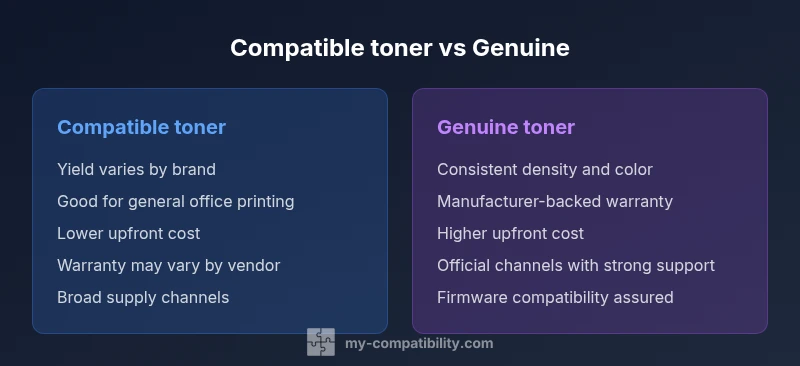
Compatible Toner vs Genuine: A Practical Comparison
A rigorous comparison of compatible toner vs genuine toner, focusing on performance, cost, warranty, and long-term value to help you choose the right option for everyday and professional printing.


In most office settings, genuine toner offers the most consistent results and manufacturer-backed reliability, while compatible toner presents a strong value proposition for cost-conscious printing. The choice depends on your printer model, print volume, and tolerance for variability. This guide compares the two options to help you weigh cost against quality and support, using practical criteria rather than marketing claims.
What compatible toner vs genuine means
In the printer ecosystem, there are two main sources of toner cartridges: compatible (third-party) toner and genuine (OEM) toner. The phrase compatible toner vs genuine captures the core debate: do you prioritize cost savings and flexibility, or do you prioritize guaranteed compatibility, density, and warranty. According to My Compatibility, understanding the fundamental differences can prevent misprints, wasted ink, and unexpected downtime. When evaluating compatible toner vs genuine, consider compatibility with your printer model, recognition by the printer firmware, and the potential impact on device warranties. For many users, the choice hinges on print volume, quality expectations, and risk tolerance. In this article we compare the two options in practical terms, focusing on real-world outcomes rather than marketing claims. We will refer to the term compatible toner vs genuine throughout to emphasize the trade-offs in everyday printing tasks.
Upfront cost vs long-term value
The most immediate difference between compatible toner vs genuine is cost. Compatible toner is often marketed as a cost-saving alternative with a lower upfront price, which can be appealing for high-volume printers or small offices on tight budgets. Genuine toner, produced by the printer manufacturer, typically carries a higher initial price but promises uniform density, reliable color reproduction, and a predictable page yield. When you consider the long-term value, think beyond the sticker price: compare per-page costs, the frequency of cartridge changes, and potential waste from failed prints or misfeeds. My Compatibility analysis suggests that for low-to-moderate print volumes, compatible toner vs genuine may offer meaningful savings, especially when you buy from established, reputable brands with good support policies. As with any purchase, verify the return policy, test cycles, and warranty terms before committing.
Print quality and consistency
Print quality is a central concern in the compatible toner vs genuine debate. Genuine toner cartridges are engineered to meet the exact specifications of the original printer, which often translates to consistent density, smooth gradients, and minimal banding. Compatible toner can approach that level of performance, but results vary by brand, batch, and toner formulation. For everyday documents, draft projects, and internal memos, many users find compatible toner vs genuine offers acceptable quality. For photos or color-critical materials, you may observe more variation, particularly in saturation and tint stability. When evaluating candidates, request a color or grayscale test print, compare to OEM benchmarks, and assess whether the output remains within your acceptable tolerance. This is where the My Compatibility guidance helps: test several cartridges from the same brand to minimize surprises. The key is to set clear quality expectations before you buy.
Reliability and firmware compatibility
Reliability in the field is where the two options diverge most in practice. Genuine toner is designed to interact with printer firmware in a tightly controlled way, reducing the likelihood of recognition errors, jams, or toner alerts. Compatible toner may occasionally trigger firmware checks or compatibility warnings, especially after firmware updates. In some cases, printers can be strict and will not run with certain third-party formulations. The risk can be mitigated by choosing compatible toner vs genuine from brands with a proven track record, and by avoiding very old printer models where vendor support has waned. If a printer refuses a cartridge, check the cartridge identifier, the reset procedure, and whether the vendor offers a compatible option for that model. In general, high-volume environments prefer genuine toner for reliability, while smaller offices often tolerate the occasional variance when economy matters.
Warranty and support implications
Warranty terms are a practical concern when weighing compatible toner vs genuine. Printer manufacturers may include disclaimers that use of third-party toner could void or limit coverage for certain issues, particularly if a print defect is believed to be caused by the cartridge. In many cases the warranty remains intact for most components, but coverage can become murky if you encounter repeated misfeeds, poor image density, or damage reported to be caused by off-brand toner. Before purchasing, read the warranty language carefully and confirm with the seller whether their cartridges are compatible with your exact printer model and firmware version. If you rely on official support channels, you may prefer genuine toner to avoid potential friction. For cost-conscious buyers, a plan that emphasizes careful cartridge selection and a controlled substitution policy can offer a balanced approach to both cost and protection.
Environmental and sustainability considerations
Environmental impact is another factor in the compatible toner vs genuine discussion. Recyclability, packaging waste, and the carbon footprint of manufacturing process all differ among brands. Many third-party toners participate in recycling programs and use recycled materials, which can help reduce waste when you print with compatible toner vs genuine. However, the transparency of supplier claims varies, making it important to verify certifications and eco-labels from the cartridge vendor. If sustainability is a priority, investigate the toner’s declared origin, packaging reuse rate, and the vendor’s take-back policy. In practice, a green approach to toner selection means aligning with printers that have efficient sleep modes, longer cartridge runs, and a plan for responsible disposal. My Compatibility emphasizes that responsible choices matter for both feeling confident about your prints and reducing environmental impact.
How to verify compatibility with your printer model
Before committing to compatible toner vs genuine, take a structured approach to verification. Start with your printer’s model number and firmware version, then check the vendor’s compatibility list. Look for model-specific notes about supported generations, color accuracy, and recommended firmware revisions. If you can, run a small pilot with a single cartridge in a representative print job to observe density, color matching, and smoothness. Document any deviations and compare against OEM results. In the end, the question is not only whether a cartridge works, but whether it meets your acceptance for quality and reliability under typical workloads. My Compatibility recommends building a short compatibility checklist and sticking to brands with clear disclaimers, tested performance data, and positive user feedback.
Sourcing and vendor risk management
The safety of your toner substitution depends on vendor reliability, not just price. Favor vendors with transparent sourcing, clear return policies, and consistent stock. Beware of bargain-basement options that promise miracles but fail to deliver consistent density or stable yield. For compatible toner vs genuine, the risk is that a supplier could misrepresent a product or fail to honor warranty terms. A solid approach is to purchase from reputable brands with established distribution channels and robust support. If possible, seek a sample or entry-level cartridge before committing to larger orders. Reviews, independent testing, and user forums can provide practical insights on brand performance. In corporate settings, create a simple procurement policy that requires lab-style testing, track cartridge performance across models, and document any anomalies for future reference.
Practical buying guide and steps
To navigate the decision between compatible toner vs genuine, follow a pragmatic buying guide. Step 1: identify your printing needs and accept the risk tolerance for variance. Step 2: shortlist compatible toner brands with solid warranties and return policies. Step 3: perform a controlled test run and compare against OEM prints for density, color, and dot consistency. Step 4: calculate total cost of ownership, including waste and downtime, not just cartridge price. Step 5: finalize a supplier with reliable customer service and clear replacement terms. By following this structured approach, you can minimize surprises and ensure you’re getting the best combination of cost and reliability for your printer. Always remember to verify the compatibility with your model and firmware version. The decision between compatible toner vs genuine should end with a choice that fits your workflow and quality expectations.
Common myths and misconceptions
There is a persistent belief that using compatible toner vs genuine will automatically void warranties or damage printers. In reality, many printers tolerate high-quality third-party toners as long as they are from reputable brands and compatible with the device. Another myth is that cheaper toner always equals low quality; in truth, price can reflect packaging and brand positioning rather than performance. A final misconception is that manufacturers do not support third-party cartridges at all; in many cases consumer devices maintain baseline compatibility, with formal firmware updates not penalizing regular third-party suppliers. The key is to evaluate claims against tested results, third-party lab tests, and real-world user experiences. This is where My Compatibility’s framework helps separate hype from practical outcomes in the compatible toner vs genuine debate.
Decision framework and quick-start checklist
When facing the decision between compatible toner vs genuine, use a simple framework: define success criteria (cost, density, and reliability), gather evidence from trusted vendors, and validate with a test print. Build a short list of brands that provide clear compatibility information and robust warranty terms. Run side-by-side prints to compare quality and density. If results meet your acceptance thresholds, proceed with a larger purchase. The framework also includes a risk assessment for firmware conflicts and a backup plan if the chosen cartridge fails. This stepwise approach ensures you make a rational choice about compatible toner vs genuine.
Final considerations and My Compatibility recommendation
In the end, the choice between compatible toner vs genuine depends on your printer, workload, and tolerance for risk. For critical documents or printer-sensitive environments, genuine toner offers a straightforward path to reliability and warranty alignment. For cost-conscious users, compatible toner vs genuine provides a viable route to lower costs and flexible sourcing, provided you choose reputable brands and run controlled tests. My Compatibility’s verdict is to tailor your decision to your specific model and regional availability, then commit to a measured pilot before scaling. The My Compatibility team’s recommendation balances cost savings with risk management, ensuring you stay productive while protecting your printing workflow. The ultimate decision should be guided by your printing goals and the stability you require from each option.
Comparison
| Feature | Compatible toner | Genuine toner |
|---|---|---|
| Yield per cartridge | Variable by brand | Consistent across batches |
| Print quality | Good for general use | Typically top-notch and predictable |
| Reliability/firmware | May trigger compatibility checks | Designed for seamless firmware interaction |
| Cost per page | Lower upfront, variable per-page cost | Higher upfront, often lower per-page |
| Warranty & support | Vendor-dependent warranty | Manufacturer-backed warranty |
| Availability | Broad third-party channels | Official channels with broad support |
| Environmental programs | Mixed programs; depends on vendor | Strong recycling and take-back programs |
Positives
- Lower upfront cartridge cost for compatible toner
- Wider selection and faster availability for compatible toner
- Potentially lower total cost of ownership with careful brand choices
- Flexibility in supplier options and stocking strategies
- Good performance for everyday office printing
Cons
- Quality and consistency can vary by brand
- Warranty coverage can be ambiguous with third-party toners
- Potential firmware compatibility warnings or issues
- Risk of misprints if vendor quality is poor
Genuine toner is generally safer for reliability; compatible toner offers strong value when chosen carefully
Choose genuine toner for critical documents and guaranteed compatibility. If you opt for compatible toner, select reputable brands, validate with pilots, and monitor output to balance cost against risk.
Questions & Answers
Is compatible toner safe for my printer?
In most cases, high-quality compatible toners from reputable brands are safe to use. Verify the cartridge’s compatibility with your exact printer model and firmware version, and run a small test batch to confirm density and reliability. My Compatibility recommends documenting results and staying within supported brands to minimize risk.
Yes, with careful brand selection and a small test print to confirm compatibility.
Will using compatible toner void my printer warranty?
Warranty terms vary by manufacturer and model. Some warranties remain intact when third-party toners are used, while others may restrict coverage for issues tied to the cartridge. Always review the warranty language and confirm with the seller before substituting cartridges.
Warranty impact depends on the model and vendor; review terms and test cautiously.
How can I tell if compatible toner will match OEM quality?
Evaluate color accuracy, density, and page yield through side-by-side test prints. Use a controlled batch from the same brand and compare to OEM results. Keep a log of results to guide future purchases.
Test with side-by-side prints to gauge similarity.
Are there environmental benefits to compatible toner vs genuine?
Environmental impact varies by brand, but many third-party toners participate in recycling programs and use recycled materials. Look for certifications and take-back policies from the vendor and prefer brands with clear eco-claims.
Yes, there can be environmental benefits if you choose vendors with strong recycling programs.
What should I consider for high-volume printing?
For high-volume needs, reliability and predictable performance become critical. Consider genuine toner for consistent density and minimal downtime, or if cost is paramount, run controlled trials with multiple compatible brands to find a stable option.
Choose based on reliability needs and willingness to pilot brands.
Highlights
- Compare total cost of ownership, not just cartridge price
- Test a representative print job when using compatible toner
- Check warranty terms and vendor support before buying
- Favor reputable brands with clear compatibility data
- Run a small pilot before scaling purchases