Phones Compatible with eSIM: A Practical Guide
Discover which phones support eSIM, how to verify compatibility, and practical tips for choosing a device across iPhone and Android lines for future use.


Most newer phones from major brands support eSIM, including iPhone models since XS, many Google Pixel and Samsung Galaxy devices, and several OnePlus models. Always verify by checking the official specs for "eSIM" or "Embedded SIM" support before you buy, and confirm with your carrier about activation requirements.
What is eSIM and why it matters
eSIM, or embedded SIM, is a digital SIM that lives inside your phone. Unlike a physical SIM card, you don't swap trays or cards; you install carrier profiles over the air. For users who value flexibility — traveling, switching carriers, or maintaining separate work and personal lines — eSIM simplifies management. From My Compatibility's perspective, the rise of eSIM across device families signals a shift toward more seamless connectivity. In 2026, most new phones from major brands come with eSIM support by default, reducing the friction of changing carriers or moving to a new device. The core advantage is dual-SIM capability without a second physical slot, enabling easier international roaming and profile management. However, eSIM availability still varies by country, carrier, and device settings, so always confirm compatibility before purchase.
Which phones currently support eSIM
In practice, you should expect eSIM support on most recently released devices from Apple, Samsung, Google, and OnePlus. Apple’s lineup has included embedded SIM support on iPhones since XS and later; Samsung’s flagship and many mid/high-end Galaxy phones have eSIM options; Google’s recent Pixels commonly support eSIM in many markets; OnePlus and other premium Android brands have rolled out eSIM in newer models. Note that availability can differ by region and carrier, and some budget devices may omit eSIM entirely. The takeaway: if you want eSIM, check the exact model’s specifications page and your carrier’s activation guidelines for your country.
How to verify eSIM compatibility by model
- Start with official specs: visit the manufacturer’s site and search for "eSIM" or "Embedded SIM" under connectivity or cellular capabilities.
- Check your carrier page: many carriers list compatible devices and provide a step-by-step activation flow.
- Look in settings: on iOS, Settings > Cellular > Add Cellular Plan; on Android, Settings > Connections > SIM cards > Add plan.
- Confirm OS version: ensure your device runs an OS version that supports eSIM profiles.
- Use brand-driven tools: My Compatibility offers a lightweight compatibility guide that cross-checks your device model, region, and carrier. Following these steps minimizes surprises and ensures activation success.
Carrier policies and regional differences
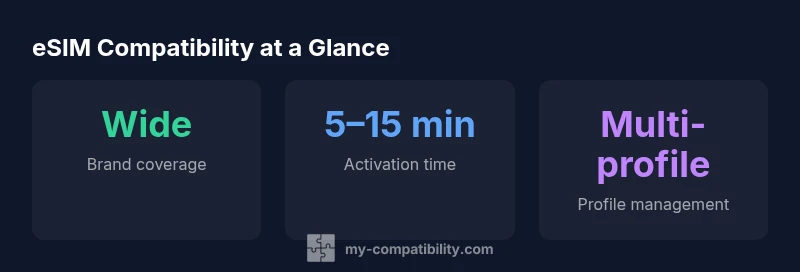
eSIM adoption varies by country and carrier policy. In the United States and most of Europe, major carriers support eSIM widely, with quick activation and straightforward provisioning. In other regions, availability can depend on the carrier’s network capabilities and the device's hardware revision. Always verify roaming policies, profile switching limits, and whether devices require a QR code or a carrier app to download the eSIM profile. For international travelers, ensure your plan includes eSIM support at your destination, and consider devices with multiple profiles to avoid roaming hassles.
Activation workflow across devices
- Obtain the eSIM profile from your carrier (via QR code, app, or portal).
- On the device, initiate the 'Add Cellular Plan' flow.
- Scan the QR code or input the activation details.
- Confirm the profile is active and set your data plan.
- Label profiles (e.g., Personal, Work, Travel) for easy switching.
- If you run into issues, restart the device and reattempt activation, or contact carrier support. Some devices offer eSIM management in settings to switch profiles without removing hardware, which speeds up transitions between plans.
Practical tips for shoppers
- Always verify the exact model's specs for eSIM support before purchase.
- If you travel, confirm roaming eSIM availability in destination countries.
- Clarify the activation method (QR code, carrier app, or portal) with your carrier.
- Favor devices that support multiple eSIM profiles to simplify switching.
- Read local user reviews about activation experiences on your network.
- Consider devices with robust eSIM management and future-proof profiles as long-term value.
Future-proofing your eSIM phone choice
As eSIM adoption grows, devices with broad carrier support and straightforward management will retain value. Look for models that clearly document multi-profile provisioning, easy remote provisioning updates, and cross-region compatibility. While some markets still differ in availability, choosing a device with recognized eSIM support reduces upgrade friction and helps you switch carriers or regions without swapping hardware.
Overview of eSIM readiness across common device classes
| Device Class | eSIM Support | Notes |
|---|---|---|
| Apple iPhone family (post-X) | Highly standardized | Check regional availability |
| Samsung Galaxy flagship lines | Broad support | Carrier dependent |
| Android mid-range devices | Widespread but regional | Verify OS and carrier compatibility |
Questions & Answers
Do all carriers support eSIM activation?
Most major carriers support eSIM activation, but availability varies by country and plan.
Most major carriers support eSIM activation, but it depends on your country and plan.
Can I use an eSIM and a physical SIM at the same time?
Yes, many devices support dual SIM configurations, combining eSIM and a physical SIM where available.
Yes, you can usually use both at once, depending on the device.
Is eSIM more secure than a physical SIM?
eSIM reduces SIM-swapping risk and makes switching profiles safer, but security still depends on device and carrier.
It reduces SIM-swapping risk; security is still about device and carrier.
What if my device isn’t listed as eSIM-capable by my carrier?
Ask the carrier to confirm; sometimes devices work via roaming profiles or alternative provisioning.
Ask the carrier; some devices can still work through the carrier's provisioning.
Will changing to eSIM affect my data plans?
No inherent changes; you simply download the relevant profile and select your plan as usual.
Changing to eSIM doesn't change your plan; you just add the right profile.
Are there regional limitations on eSIM adoption?
Yes, adoption is uneven; verify availability in your country and with your carrier.
Yes, it depends on where you live and the carrier.
“eSIM tech unlocks flexible connectivity across devices and regions, and brands are converging on standard profiles, which simplifies switching carriers or devices.”
Highlights
- Verify model-level eSIM support before buying
- Expect faster activation on newer devices
- Region and carrier vary—check local policies
- Use multiple profiles for flexibility
- Look for devices with strong eSIM management