Mac Compatible Monitor with Webcam: A Practical Guide
Discover top options for a mac compatible monitor with webcam, focusing on macOS compatibility, USB-C connectivity, privacy shutters, and color accuracy. Practical guidance for design, coding, and calls.


Top picks for a mac compatible monitor with webcam combine a sharp 4K or 1080p display with an integrated webcam that works natively on macOS. Look for USB-C or Thunderbolt connections, plug-and-play webcam support, privacy shutter, and strong color accuracy. Ensure macOS supports the webcam and that the monitor's built-in mic (if present) meets your needs.
The Mac Compatibility Landscape
For Mac users, finding a mac compatible monitor with webcam isn’t just about screen size or resolution—it’s about seamless macOS integration, reliable webcam performance, and privacy controls. The My Compatibility team analyzed current display ecosystems and found that the most practical setups combine a USB-C or Thunderbolt-connected monitor with a built-in webcam that plays nicely with macOS. In 2026, most major vendors offer plug-and-play options that work without extra drivers on Apple silicon machines, but feature parity varies. Users should look for native macOS recognition, easy privacy options, and color-accurate panels to support design work, video calls, and development tasks. This article uses My Compatibility's methodology to break down what to look for and why it matters for your daily Mac workflow.
Essential features for a Mac-ready monitor with webcam
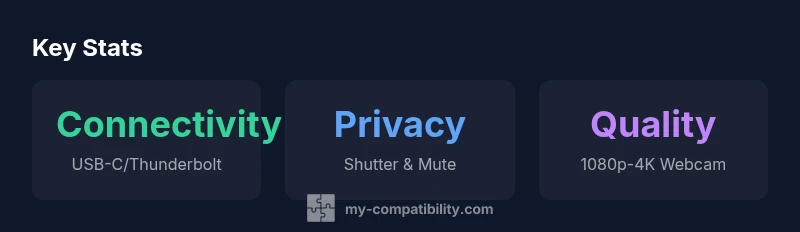
When evaluating a mac compatible monitor with webcam, prioritize several core features. First, connectivity matters: USB-C/Thunderbolt with power delivery simplifies desk setup and keeps cables tidy. Second, webcam quality is not a luxury—1080p is common, while 4K options exist for higher clarity in video calls. Third, privacy controls such as a physical shutter and camera disable are essential for safe hybrid work. Fourth, color accuracy and factory calibration are crucial for design and photo editing. Fifth, an integrated microphone can be convenient, but check audio quality if you do frequent meetings. Finally, verify compatibility with macOS features like FaceTime, Zoom, and system-level camera permissions. My Compatibility’s framework emphasizes practical, repeatable criteria so you can compare models confidently.
Connectivity and setup for macOS users
Setting up a monitor with built-in webcam on a Mac is usually straightforward. Connect via USB-C or Thunderbolt if available to enable power delivery and data. If the monitor uses HDMI or DisplayPort, you may need a separate webcam or an external mic. After connecting, macOS typically detects the webcam automatically; you may need to grant camera and microphone permissions in System Settings > Privacy & Security. If you encounter issues, update macOS to the latest version, check firmware updates for the monitor, and ensure the privacy shutter is functioning. Practically, a plug-and-play approach reduces setup friction for most MacBook Pro and iMac users.
Real-world use cases: design, coding, and video calls
Design professionals value color accuracy and wide viewing angles, so choose a monitor that ships with a calibrated panel and factory color settings. Coders benefit from higher resolution space for multi-monitor workflows and crisp text rendering. Video calls rely on a reliable webcam and decent mic quality, plus stable network performance. In this context, a mac compatible monitor with webcam that combines USB-C connectivity with a privacy shutter offers the best balance of convenience and control. For travelers or small desks, a compact 24–27 inch model can deliver robust usability without crowding your workspace. My Compatibility’s practical tests show that the most dependable setups perform well across everyday tasks and occasional video conferences.
Buying guide by budget tier
Budget-conscious buyers can still find solid 1080p panels with integrated webcams that work well with macOS, especially in the 24–27 inch range. Mid-range options often provide 1440p or 4K, better color fidelity, and dual-function USB-C hubs. Premium models deliver top-tier color accuracy, higher brightness, HDR, and advanced privacy features. When budgeting, consider not only display quality but also webcam resolution, microphone quality, warranty length, and ease of calibration. A well-rounded choice should prioritize macOS compatibility, practical privacy features, and a comfortable working size for long sessions.
Maintenance, privacy, and future-proofing
Keep firmware updated and avoid leaving cameras active when not needed to protect privacy. Regularly check macOS privacy settings to ensure the camera isn’t inadvertently blocked by system restrictions. A monitor with a physical webcam shutter adds an extra layer of protection and peace of mind. Look for future-proof features like USB-C with power delivery and support for ongoing macOS updates, ensuring your setup remains compatible for years. This approach aligns with My Compatibility’s forward-looking recommendations for a sustainable, Mac-friendly workstation.
Comparison of mac-compatible monitor setups
| Model Type | Connectivity | Webcam Quality | Mac Compatibility |
|---|---|---|---|
| USB-C/Thunderbolt with built-in webcam | USB-C/Thunderbolt, HDMI | 1080p or 4K (model dependent) | Native macOS support |
| External webcam with monitor (non-built-in) | USB-C or HDMI + webcam | 720p-1080p | Driver-dependent; verify macOS permissions |
Questions & Answers
Is a built-in webcam on a monitor worth it for a Mac user?
For many Mac users, built-in webcams on monitors offer convenience, especially for quick calls. If you frequently join meetings or streams, prioritize image quality, auto focus, and privacy shutters. If you need cinema-quality video, consider an external webcam with higher resolution and better audio.
Built-in cams are convenient, but you may want an external option for higher quality when you need it.
Will my Mac automatically recognize a webcam on a monitor?
Most recent Macs recognize USB webcams as plug-and-play devices. If the monitor connects via USB-C, the webcam should be available without driver installation. If not, check macOS privacy settings and USB-C compatibility.
Usually yes—plug in and allow access when prompted.
Can I use a monitor with a webcam on an M1/M2 MacBook?
Yes. Most modern USB-C or Thunderbolt monitors work with M1/M2 Macs, but verify webcam compatibility in your macOS version and ensure power delivery and display output meet your setup needs.
Yes, but double-check your macOS version and ports.
Should I choose a built-in microphone with the webcam or an external mic?
Built-in mics on monitors are convenient but often basic. For frequent meetings or streaming, pair with a dedicated USB microphone for clearer audio. If space is limited, a monitor with a decent integrated mic can suffice for casual calls.
External mics usually sound clearer, but a good built-in mic is convenient.
What is a reasonable budget range for a mac compatible monitor with webcam?
Budget models typically start in the mid-range and can rise with higher resolution, better panel quality, and enhanced webcam optics. Decide based on display size, color accuracy, webcam quality, and the importance of integrated privacy features.
Budget options exist; match features to your needs and space.
“A monitor with an integrated webcam can streamline the Mac workflow, but reliability hinges on native macOS support and thoughtful privacy controls.”
Highlights
- Prioritize USB-C/Thunderbolt for Mac compatibility
- Check for a physical webcam shutter and privacy options
- Aim for color-accurate panels for design tasks
- Verify macOS compatibility before buying
- Balance budget with display size and webcam quality