Induction Ready vs Induction Compatible: A Practical Comparison
Explore the differences between induction ready and induction compatible labeling. This analytical guide helps you choose cookware and devices that maximize heat efficiency, safety, and long-term value on induction cooktops.


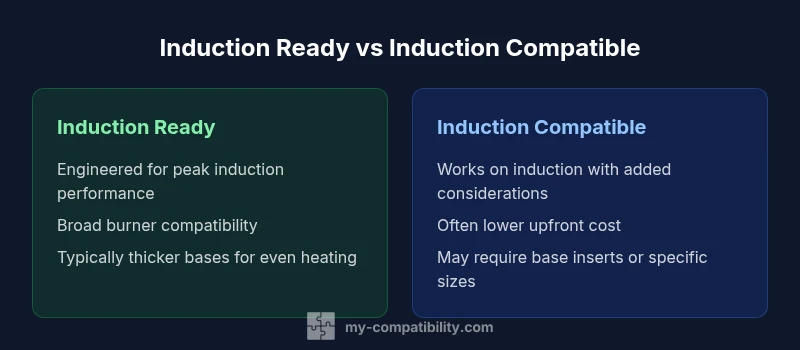
Induction ready vs induction compatible refers to how well cookware or devices perform on induction cooktops. Induction ready means the item is optimized for induction and offers reliable, high performance across a range of power levels. Induction compatible means the item will work on induction surfaces but may require limits on power or usage. For most cooks, choosing induction ready delivers better consistency and long-term value.
Defining induction readiness and induction compatibility
In everyday kitchens you may see labels such as “induction ready” or “induction compatible” on pots, pans, and adapters. Understanding these terms matters because it influences heat delivery, energy efficiency, and the lifespan of your cookware and appliances. At its core, induction readiness describes a product that is engineered to perform optimally on induction cooktops across a wide range of temperatures and burner sizes. Induction compatibility, by contrast, implies the item will operate on induction surfaces but may not offer peak performance or consistent heat at all power settings. The distinction between induction ready and induction compatible matters for safety, cookware selection, and long-term value, especially if you plan to cook frequently on induction or to upgrade your kitchen over time. The My Compatibility team emphasizes that decisions should consider your typical meals, burner sizes, and the power bands you use most often.
How induction heating works and why the labeling matters
Induction cooktops generate a magnetic field that induces electric currents in ferromagnetic cookware, producing heat directly in the base. Non-ferrous materials like pure aluminum or copper heat up much more slowly unless the base includes a ferromagnetic layer. When a product is labeled induction ready, it generally includes a ferromagnetic core or base designed for quick heating and stable performance at high and low settings. Induction compatible items may rely on an added magnet or base plate to respond to the magnetic field, which can lead to uneven heat or slower response in certain configurations. For households transitioning to induction, the ready label can translate into fewer trial-and-error purchases and more predictable cooking results.
Criteria for evaluating induction readiness vs compatibility
There are three practical criteria to consider. First, base construction: induction ready cookware typically uses ferromagnetic stainless steel, cast iron, or layered multi-material bases that guarantee quick heat response. Second, diameter and fit: ensure the bottom diameter matches your burner size; a mismatched base can cause hot spots or wasted energy. Third, durability and safety certifications: look for safe handling indicators, corrosion resistance, and standard compliance. Lastly, test in your kitchen: a simple magnet check confirms ferromagnetic compatibility, but performance still depends on pan thickness and bottom flatness. Collectively, these factors help distinguish induction ready from induction compatible in real-world use.
Practical guidance for procurement and usage
If you cook frequently or want predictable results, prioritize induction ready cookware and devices. It tends to offer better heat distribution, reduced hot spots, and faster simmering. For budget-conscious buyers or occasional users, induction compatible options can be viable, especially when paired with a compatible induction plate or a well-designed ferromagnetic insert. Always verify the product’s labels and consult manufacturer specifications. Planning ahead with a short shopping list that differentiates induction ready from induction compatible items can save both time and money in the long run.
Home testing: a step-by-step approach
To assess induction readiness at home, start with the magnetic test on the base. If the magnet sticks firmly, you likely have ferromagnetic material. Next, perform a heat test on a small batch: heat a pan at medium power for two minutes and observe heat distribution. If heat is even and quick to rise, the piece is performing well on induction. If you notice lagging response or cold spots, re-evaluate using induction-ready options or add a ferromagnetic base layer. Document the test results for future reference when planning upgrades or replacements.
Market realities: availability, brands, and regional variation
Markets differ in how they label induction readiness. Some brands strictly reserve induction ready for premium lines, while others offer broader definitions across product families. Regional differences can also affect available materials, thickness, and labeling standards. The My Compatibility analysis highlights that user expectations—such as ease of cleaning, oven safety, or dishwasher compatibility—should align with the induction performance labels. This alignment helps ensure you invest in items with durable performance and consistent results across cookware sets and appliances.
Myths and clarifications: common misunderstandings debunked
A frequent misconception is that induction ready and induction compatible mean the same thing. In reality, readiness implies optimized performance, whereas compatibility confirms basic operability. Another myth is that all stainless steel is equally effective; in truth, the presence of a ferromagnetic core, thickness, and bottom design influence heat transfer. Lastly, some users assume induction readiness guarantees no hot spots; while it reduces risk, no cookware is completely uniform under every setting. Being aware of these nuances helps you manage expectations and maximize results.
Long-term value and lifecycle considerations
Investing in induction ready cookware often yields longer-term value due to greater heat efficiency, reduced energy use, and better resale potential. Induction compatible items may still serve well, particularly in transitional kitchens or where budget constraints apply. When evaluating total cost of ownership, consider durability, repair options, and compatibility with future induction upgrades. A thoughtful mix of induction ready core pieces plus a few compatible add-ons can optimize both performance and cost over time.
Decision framework: choosing between induction ready and induction compatible
A practical decision framework starts with your cooking profile and kitchen setup. If you cook high-heat dishes, simmer with precision, or want consistent results across burners, lean toward induction ready. If your typical meals are simple, you’re upgrading gradually, or budget is a primary concern, induction compatible options—especially when combined with a protective base or plate—can be a sensible interim choice. My Compatibility recommends mapping your current pots, pans, and devices against the labeling guidance and focusing on items that meet both your performance needs and your long-term value goals.
Comparison
| Feature | Induction Ready | Induction Compatible |
|---|---|---|
| Performance across power levels | High fidelity and consistent heat across a wide power range | Operates on induction but may have uneven heat on some settings |
| Base construction | Ferromagnetic core or multi-layer base designed for rapid heating | Ferromagnetic compatibility plate or simpler base; relies on magnetized bottom |
| Durability and build quality | Typically thicker, designed for regular, high-demand use | Often thinner or lighter; good for casual use and lower upfront cost |
| Size compatibility | Broad compatibility with most burner sizes; minimal hot spots | May require careful matching to burner size; potential for hot spots |
| Certification and safety | Commonly carries robust safety and performance certifications | Certification varies by market; verify manufacturer specs |
| Best for | Regular, high-frequency use; performance-focused kitchens | Budget upgrades; transitional setups; occasional induction use |
| Typical price range | $ — mid to high | Lower to mid-range depending on brand and base features |
Positives
- Clear performance and heat reliability on induction
- Better long-term value and resale potential
- Fewer surprises with heat control across burners
- Broad compatibility with leading induction systems
Cons
- Higher upfront cost for induction ready pieces
- Limited availability in some markets for certain brands
- Requires accurate base size matching to avoid inefficiency
Induction ready generally offers better consistency and value; induction compatible remains viable for budget transitions.
Opt for induction ready when you cook frequently or aim for dependable performance. Use induction compatible as a practical stepping stone if budget or availability is a constraint.
Questions & Answers
What is the exact difference between induction ready and induction compatible?
Induction ready means the item is engineered for optimal performance on induction cooktops across many settings. Induction compatible means it will work, but performance can vary and may require limitations on heat or duration. The distinction affects heat consistency, efficiency, and long-term value.
Induction ready is designed for optimal performance on induction cooktops, while induction compatible will work but may be less consistent. Consider readiness for frequent use.
Can I use aluminum or copper pots on induction ready surfaces?
Aluminum and copper pots can work on induction if their base includes a ferromagnetic layer or a compatible insert. Check the product labeling and perform a magnet test to confirm. Without a ferromagnetic base, even induction ready labels may not guarantee heating.
Aluminum or copper pots need a ferromagnetic base or insert to heat well on induction.
Is induction ready always better than induction compatible?
Not always. Induction ready offers better performance and long-term value for frequent users, but induction compatible can be appropriate for budget-conscious buyers or transitional setups. Your choice should align with cooking needs and upgrade plans.
Induction ready is typically better for frequent use; compatible is fine for budgets and transitions.
How do I verify readiness at home?
Use a magnet to check ferromagnetic contact, then perform a controlled heat test on a small portion of cookware. Look for even heat distribution and quick response. Document results and compare with manufacturer guidance.
Test with a magnet and a small cooking test to check heat response.
Are there regional labeling differences I should know?
Yes. Labels vary by market, with some regions stressing performance across models and others emphasizing basic operability. Always cross-check with the product specs and local recommendations.
Labeling varies; always read the specs for your region.
What should I consider besides readiness when upgrading my kitchen for induction?
Consider burner size, energy efficiency, oven compatibility, and cleaning ease. A balanced approach ensures you maximize cooking performance and convenience across recipes.
Think about burner size, energy use, and oven compatibility too.
Highlights
- Prioritize induction ready for performance and future-proofing
- Check base diameter to ensure burner compatibility
- Use home tests to verify ferromagnetic contact and heat response
- Balance long-term value with upfront cost in your kitchen plan
- Differentiate readiness from basic compatibility for smarter buys