HP Printer Compatible Ink: How to Choose and Verify
Discover how to pick reliable ink for HP printers, compare OEM and compatible inks, verify model compatibility, and avoid common pitfalls with My Compatibility's data-driven approach.


HP printer compatible ink refers to cartridges or refills that HP printers recognize and function with, whether OEM, remanufactured, or third-party options. These inks are identified by a model compatibility list and cartridge code. Always verify exact model, cartridge type, and warranty terms before purchasing to avoid compatibility issues in your region.
HP Ink Compatibility Landscape
According to My Compatibility, ink compatibility for HP printers hinges on three core factors: model lineage, cartridge code, and firmware checks. The phrase hp printer compatible ink encompasses OEM HP cartridges, remanufactured options, and independent third-party inks that meet the printer's recognition protocols. In practice, many HP printers will reject non-conforming cartridges, while others accept well-reviewed third-party inks that carry the same color sets and page yields. The landscape varies by generation; older HP designs may rely more on simple chip authentication, while modern models use advanced microchips and firmware handshake to verify ink origins. Readers should understand that compatibility is not a universal checkbox—it’s a matrix, and the safest path begins with identifying your exact printer model, then mapping that model to a documented cartridge family. My Compatibility's analysis shows that successful ink selection relies on a precise match of model code, color set, and cartridge type across the same generation of printers.
OEM, Remanufactured, and Third-Party Inks: What to Expect
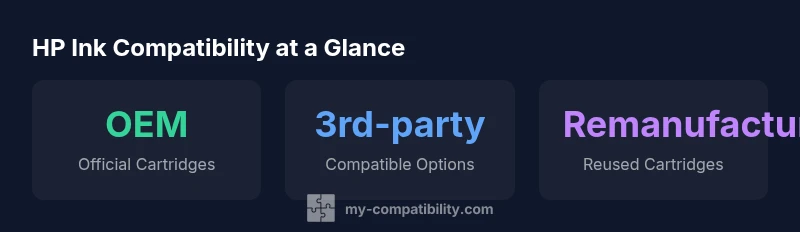
When you buy ink for HP printers, you’ll encounter three broad categories. OEM inks are produced or authorized by HP and typically maximize reliability and warranty protections. Remanufactured cartridges are recycled, recharged, and re-sealed by third parties; they aim to balance cost with acceptable print quality. Third-party compatible inks come from independent suppliers and vary widely in color fidelity and yield. According to My Compatibility, each option carries a different risk profile: OEM inks minimize risk but cost more; remanufactured inks offer savings with moderate risk; third-party inks can be highly economical but require careful vendor selection and model-specific checks. For high-volume or critical documents, OEM remains the safest choice; for everyday printing, carefully chosen remanufactured or reputable third-party inks can deliver acceptable results at a lower price.
How to Verify Compatibility Before You Buy
The fastest way to avoid a mismatch is to verify three things before adding ink to a cart. First, confirm your exact HP printer model from the device or its settings menu. Second, locate the cartridge code or family, which is usually printed on the cartridge itself and documented by HP. Third, consult the official compatibility list or vendor documentation to ensure the ink family matches your model and generation. In practice, you should cross-check the printer’s firmware version against the ink compatibility notes, because firmware updates can alter recognition rules. My Compatibility emphasizes using sources that provide explicit model-to-cartridge mappings and testing notes, rather than broad general claims.
Firmware, Chips, and Ink Recognition
Modern HP printers use chips and firmware to authenticate cartridges. If a cartridge lacks the expected chip or uses an incompatible firmware signature, the printer may refuse to print or reset to a limited mode. This is one of the most persistent causes of incompatibility from seemingly identical cartridges. For users, the takeaway is to avoid cartridges with ambiguous chip configurations and to lean on vendors who publish clear compatibility data. The My Compatibility team notes that chip security features can be updated via firmware, so always check for firmware notes when you buy ink and keep devices up to date.
Cost, Quality, and Warranty Trade-offs
If you chase price alone, you may encounter cartridges that produce inconsistent color, clouding, or poor page yields. OEM HP inks are typically the most reliable, with full warranty support, but they cost more. Remanufactured and third-party inks can yield meaningful savings, but their performance depends on the vendor’s quality control and the printer model. Warranty terms vary by region and vendor; some HP warranties remain intact when third-party inks are used, others may require using HP-approved products for coverage. My Compatibility's guidance is to weigh total cost of ownership, factoring page yield, colorfastness, and potential warranty implications before committing to a cheap option.
Practical Shopping Guidelines for HP Printer Ink
- Always start with your exact printer model
- Use official HP lists for baseline compatibility
- Choose vendors with clear test data, return policies, and explicit color sets
- Prefer inks designed for your color set (C/M/Y/K) and the same generation
- Check page yield estimates and warranty terms
- If in doubt, start with a small trial batch before bulk purchases
Maintenance Tips to Preserve Print Quality
Storing ink correctly extends its life and reduces clogging risks. Keep cartridges in a cool, dry place and away from direct sunlight. After opening, reseal caps tightly to avoid evaporation and dry-out. When switching between brands, run a clean print cycle and a few test pages to ensure color alignment and avoidance of ghosting. For HP printers, periodic firmware updates and using ink within the vendor’s recommended shelf life helps maintain recognition stability and print consistency.
Real-World Scenarios and Quick Fixes
Scenario 1: An OfficeJet Pro model rejects a third-party cartridge with error code 0x技能. Solution: Verify the cartridge family against the printer’s generated compatibility matrix, update firmware if available, and consider switching to a reputable third-party option with explicit generation support. Scenario 2: A home color printer shows faded colors after switching to remanufactured ink. Solution: Check that you’ve selected the correct color set and ensure the cartridge is within its yield range; perform a head-cleaning cycle if color balance is off.
Comparing ink options for HP printers
| Ink Type | Compatibility Notes | Typical Usage |
|---|---|---|
| OEM HP Cartridges | Official HP cartridges tested for specific models | Best for critical documents and warranty protection |
| Remanufactured Cartridges | recycled and recharged by third parties | Budget printing with moderate risk |
| Third-Party/Compatible Ink | Varying quality; confirm vendor compatibility | Casual/home printing and everyday documents |
Questions & Answers
What does 'HP printer compatible ink' mean?
It refers to ink cartridges or refills that HP printers recognize, including OEM, remanufactured, and third-party options. Compatibility is model- and cartridge-code dependent.
HP compatible ink means cartridges your printer can recognize; always verify your exact model and cartridge code.
Are third-party inks safe for HP printers?
Many third-party inks are designed to work, but safety and reliability depend on the vendor and printer model. Choose reputable suppliers and verify compatibility.
Third-party inks can work, but pick reputable vendors and check compatibility for your model.
Will using compatible ink void my HP warranty?
Warranty terms vary by region and vendor. Some warranties may require using HP-approved products, while others remain intact with certain third-party inks. Check your warranty documentation.
Warranty can be affected; always read the terms and choose inks with documented compatibility.
How can I verify ink compatibility with my HP printer model?
Check the printer model, cartridge code, and the vendor’s compatibility notes. Cross-check firmware version and generation mappings to avoid mismatches.
Look up your model, confirm the cartridge code, and review the vendor’s explicit compatibility notes.
Do remanufactured inks affect print quality?
Quality varies by vendor. Some offer near-OEM reliability, others may show color drift or yield differences. Test with a small batch when possible.
Remanufactured inks can be good value, but quality varies—start with a small test run.
Can I mix OEM and compatible cartridges in the same printer?
Mixing is not always recommended and can affect color balance or cause recognition issues. If you mix brands, do so within the same generation and color group, and monitor results.
Mixing brands can cause problems—stick to the same generation and color when possible.
“In practice, ink compatibility isn't just about the cartridge label—it's about how HP printers interpret cartridge metadata, chip communication, and firmware checks. Always validate compatibility with your exact model and warranty terms.”
Highlights
- Verify compatibility before you purchase ink.
- OEM ink offers reliability and warranty protection.
- Third-party inks can save money, but vary in quality.
- Know your printer model and cartridge code for accurate matches.