Original Ink Cartridges vs Compatible: A Practical Guide
A data-driven, balanced analysis of original ink cartridges versus compatible options, examining cost, quality, warranty, and long-term value for printers and everyday users.


Original ink cartridges vs compatible options hinge on guaranteed compatibility, print quality, and official support versus lower upfront costs and broader brand options. This comparison highlights where each choice excels and where risk factors may appear, helping you decide based on printer model, usage, and tolerance for variability.
What Are Original Ink Cartridges vs Compatible Ink Cartridges?
When evaluating the topic of original ink cartridges vs compatible, it helps to start with clear definitions. Original cartridges are manufactured by the printer maker and are designed to work with the printer’s firmware, color calibration, and security features. Compatible cartridges, typically produced by third-party vendors, aim to match the OEM’s performance at a lower price, but quality can vary by brand and batch. In the broader landscape described by My Compatibility, the market now includes reputable remanufactured and refilled options that can approach OEM results, alongside cheaper, lower-quality choices. The key distinction is not only price but also reliability, warranty coverage, and compatibility guarantees. This is especially important for multi-color printers and devices with firmware-based ink tracking. For readers seeking a concise frame, remember: the debate around original ink cartridges vs compatible mostly centers on consistency versus cost, with a tiered quality spectrum depending on supplier standards.
Cost, Value, and Long-Term Implications
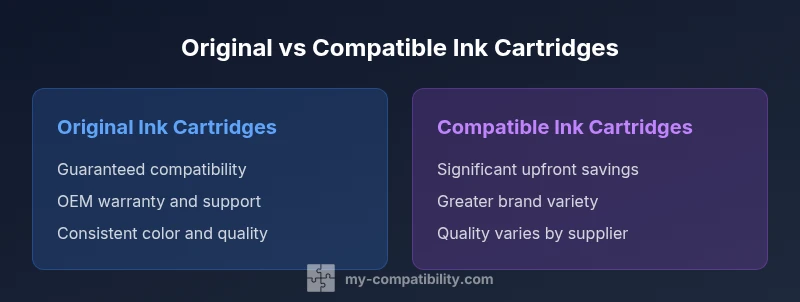
A central axis in the original ink cartridges vs compatible analysis is long-term value. Original cartridges come with predictable costs, a built-in warranty from the manufacturer, and ready access to official support channels. Compatible cartridges offer substantial upfront savings and a wider selection of brands, which can reduce expenses for high-volume users. However, price alone rarely tells the full story. Consider per-page costs, memory of color accuracy across loaded media, and the potential need for more frequent replacements if a batch performs inconsistently. My Compatibility’s framework emphasizes evaluating total cost of ownership over the printer’s lifespan, not just the sticker price at checkout.
Print Quality, Color Consistency, and Longevity
Whether you choose original ink cartridges vs compatible options, print quality and longevity are pivotal. OEM cartridges typically deliver consistent color reproduction, sharp text, and reliable saturation across pages, which matters for photos, presentations, and archival documents. Quality variants among compatibles can range widely—from near-OEM parity to noticeable color shifts or variability between batches. To minimize risk, select compatible brands with strong customer reviews, tested compatibility with your exact printer model, and clear quality guarantees. When print jobs demand high fidelity, originals remain the safer bet; for routine office tasks, high-quality compatibles can deliver satisfactory results at a lower total cost.
Printer Compatibility, Firmware, and Warranty Implications
Firmware and color management play a significant role in the original ink cartridges vs compatible debate. OEM cartridges are designed to interface perfectly with the printer’s firmware, reducing the chance of error codes and miscalibrations. Compatibles may work with many models but can trigger compatibility issues on newer firmware or after updates, leading to warnings or suboptimal color reproduction. Warranty implications vary by manufacturer and jurisdiction; some printers explicitly require OEM consumables for warranty protection, while others allow reputable third-party cartridges with no effect on warranty. Always verify your printer’s policy and test a small batch before committing to a full replacement run.
Availability, Sourcing, and Brand Variability
Availability is another critical factor in the original ink cartridges vs compatible discussion. Original cartridges are typically sold through official channels, ensuring consistent stock and genuine parts. Compatibles, by contrast, come from a broader ecosystem of brands and retailers, which can widen price competition but also increases risk of counterfeit or ill-fitting products. The quality spectrum among compatibles is broad—some brands provide robust performance and color accuracy, while others may underperform. The best approach is to research the supplier’s reputation, check model compatibility lists, and look for guarantees such as return policies and replacement options. In practice, you’ll often find that the right choice depends on your printer model, expected volume, and tolerance for potential reseating or reprints.
Environmental Impact, Recycling, and Sustainability
In the original ink cartridges vs compatible conversation, environmental considerations matter. OEM programs frequently emphasize take-back schemes and certified recycling, which can improve end-of-life outcomes. Compatible cartridges may also be remanufactured or recycled, but processes vary by brand and region. If sustainability is a priority, look for suppliers with transparent recycling programs, cartridge return incentives, and documented waste reduction metrics. For many users, choosing remanufactured or recycled options within a trusted brand can balance cost with environmental responsibility while maintaining reasonable print quality.
Real-World Scenarios: When to Favor Each Option
Understanding when to opt for original ink cartridges vs compatible ink cartridges is about risk tolerance and usage patterns. In high-stakes applications such as legal documents, marketing materials with color-critical images, or archival records, originals reduce the risk of color drift or performance issues. In cost-sensitive environments with standard text-heavy output, high-quality compatibles provide meaningful savings—especially when purchasing in bulk and selecting brands with strong warranties. For home use, the decision often hinges on print volume, color needs, and willingness to deal with occasional recalibration. My Compatibility’s guidance suggests evaluating your exact scenario before committing to a single path.
How to Vet a Compatible Brand: A Practical Checklist
If you’re leaning toward compatibles, use a rigorous checklist to select a brand you can trust. Verify printer model compatibility, read third-party reviews from independent sources, and confirm return and warranty terms. Check the cartridge’s chip and firmware compatibility, verify color accuracy with test pages, and ensure consistent feed performance. Keep a log of pages printed with new cartridges to monitor whether color shifts, banding, or other issues emerge over time. A careful, methodical approach minimizes risk and helps you realize the cost savings without sacrificing essential quality.
Purchasing, Stock Management, and a Final Thought
Finally, plan your purchase with a strategy that matches your printer’s needs and your workflow. Keep a small buffer of cartridges, especially if you rely on color-critical output. Maintain receipt records and test pages to monitor performance; document any issues promptly with the supplier. Whether you choose original ink cartridges vs compatible options or a mix for different job types, your goal should be reliable operation, predictable cost, and consistent results.
Comparison
| Feature | Original ink cartridges | Compatible ink cartridges |
|---|---|---|
| Cost considerations | Higher upfront cost | Lower upfront, variable long-term costs by brand |
| Print quality and color fidelity | Consistent OEM-grade results | Quality varies by brand; high-quality options exist |
| Printer compatibility | Guaranteed compatibility with printer firmware | Depends on brand; verify model compatibility |
| Warranty and support | Official warranty and service from manufacturer | Limited or no formal warranty; support depends on supplier |
| Availability and supply chain | Widely available from manufacturer channels | Broad but uneven supply for certain models |
| Environmental impact and recycling | Official recycling programs; better traceability | Varies by brand; depends on remanufacturing practices |
Positives
- Guaranteed compatibility with printers and firmware
- Official warranty and manufacturer support
- Predictable quality and color calibration
- Simplified returns and verified compatibility
Cons
- Typically higher upfront cost per cartridge
- Long-term per-page costs can be higher for low-volume users
- Limited flexibility if a model is discontinued by the manufacturer
Original cartridges are preferred for warranty and reliability; compatibles win on cost and choice when selected carefully
Choose original ink cartridges when warranty protection and consistent color accuracy matter most. Opt for high-quality compatibles if cost savings and variety are your top priorities, and you verify model compatibility and supplier reliability.
Questions & Answers
Are original ink cartridges required for printer warranties?
Warranty policies vary by manufacturer and region. Some printers require OEM consumables to maintain warranty coverage, while others allow reputable third-party cartridges without voiding the warranty. Always check the printer maker’s policy and the terms of any service agreement.
Warranty rules depend on the printer brand and region. Check the official policy before buying third-party cartridges.
Do compatible ink cartridges void printer warranties?
In many cases, using compatible cartridges does not automatically void the warranty, but some manufacturers reserve the right to limit coverage for issues related to third-party consumables. Review the warranty terms and retain proof of purchase and compatibility checks.
It depends on the warranty terms; verify with the manufacturer and keep receipts.
How can I assess print quality when trying a new brand?
Start with a standard test page that includes text, grayscale, and color images. Compare to a baseline print from original cartridges. Look for color accuracy, saturation, graininess, and any banding or misalignment across multiple pages.
Run a test page and compare color accuracy and consistency to your baseline.
What should I verify before purchasing a compatible cartridge?
Confirm model compatibility, check the supplier’s return policy, read third-party reviews, and ensure the cartridge includes a installed chip that interfaces with your printer. Consider a small trial run before stocking up.
Confirm model fit, read reviews, and test before buying in bulk.
Are there environmental benefits to using compatibles?
Remanufactured and recycled cartridge programs can reduce waste and conserve resources. Look for suppliers with transparent recycling credentials and take-back options to maximize environmental benefits.
Some compatible programs emphasize recycling and waste reduction.
Is the cost-per-page usually lower with originals?
Original cartridges typically have a higher upfront price, which often translates to a higher per-page cost. Compatible cartridges can offer competitive or lower per-page costs if you select reliable brands and print in typical volumes.
Prices per page vary; compatibles can be cheaper if chosen wisely.
Highlights
- Evaluate total cost of ownership, not just upfront price
- Test print quality when trying new brands
- Check printer warranty implications before switching
- Prioritize reputable compatible brands with clear guarantees
- Consider environmental programs when possible