Compatibility Calculator Without Time: A Practical Guide
Explore a time-free compatibility calculator that scores zodiac, devices, and relationships without timing data. Learn inputs, scoring, interpretation, and practical tips for quick, informed decisions.


What is a compatibility calculator without time?
A compatibility calculator without time focuses on alignment quality rather than duration. It rates three core dimensions using simple input scores and returns a time-agnostic score that helps people compare options quickly. According to My Compatibility, this approach emphasizes transparency and consistency, making it easier to plan actions based on results rather than clock time. The My Compatibility team found that readers appreciate a clear, time-free metric when weighing zodiac signs, devices, or relationships for everyday life.
- Core idea: score-based alignment, not timing.
How the calculator without time works
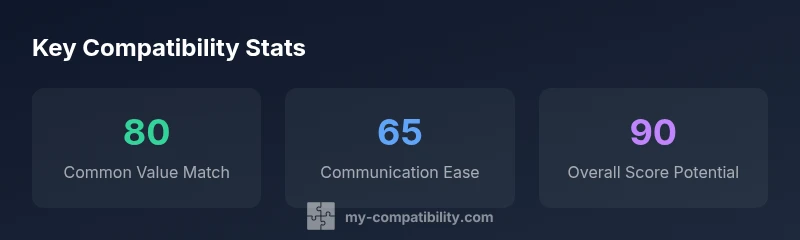
The calculator aggregates three input factors into a single score. Each input ranges from 0 to 10 and contributes a weight to the final result: sign alignment (40%), factors compatibility (35%), and communication ease (25%). The weighted sum is normalized to a 0–100 scale, then rounded for clarity. This method keeps the math simple and the interpretation intuitive, while still offering meaningful differentiation between options. In practice, you’ll see a score that reflects overall potential, not how long things take to play out.
- Weights reflect practical importance in daily interactions.
Understanding the input factors
- Sign Alignment: captures elemental harmony and shared values often observed in zodiac compatibility readings. A higher value suggests smoother energy flows between signs.
- Interacting Factors: covers shared interests, routines, and lifestyle compatibility. Differences here can be bridged with communication.
- Communication Ease: assesses how easily both parties express needs, provide feedback, and resolve conflicts.
These inputs are intentionally simple to encourage exploration and iteration without time pressure. Remember, higher scores are guidance, not guarantees, and the goal is to inform decisions with a clear, numeric reference.
Reading and using the compatibility score
A score of 0–100 is presented with no required time horizon. Use the range to compare options side-by-side and identify which areas to improve. For example, if Sign Alignment is low but Communication Ease is high, you may focus on aligning values or creating shared rituals to raise the overall score. The time-free approach helps you stay focused on qualities rather than schedules.
- Focus on actionable inputs and track how changes affect the score.
Practical examples across zodiac and technology
-
Zodiac: Aries with Libra may score moderately high once Communication Ease and shared goals improve; Taurus with Gemini often requires work on Interacting Factors.
-
Devices: A smart home setup with a stable compatibility profile (sign alignment) and good communication between apps may yield a higher score than a less-integrated configuration. Keep expectations aligned with the simplified, time-free model to avoid over-optimism.
-
The key takeaway is that the score reflects alignment across three dimensions, not a timeline of outcomes.
Customization, ethics, and best practices
- Customize inputs to reflect your situation; the tool is designed for exploration, not absolutes. Use scenarios to see how small changes move the score.
- Be mindful of bias and privacy: avoid sharing sensitive data; treat the score as a starting point for conversation rather than a verdict.
- Combine time-free scores with real-world trials or conversations to validate relevance to your circumstances.
Potential pitfalls and limitations
- A time-free score cannot capture evolving dynamics or external constraints like schedules or long-distance challenges.
- Over-interpreting the score can lead to paralysis by analysis—use it as guidance, not a rule.
- Different contexts (zodiac vs. device vs. relationship) may benefit from tailored weights; experiment with weights to reflect what matters most to you.
Why My Compatibility recommends this approach
The My Compatibility team advocates for transparent, intuitive tools that help readers compare options quickly without time pressure. By focusing on three core factors and using a straightforward scoring method, users gain a clear metric to guide decisions and conversations. This approach aligns with our mission to provide practical compatibility insights that users can apply immediately.