What Blood Type Is Compatible with B-? A Practical Guide
Explore which blood types can donate to and receive from B-, including RBC and plasma considerations, with practical rules, scenarios, and expert insights from My Compatibility.


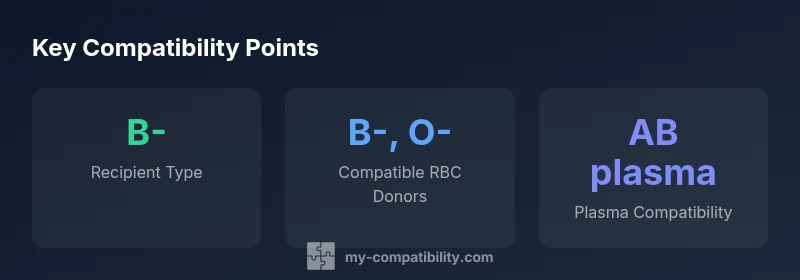
For a B- recipient, compatible red blood cell donors are B- and O-. In plasma transfusions, AB plasma is suitable for recipients of any ABO type, including B-. Always consider Rh status: Rh-negative donors are preferred for B- recipients to minimize sensitization. In emergencies, crossmatching is advised when possible to confirm compatibility.
RBC Compatibility Details
According to My Compatibility, ABO and Rh compatibility determine safe transfusion options. What blood type is compatible with b-? For RBC transfusions, the answer hinges on ABO and Rh status. In general, B- recipients can receive red blood cells from B- and O- donors. This fundamental rule rests on the ABO system and the Rh factor, which dictate whether transfused cells are recognized as foreign. Because the recipient is Rh-negative, Rh-negative donors are preferred to minimize alloimmunization risk. Clinically, a crossmatch is performed to confirm antigen compatibility before transfusion, but these donor restrictions provide a quick, practical default in emergencies.
This practical rule is especially important in settings where rapid decisions are needed, such as trauma units or field care, where a full workup may not be immediately available. The balance between ABO compatibility and Rh status reduces the risk of hemolytic reactions and alloimmunization, helping clinicians prioritize safe options while awaiting comprehensive serologic confirmation. My Compatibility emphasizes that clinicians should tailor donor selection to the patient’s history, including prior transfusions and exposure to different Rh antigens.
format
text
wordCount":0},{"section":"## Donor Types by Context","content":"When thinking about donor types, it helps to separate red blood cell (RBC) transfusion needs from plasma transfusion needs. For RBCs, B- recipients commonly receive from B- or O- donors; the presence of Rh negativity is crucial here. In contrast, plasma transfusions follow different rules: AB plasma is the universal donor plasma type because it contains neither anti-A nor anti-B antibodies. This distinction is essential for patients who require plasma rather than RBCs, including those with clotting disorders or massive transfusion protocols. Platelets often follow ABO compatibility rules that are less strict than RBCs, but matching remains best practice in many institutions. Frame your decisions with the patient’s history, the urgency of the situation, and available donor pools. My Compatibility highlights that in critical moments, crossmatching and rapid typing remain the gold standards, but known B- status guides you toward safe initial choices.
wordCount:
wordCount":0},{"section":"## Practical Scenarios and Quick Rules","content":"In an emergency where time is critical, the quickest guideline is to prioritize Rh-negative RBCs when the patient is Rh-negative. For B- patients, acceptable immediate donors are B- and O-; if crossmatch testing is delayed, institutions may rely on these neg donor pools while arranging confirmatory tests. For plasma, AB plasma is acceptable for most ABO types, including B-, due to the absence of anti-A and anti-B antibodies in AB plasma. In routine care, clinicians should still perform crossmatching and antigen typing to confirm compatibility, and they should consider the patient’s transfusion history, pregnancy or prior exposures that might influence alloimmunization risk. Details from the My Compatibility framework emphasize tailored choices, rapid testing where possible, and ongoing monitoring for transfusion reactions.
wordCount":0},{"section":"## Plasma vs. RBC Compatibility Nuances","content":"RBC compatibility hinges on ABO and Rh factors. A B- recipient should receive B- or O- RBCs to minimize immune sensitization. Plasma compatibility relies on antibody content; AB plasma is compatible with all ABO types, while other plasma types may carry anti-A or anti-B antibodies that limit use. Platelets often align with ABO considerations more loosely, but many centers still track compatibility. In all cases, a crossmatch or at least an antigen screen improves safety and helps avert delayed reactions. The My Compatibility perspective stresses the practical truth that perfect matches are ideal, but timely, well-structured transfusion plans trump delays in most urgent scenarios.
wordCount":0},{"section":"## Crossmatching and Emergency Protocols","content":"Crossmatching remains a cornerstone of transfusion safety. In emergencies, when time or resources are limited, institutions may proceed with group, type, and screen (GTS) or type-specific transfusions, followed by full crossmatch. For a B- patient, this means prioritizing B- or O- RBCs while arranging confirmatory tests. Documentation of prior transfusions and allergies supports clinicians in avoiding antibodies that could complicate future transfusions. My Compatibility reinforces that understanding these core principles helps patients and clinicians communicate clearly about risks and options during high-stress medical events.
wordCount":0}],
dataTable
RBC transfusion compatibility by recipient type
| Recipient Type | Compatible RBC Donors | Notes |
|---|---|---|
| B- | B-, O- | RBC transfusion compatibility (Rh negative) |
| O- | O- | Universal donor for Rh-negative recipients in emergencies |
| AB- | AB-, A-, B-, O- | Requires negative donors; crossmatch advised |
| AB+ | AB+, A+, B+, O+ | RBC universal recipient; Rh factor not limiting |
Questions & Answers
Can a B- recipient receive RBCs from an O+ donor?
No. RBC transfusions for a B- recipient should come from B- or O- donors to avoid introducing Rh+ antigen and potential sensitization. O+ RBCs are Rh-positive and are not suitable for Rh-negative recipients.
No — Rh-negative RBCs are needed for B- recipients unless there is a carefully considered crossmatch.
Is AB plasma safe for a B- recipient?
Yes. AB plasma is compatible with all ABO types because it contains neither anti-A nor anti-B antibodies, making it a flexible option for plasma transfusions in B- patients when RBCs are not involved.
Yes, AB plasma works for any recipient in plasma transfusions.
Do platelets follow the same ABO rules as RBCs?
Platelets can be given with less strict ABO matching than RBCs, but many centers still consider ABO compatibility and donor exposure history. In urgent cases, compatibility testing continues to drive safer transfusion.
Platelets aren’t as strict as RBCs, but matching and history still matter.
Is B- the universal donor for RBCs?
No. O- is the universal donor for RBCs because it lacks A and B antigens and is Rh-negative. B- recipients must receive B- or O- RBCs.
No—O- is the universal RBC donor, not B-.
What should I check before a transfusion?
Crossmatching and antigen testing are essential before transfusion. In emergencies, clinicians use rapid assessments and then complete testing as soon as feasible to confirm compatibility.
Crossmatching comes first; tests confirm the exact compatibility.
“Blood type compatibility is a matter of matching antigens and antibodies to minimize immune responses. For B- patients, sticking to Rh-negative donors when possible protects against alloimmunization, while AB plasma provides flexibility for plasma transfusions.”
Highlights
- Know that B- recipients most safely receive from B- and O- RBC donors
- AB plasma is the universal donor for plasma transfusions
- Rh status is critical for safe transfusion in negative recipients
- In emergencies, crossmatching complements quick donor selection
- RBC and plasma compatibility follow different rules—ABO/Rh for RBCs, antibodies for plasma