Compatible Blood Type Chart: Reading Blood Compatibility
Understand how a compatible blood type chart works, including ABO/Rh basics, crossmatching, and practical applications for transfusions, pregnancy, and emergency care.


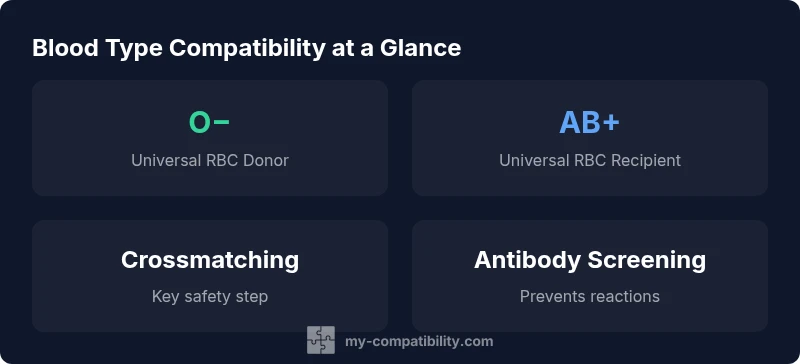
A compatible blood type chart maps which donor types can safely transfuse to which recipients based on ABO and Rh compatibility. In practice, this chart guides clinicians, but it relies on crossmatching and antibody screening for safety. For red blood cells, O− is the universal donor and AB+ is the universal recipient, though real-life decisions also depend on antibody profiles and urgency.
What a compatible blood type chart really shows
A compatible blood type chart is a quick reference that aligns donor and recipient blood groups based on ABO and Rh factors. It’s a foundational tool in transfusion medicine, but it does not replace crossmatching or antibody screening. The chart summarizes which donor types are typically safe for specific recipients and highlights where extra caution is needed. Clinicians interpret the chart in conjunction with patient history, urgent clinical needs, and laboratory assays. According to My Compatibility, understanding the chart helps healthcare teams communicate clearly during emergencies and routine transfusions alike, reducing the risk of incompatibility reactions while streamlining decision-making. A well-used chart also supports patient education, so individuals know what to expect when RBC transfusions are planned or needed.
ABO and Rh compatibility basics
ABO compatibility is about matching the blood type antigens between donor and recipient. The Rh factor (positive or negative) adds another layer of compatibility, particularly for pregnant patients and long-term transfusion planning. In general terms, RBC transfusions require a donor whose ABO type and Rh status align with the recipient’s. The universal donor concept (O−) and universal recipient concept (AB+) are simplified summaries; real practice uses precise crossmatching to confirm compatibility and to detect antibodies that could react with donor cells.
How crossmatching adds safety beyond the chart
Crossmatching is a laboratory test that compares the patient’s plasma with donor red blood cells to detect antibodies that could cause a transfusion reaction. There are different methods (serological crossmatch, computerized crossmatch), but the goal is the same: ensure that the donor cells will not be attacked by the recipient’s immune system. This step is crucial even when the chart suggests a compatible match, because antibodies not reflected in the chart can still cause adverse reactions. In emergencies, a rapid crossmatch is used alongside ABO/Rh checks to accelerate safe transfusion.
Practical uses in clinical settings: transfusion planning, emergencies, and surgery
Hospitals rely on compatible blood type charts during both planned and urgent procedures. For elective surgeries, teams pretype and screen patients and coordinate donor units that satisfy ABO/Rh requirements. In emergencies, the chart offers a rapid, high-level guide while the lab completes full crossmatching. Surgeons and anesthesiologists need to understand the chart’s limits and work with transfusion services to order appropriate units swiftly, minimizing risks and delays.
Special cases: pregnancy, antibodies, and rare phenotypes
Pregnant patients require careful attention to Rh status and potential antibodies that could affect the fetus. Antibody screening helps predict incompatibilities beyond ABO/Rh type. Rare phenotypes require specialized donor units; in those cases, clinicians rely on extended phenotyping and, if needed, matched donor registries. The chart remains a starting point, with laboratory testing refining the final compatibility assessment for maternal-fetal safety and neonatal outcomes.
Reading and interpreting your chart: what to ask clinicians
When you review a compatible blood type chart with medical staff, ask about antibody screening, crossmatching methods, and any special considerations for your medical history. If you have rare phenotypes or prior transfusion reactions, request detailed compatibility testing and a plan for future transfusions. Understanding the process empowers patients: you can participate in decisions and ensure transfusion safety from the outset.
Rule-based overview of RBC donor-to-recipient compatibility by ABO/Rh
| Donor Type | Compatible Recipient Types (ABO/Rh) | Notes |
|---|---|---|
| O− | All ABO/Rh types | Universal donor for RBC transfusions; crossmatching advised in practice |
| O+ | O+, A+, B+, AB+ | Rh positive donor; suitable for recipients with positive Rh |
| A− | A−, A+, AB−, AB+ | ABO-compatible with both Rh− and Rh+ recipients |
| A+ | A+, AB+ | Requires ABO match; Rh+ recipients only |
| B− | B−, B+, AB−, AB+ | ABO-compatible donors for most recipients |
| B+ | B+, AB+ | Rh+ compatibility; ABO-match required |
| AB− | AB−, AB+ | Receives from O−, O+, A−, A+, B−, B+, AB−, AB+ depending on ABO type |
| AB+ | AB−, AB+ | AB blood type recipients only; Rh can be either - or + |
Questions & Answers
What is a compatible blood type chart?
A compatible blood type chart summarizes ABO and Rh compatibility to guide donor-recipient matching for transfusions. It is used alongside lab tests to ensure safety.
A compatibility chart helps clinicians pick safe donor types, but it’s used with lab tests for safety.
Why is crossmatching necessary even if the chart looks compatible?
Crossmatching detects antibodies not reflected in the chart that could cause transfusion reactions. It provides a patient-specific safety check before transfusion.
Crossmatching finds hidden antibodies, ensuring safety beyond the chart.
Can plasma compatibility differ from RBC compatibility?
Yes. Plasma compatibility follows different rules than RBCs because plasma contains antibodies that can react with donor cells. Clinicians consider plasma compatibility separately in some therapies.
Plasma compatibility is a separate check from red blood cell compatibility.
Who is a universal donor or universal recipient for RBC transfusions?
O− is the common universal donor for red blood cells, and AB+ is the universal recipient. Individual patient factors and crossmatching still guide final decisions.
O negative is the usual universal donor; AB positive is the universal recipient.
How do charts apply to pregnancy?
In pregnancy, Rh status and antibodies are especially important. Rh incompatibility can affect the fetus, so maternal and fetal blood types are monitored with careful testing.
Rh status matters a lot in pregnancy; doctors test for antibodies too.
What should I ask if I have a rare blood type?
Ask about extended phenotyping and access to donor registries. Your care team can plan ahead for future transfusions with compatible units.
Ask about extended typing and access to compatible donor units.
“A well-constructed compatible blood type chart is a critical starting point, but laboratory crossmatching and antibody screening remain essential to patient safety.”
Highlights
- Understand ABO and Rh basics before relying on charts
- Always pair charts with crossmatching and antibody screening
- Universal donors/recipients are simplifications; use lab tests for final decisions
- Know special considerations for pregnancy and rare blood types
- Ask about extended compatibility testing for unique clinical scenarios