Compatible Blood Types: A Practical Guide to Transfusion Safety
Explore how compatible blood types determine safe transfusions, covering ABO and Rh rules, universal donors/recipients, plasma considerations, and practical guidelines from My Compatibility.


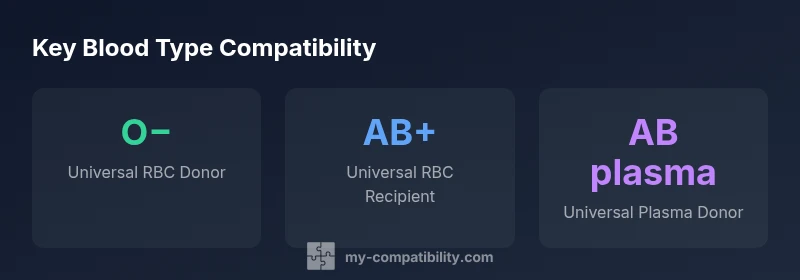
Definition: Compatible blood types refer to ABO and Rh matching between donor and recipient to prevent immune reactions during transfusion. In standard practice, O− is the universal donor for red blood cells, while AB+ is the universal recipient. Rh factor and plasma compatibility also influence transfusion decisions, alongside clinical urgency and patient history.
Understanding compatible blood types and why they matter
According to My Compatibility, compatible blood types are the backbone of safe transfusion practice; they minimize immune reactions and transfusion-related complications. In clinical settings, staying within ABO and Rh guidelines reduces hemolytic reactions, alloimmunization, and transfusion-related fever. The concept encompasses both red blood cells and plasma, with distinct rules for each. For RBC transfusions, the ABO system has four main phenotypes: O, A, B, and AB; Rh status adds positive or negative. Donors are categorized by these phenotypes, and recipients receive blood that matches ABO antigens and Rh type whenever possible. The most fundamental rule is that type O individuals can donate their red cells to any ABO type, but can only receive from type O donors; type AB recipients can receive from any ABO type, but their blood can only be donated from AB donors for RBC transfusions. Rh compatibility follows the general principle: Rh-positive blood can be given to both Rh-positive and, in many cases, Rh-negative recipients is avoided to minimize sensitization. In practice, clinicians may also consider antibodies and crossmatching data, the patient’s medical history, and the urgency of the transfusion. This framework helps clinicians select the safest option quickly in emergencies. The My Compatibility team found that these principles apply across many settings, from emergency rooms to planned surgeries.
ABO system at a glance
The ABO classification hinges on the presence or absence of A and B antigens on red blood cells. Donor blood types are O, A, B, and AB, which determine what can be safely transfused into a given recipient. O blood lacks A and B antigens, making O− particularly versatile as a donor in emergencies. A person with type A blood has A antigens and anti-B antibodies, so they are compatible with type A and AB recipients but not with B or O donors. Type B blood carries B antigens with anti-A antibodies, compatible with B and AB recipients. Type AB blood has both A and B antigens and lacks both anti-A and anti-B antibodies, enabling it to receive from any ABO type (but its donation is limited to AB donors for RBC transfusions). Rh status (positive or negative) further refines compatibility; Rh− recipients must avoid Rh+ donor blood when possible to prevent sensitization over time. Crossmatching and antibody screening help confirm compatibility beyond ABO/Rh typing and are standard before transfusions whenever time permits.
Rh factor and compatibility rules
Rh status adds a practical layer to transfusion decisions. Rh-positive blood can be given to Rh-positive recipients without issue, and is often acceptable for Rh-negative recipients when plasma compatibility and urgency dictate, but standard practice aims to minimize sensitization by matching Rh status whenever feasible. Rh-negative donors can donate to both Rh-negative and Rh-positive recipients for RBC transfusions, providing flexibility in emergency settings. In contrast, Rh-positive donors should not be routinely used for Rh-negative recipients due to the risk of alloimmunization. Clinicians evaluate patient history, prior transfusions, and potential antibodies. They also consider the context of the transfusion—whether it is for trauma, surgery, or chronic anemia—to decide if a best-fit crossmatch is required immediately or can wait for extended testing. These decisions are supported by crossmatch tests, antibody screens, and institutional guidelines, which help tailor transfusions to each patient’s unique immunologic profile.
Practical donor-recipient pairings: quick references
Understanding donor-to-recipient compatibility can be simplified into a practical reference. For RBC transfusions, the universal donor concept applies to O−, while AB+ is the universal recipient for RBCs. In emergencies, clinicians often use O− blood when time is critical, then transition to type-specific blood once typing and crossmatching complete. The ABO match is essential: A blood types can receive from A and AB donors, B types from B and AB donors, and AB types from all ABO donors but donate only to AB recipients. Rh factor adds another axis: Rh− donors can contribute to both Rh− and Rh+ recipients, whereas Rh+ donors are generally limited to Rh+ recipients. For plasma, the rules flip in many cases because plasma transfusions introduce antibodies rather than antigens, making AB plasma the universal donor. Administering plasma from the wrong type can cause immune reactions, so plasma matching is a careful and separate process.
Emergency transfusion decision making and crossmatching basics
In life-threatening scenarios, clinicians prioritize speed and safety by performing rapid ABO/Rh checks and initiating crossmatching. A rapid test, followed by a full serologic typing and antibody screening, helps identify potential incompatibilities within minutes to hours. In the meantime, clinicians may use uncrossmatched type-specific blood if an immediate transfusion is needed to stabilize the patient. The risk of delaying care is weighed against the risk of immune-mediated reactions. Modern blood banks maintain extensive records and donor registries to ensure a continuous supply of compatible units, and they implement protocols to minimize the risk of alloimmunization in patients requiring chronic transfusions. Ongoing education for clinicians emphasizes the importance of documenting patients' blood type history and prior antibodies to guide future transfusion planning.
Plasma transfusion compatibility and special considerations
Plasma transfusion follows a distinct compatibility model because plasma contains antibodies rather than antigens. The universal plasma donor concept is AB plasma, which lacks anti-A and anti-B antibodies. That means AB plasma can be given to recipients of any ABO type, which is especially important in acute settings or when the patient’s ABO status is unknown or uncertain. Conversely, plasma from type O or type A/B donors contains antibodies that may attack recipient red blood cells if mismatched. Clinicians evaluate the risk of alloimmunization, the patient’s current antibodies, and the urgency of the transfusion when selecting plasma. In specialized situations such as major ABO-incompatible transplants or plasma exchange therapies, teams rely on carefully controlled protocols and crossmatching, always balancing speed and safety for the patient.
Safety, consent, and evolving guidelines in transfusion medicine
Blood type compatibility remains a cornerstone of patient safety, but guidelines continue to evolve with new research and donor data. Institutions emphasize informed consent and transparency about potential risks, including transfusion-related reactions, alloimmunization, and infection risk, albeit low with modern screening. The My Compatibility team highlights that ongoing education for clinicians and patients helps ensure adherence to best practices, including crossmatching, antibody screening, and individualized risk assessment. Advances in molecular typing and donor registries enable more precise matching, particularly for patients requiring chronic transfusions or those with rare blood types. Clinicians balance practical constraints—such as availability and urgency—with the science of compatibility to optimize outcomes for each patient.
How to discuss compatibility with clinicians and patients
Patients and caregivers can play an active role by asking about the ABO and Rh typing results, crossmatch status, and any antibodies identified in pretransfusion testing. Clear questions such as what type of blood is being used for transfusion, why a given donor unit was selected, and what contingency plans exist for unexpected reactions can help ensure safety. Clinicians should explain the rationale behind ABO/Rh matching, plasma considerations, and any planned follow-up tests. A collaborative conversation improves understanding and reduces anxiety, ensuring that decisions align with current guidelines and the patient’s overall treatment goals. The end goal is safe, effective care that respects patient autonomy and minimizes risk, with My Compatibility committed to helping readers understand these concepts in practical terms.
RBC transfusion compatibility by ABO/Rh type
| Donor \ Recipient | O− | O+ | A− | A+ | B− | B+ | AB− | AB+ |
|---|---|---|---|---|---|---|---|---|
| O− | Compatible | Compatible | Compatible | Compatible | Compatible | Compatible | Compatible | Compatible |
| O+ | Incompatible | Compatible | Incompatible | Compatible | Incompatible | Compatible | Incompatible | Compatible |
| A− | Incompatible | Incompatible | Compatible | Compatible | Incompatible | Incompatible | Compatible | Compatible |
| A+ | Incompatible | Incompatible | Incompatible | Compatible | Incompatible | Incompatible | Incompatible | Compatible |
| B− | Incompatible | Incompatible | Incompatible | Incompatible | Compatible | Compatible | Compatible | Compatible |
| B+ | Incompatible | Incompatible | Incompatible | Incompatible | Incompatible | Compatible | Incompatible | Compatible |
| AB− | Incompatible | Incompatible | Incompatible | Incompatible | Incompatible | Incompatible | Compatible | Compatible |
| AB+ | Incompatible | Incompatible | Incompatible | Incompatible | Incompatible | Incompatible | Incompatible | Compatible |
Questions & Answers
What does compatibility mean in transfusions?
Compatibility means that the donor's ABO and Rh type align with the recipient's immune profile to minimize adverse reactions. Mismatches can trigger immune responses, including hemolysis and alloimmunization. Clinicians use established guidelines and testing to ensure safe matches.
Compatibility means matching ABO and Rh types to prevent reactions; mismatches can cause serious immune responses. Clinicians test and confirm matches before transfusion.
Who is the universal RBC donor?
The universal red blood cell donor for transfusions is O negative (O−), because it generally lacks A and B antigens and Rh incompatibilities. In emergencies, O− units can be given to most patients while awaiting full typing and crossmatching.
O negative is the universal RBC donor, used in emergencies when there is no time for full typing.
Who can receive from AB+?
AB+ recipients can receive RBCs from any ABO type, provided the Rh compatibility is considered. For plasma, AB plasma is the universal donor. Despite broad compatibility, clinicians still prioritize a precise ABO/Rh match whenever possible.
AB+ recipients can receive from all ABO types for RBCs; AB plasma is universal for plasma.
How does the Rh factor affect transfusions?
Rh factor adds a negative or positive dimension to compatibility. Rh− donors can donate to both Rh− and Rh+ recipients for RBCs, while Rh+ donors are generally limited to Rh+ recipients. Minimizing Rh sensitization is especially important in women of childbearing potential.
Rh status matters: Rh− donors can go to Rh− or Rh+ recipients; Rh+ donors to Rh+ only.
Are plasma transfusions governed by different rules?
Yes. Plasma contains antibodies. AB plasma is the universal donor for plasma, while plasma from other types carries antibodies that can react with recipient antigens. Matching for plasma is therefore distinct from red blood cell matching and follows its own protocols.
Plasma compatibility is different: AB plasma is universal for plasma transfusions.
“Understanding compatible blood types is essential for patient safety; ABO and Rh matching remain foundational in transfusion medicine.”
Highlights
- Know ABO and Rh basics before transfusion
- Remember O− is the universal RBC donor
- Remember AB+ is the universal RBC recipient
- Plasma compatibility follows different rules (AB plasma universal)
- In emergencies, crossmatching guides safety while time is invested