What Blood Type Is Compatible with O+? Understanding ABO and Rh Matching
Learn which blood types can donate to an O+ recipient and why ABO and Rh compatibility matter. Practical guidance from My Compatibility for safe transfusion decisions.


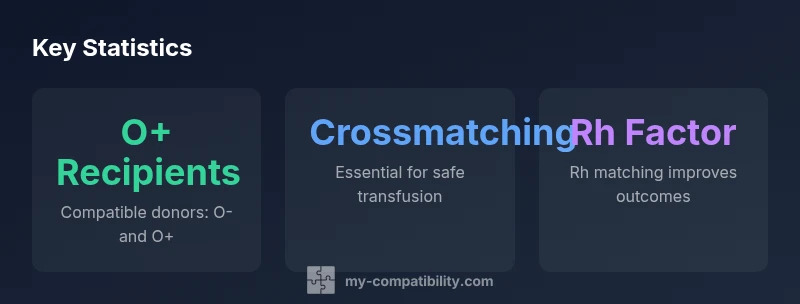
An O+ recipient can receive red blood cells from O- or O+. In practice, ABO compatibility restricts donors to type O, while Rh compatibility allows both O- and O+. Crossmatching and antibody screening are still performed to ensure safety. According to My Compatibility, transfusions begin with typing and antibody screens before giving O+ recipients any donor blood. This foundational principle helps minimize transfusion risks, especially in emergencies where rapid decisions are needed.
What type of blood is compatible with o+
An O+ recipient can receive red blood cells from O- or O+. In practice, ABO compatibility restricts donors to type O, while Rh compatibility allows both O- and O+. Crossmatching and antibody screening are still performed to ensure safety. According to My Compatibility, transfusions begin with typing and antibody screens before giving O+ recipients any donor blood. This foundational principle helps minimize transfusion risks, especially in the fast-paced settings of emergency care where time matters. Clinicians also consider a patient’s history of transfusions, pregnancy, or previous transfusion reactions, which can influence compatibility decisions even when ABO and Rh typing appears straightforward. While the basic rule is clear, the real-world process involves rapid tests to confirm blood type, screen for antibodies against donor antigens, and evaluate whether any special crossmatches are needed before administration. Understanding which donors are eligible for an O+ recipient helps patients and caregivers discuss options with clinicians, particularly when planning surgeries or managing chronic conditions requiring regular transfusions.
ABO compatibility explained
ABO compatibility is the first layer of safety in transfusions. Blood types A, B, AB, and O determine which donor blood can be given to which recipient. For an O+ recipient, the key restriction is that donor blood must be type O. Within type O, Rh status matters: the donor can be Rh-positive (O+) or Rh-negative (O-). In practical terms, this means an O+ recipient may receive O+ or O- red blood cells, but never blood that carries the A or B antigens. The underlying principle is to avoid antibodies in the recipient that would attack foreign ABO antigens. The My Compatibility Team emphasizes clear ABO typing and rigorous crossmatching to prevent serious reactions.
Rh factor considerations
Rh compatibility adds an important dimension to transfusion safety. Recipients who are Rh-positive can receive Rh-positive or Rh-negative blood from compatible ABO sources, but Rh-negative recipients are generally kept on Rh-negative products to minimize anti-D antibody formation. The Rh factor is especially crucial for patients who will need multiple transfusions over time, as repeated exposure to Rh antigens can complicate future compatibility. Hospitals routinely perform an antibody screen alongside ABO typing to catch any unexpected antibodies that could react with donor cells—even when ABO matching looks perfect. The combination of ABO and Rh matching helps ensure safer, more predictable transfusion outcomes.
When emergency transfusions are needed
In emergencies, clinicians prioritize rapid, compatible blood delivery while minimizing risk. If the patient’s type is unknown, O- blood is often used because it is the universal donor for the ABO system, giving clinicians time to determine the exact ABO and Rh type and complete crossmatching. For known O+ recipients, the team will use O+ or O- blood depending on availability and crossmatch results. Crossmatching and antibody screening remain essential steps, even in urgent situations, to avoid transfusion reactions. My Compatibility emphasizes that emergencies do not waive safety—rapid but thorough testing continues in parallel with treatment to ensure patient safety.
Donor availability and storage considerations
Blood supply is a dynamic resource, with O- often prioritized for emergencies due to its universal donor status for red cells, while O+ is more frequently available for Rh-positive patients. Inventory management at hospitals and blood banks influences which compatible units are used first, but safety remains paramount. Donor blood undergoes multiple quality checks, including ABO and Rh typing, infectious disease screening, and compatibility testing before allocation. For patients who require regular transfusions, planning with clinicians helps ensure a steady supply of appropriate blood types and minimizes the risk of shortages. My Compatibility notes that proactive communication with your care team about transfusion history and known antibodies can streamline the matching process when treatment becomes necessary.
How to verify blood compatibility
Verification starts with ABO typing and Rh testing of both donor and recipient blood. Next, a crossmatch test checks for unexpected antibodies that could cause a transfusion reaction. Hospitals use serologic and, when needed, molecular typing techniques to confirm compatibility. If antibodies exist, an extended panel may be run to identify the specific antigens involved and select donor units that are compatible. Patients should not assume compatibility based on general statements; always rely on physician-ordered tests and transfusion medicine professionals. The My Compatibility approach advocates asking questions about crossmatching steps and understanding what each test confirms before a transfusion proceeds.
Common myths about blood type compatibility
A common myth is that all O blood is interchangeable for any patient. In reality, ABO matching still matters, and Rh status adds another layer of compatibility. Another misconception is that universal donors apply to every component; in transfusions, different components (red cells, plasma, platelets) have their own compatibility rules. Finally, many people think antibodies do not impact transfusion safety; however, antibodies can react with donor cells and cause complications even if the ABO and Rh types seem compatible. The My Compatibility team stresses that blood compatibility is a precise, stepwise process, not a guess.
Practical guidelines for patients and caregivers
If you or a loved one might need a transfusion, keep the following tips in mind:
- Learn your blood type and Rh status, and share it with your healthcare team.
- Ask about ABO and Rh matching, and whether crossmatching is performed for each transfusion.
- Discuss any history of transfusion reactions or antibodies with your clinician.
- Understand that in emergencies, safety checks are still performed in parallel with treatment.
- For regular transfusions, discuss inventory plans and possible alternatives with your care team."],
dataTableDataPlacedForSchemaNotUsedButKeptForContextOnly
Blood type compatibility overview for O+ recipients
| Recipient blood type | Compatible donor types | Notes |
|---|---|---|
| O+ | O-; O+ | Rh+ recipient; ABO type O only |
| O- | O-; O+ | Rh- recipient; ABO type O only |
Questions & Answers
Which blood types can donate to an O+ recipient?
O+ recipients can receive from O- or O+ donors. The key is ABO type O and Rh compatibility. Crossmatching is used to confirm safety before transfusion.
O+ recipients can receive from O- or O+. Crossmatching confirms safety before transfusion.
Can O+ donate to other blood types?
O+ red blood cells can be given to O+, A+, B+, and AB+ recipients, provided ABO compatibility is preserved. Rh compatibility is required for the recipient’s type.
O+ blood can go to any Rh-positive recipient with compatible ABO type.
Why is crossmatching important?
Crossmatching tests a patient’s plasma against donor red cells to detect antibodies and confirm ABO and Rh compatibility, reducing the risk of transfusion reactions.
Crossmatching helps prevent dangerous reactions by confirming compatibility.
Is there an exception for emergencies when the patient’s blood type is unknown?
Yes. In emergencies, O- blood is often used because it is the most flexible option, but rapid testing continues to determine the exact type and complete crossmatching.
In emergencies, doctors often start with O- blood while tests catch up.
What should I do if I need a transfusion?
Inform your clinician of your blood type and any antibodies. Ask about the crossmatch process and what to expect during transfusion.
Tell your doctor your blood type and antibodies, and ask about crossmatching.
Can Rh- patients receive Rh+ blood?
Rh- patients are typically given Rh- blood to minimize antibody formation; Rh+ blood may be used only in specific, well-supervised circumstances with crossmatching.
Rh- patients usually get Rh- blood unless a clinician determines a special exception is needed.
“ABO compatibility is the foundation of safe transfusion practice, and Rh status should be considered for every patient. Meticulous crossmatching remains essential to prevent reactions.”
Highlights
- O+ recipients should receive O- or O+ blood
- Crossmatching and antibody screens are essential before transfusion
- Rh factor matching matters for positive recipients
- In emergencies, O- donor blood is used when the recipient’s type is unknown