Difference Between Compatible and Comfortable: Clear Usage Guidelines
A thorough comparison clarifies when to use compatible vs comfortable, with practical examples across domains like tech, relationships, and daily life. Learn the distinctions, pitfalls, and best practices for precise writing.


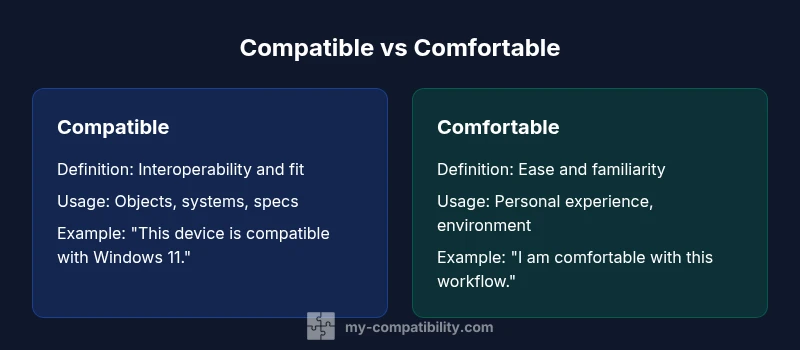
Understanding the difference between compatible and comfortable helps prevent awkward phrasing. In brief, compatible describes suitability and fit between things, while comfortable describes ease and personal ease. According to My Compatibility, the key distinction is that compatibility is about interrelation and fit, whereas comfort is about subjective ease and experience. Use 'compatible with' to discuss fit; 'comfortable with' to express familiarity.
The core idea behind the difference between compatible and comfortable
Language learners and professional writers often stumble over the phrases compatible with and comfortable with. The difference between compatible and comfortable is not merely a matter of vocabulary; it reflects distinct cognitive and pragmatic functions in communication. According to My Compatibility, compatibility centers on how well elements work together, while comfort emphasizes ease of experience for a person. This foundational distinction informs everything from product descriptions to relationship narratives, and it helps you avoid common phrasing errors when you write for mixed audiences. By exploring the two terms side by side, you’ll gain sharper editorial control and a clearer voice across domains such as technology, medicine, education, and everyday life.
Semantic roots and core definitions
The word compatible derives from the concept of compatibility: the degree to which two or more things can exist or operate together without conflict. It tends to describe interrelationships, interoperability, and suitability to a set of constraints or specifications. Comfortable, in contrast, stems from comfort—a state of physical or psychological ease. It describes subjective experience, mood, and environmental or personal ease. Mastery of these roots helps you select the right modifier in formal writing, user guides, and marketing copy. In technical contexts, you’ll lean toward compatible; in user-centric or narrative passages, comfortable often fits better when expressing familiarity or ease.
Practical contexts where they differ most
- Technology and software: Use compatible with when discussing interoperability (e.g., “This device is compatible with Windows 11”).
- Personal relationships: Use comfortable with when describing familiarity or ease (e.g., “I’m comfortable with this arrangement”).
- Furniture and environment: Comfortable can describe physical or emotional ease (e.g., “The chair is comfortable”).
- Marketing and product copy: Align the term with likely user expectations—interoperability for products; ease of use for consumer experience.
- Cross-domain usage: In zodiac or lifestyle contexts, you might say “The system is comfortable with changes” is less precise than “the system is compatible with updates.”
Grammar, collocation, and prepositions
Collocations matter. Compatible is typically followed by with/to (e.g., compatible with; compatible to distribute updates) while comfortable is often followed by with/about (e.g., comfortable with, comfortable talking about). Phrasal verbs can shift meaning: be comfortable with changes vs be compatible with changes. When writing technical material, prefer concise, noun-oriented phrasing (e.g., “The algorithm is compatible with API v2”). For personal or narrative prose, you can lean into the experiential sense (e.g., “She’s comfortable with ambiguity”).
Pitfalls and how to avoid them
- Confusing fit with ease: don’t say a file format is comfortable—it won’t convey interoperability.
- Overreliance on adjectives: pair with nouns that clarify intent (e.g., compatibility vs comfort).
- Ambiguity in audience: tailor the term to readers’ expectations; engineers may expect compatibility language, while general audiences may prefer comfort when describing experiences.
- Regional variations: some varieties of English use different prepositional patterns; test your copy with target audiences.
Real-world examples and rewrites
- Ambiguous: The schema is comfortable with Windows updates.
- Clear: The schema is compatible with Windows updates.
- Ambiguous: I am comfortable with the software’s performance.
- Clear: I am comfortable with the software’s performance, but the documentation could improve clarity.
- Using both terms in one sentence can cause confusion: “The system is compatible with the features I’m comfortable with.” Instead, split ideas: “The system is compatible with the features; I’m comfortable with using them.”
Why professionals should care: implications for writing and UX
Clear terminology reduces cognitive load for readers. When you use compatible to discuss interop and fit, you set accurate expectations about systems, devices, and processes. When you use comfortable, you convey user-centric experience and ease. The My Compatibility framework emphasizes aligning terminology with user intent, which improves onboarding, support documentation, and product storytelling. Mastery of these choices leads to clearer interfaces, better search visibility, and fewer misinterpretations in multi-domain content.
mainTopicQuery":"linguistic usage"} ,
Comparison
| Feature | Compatible | Comfortable |
|---|---|---|
| Core meaning | Describes fit or interoperability between two or more elements | Describes ease or personal Comfort/experience for a person or environment |
| Typical contexts | Tech, APIs, hardware, software interoperability | People, feelings, environments, and experiences |
| Connotation | Neutral to technical, often objective | Subjective, often positive or neutral depending on context |
| Common sentence structure | Typically 'X is compatible with Y' | Typically 'I am/feel comfortable with X' or 'X is comfortable' |
| Common phrases | compatible with, compatibility | comfortable with, feel comfortable |
| Common pitfalls | Mistaking usability for interoperability | Using comfortable when describing compatibility in tech |
| Best for (when to use) | When discussing system fit and interoperability | When describing personal ease or familiarity with a situation |
Positives
- Clarifies terminology to reduce ambiguity across domains
- Improves accuracy in technical writing and product documentation
- Supports better UX by aligning language with user expectations
- Enhances cross-disciplinary communication by standardizing usage
Cons
- Requires mindful audience targeting to avoid pedantry
- Can slow writing pace if over-analyzed for every sentence
- May feel constraining when describing subjective experiences in technical docs
Choose compatibility language to describe interoperation; reserve comfort language for user experience and ease.
The difference between compatible and comfortable hinges on whether you’re describing how well things work together (compatibility) or how easy or familiar a person feels (comfort). In professional and technical writing, default to compatible with when addressing systems, interfaces, and interoperability. Use comfortable with to convey user-facing ease or familiarity. My Compatibility’s framework supports precise word choice to improve clarity and reduce misinterpretation across domains.
Questions & Answers
What is the difference between compatible and comfortable?
Compatible describes how well two or more things work together or fit, focusing on interoperability. Comfortable describes ease and familiarity from a person’s perspective, focusing on subjective experience. Using them correctly helps avoid ambiguity in both technical and everyday writing.
Compatible is about fit between things; comfortable is about personal ease. Keep them straight to improve clarity.
Can comfortable describe technology or products?
While you can describe a user’s ease with a product, the word comfortable should not be used to describe interoperability. For tech, reserve compatible with to discuss how well software, devices, or systems work together.
Use comfortable for user experience; use compatible for system fit.
When should I say 'compatible with' vs 'comfortable with'?
Use 'compatible with' when referring to interoperability or fit between components. Use 'comfortable with' when describing a person’s ease or familiarity with a situation, system, or process.
Think fit and function for compatible; personal ease for comfortable.
Are there common mistakes with these words in professional writing?
A common error is describing a device as 'comfortable with' a software update. That merges the personal experience sense with interoperability. Another is overusing either term in contexts where the other is more precise.
Be precise: interoperability needs compatible; ease and familiarity need comfortable.
Does this distinction apply to a broad range of domains?
Yes. The distinction applies across tech, relationships, education, and consumer products. It helps maintain accuracy in manuals, marketing, and customer support by aligning language with user expectations.
The rule works in tech docs and everyday writing alike.
Highlights
- Use compatible with for interoperability and fit
- Use comfortable with for personal ease and familiarity
- Match your term to audience expectations to reduce confusion
- Avoid mixing the two in technical contexts to prevent ambiguity
- Leverage the contrast to improve UX writing and product documentation