Rooster and Tiger Compatibility: A Zodiac Pairing Guide
Explore rooster and tiger compatibility in Chinese astrology. Analyze dynamics, communication styles, and practical tips for relationships, friendships, and work.


Rooster and Tiger compatibility tends to be mixed but workable when both parties respect boundaries. The Tiger's bold drive can inspire, while the Rooster's precision keeps plans on track; tension arises around control and pace. With clear communication and defined roles, Rooster and Tiger can build a productive partnership. This pairing benefits from routine alongside bold experimentation, provided expectations are aligned.
Overview of Rooster and Tiger in Chinese Astrology
In Chinese astrology, the Rooster (the tenth sign) and the Tiger (the third sign) occupy distinct energetic frequencies. The study of rooster and tiger compatibility explores how two fundamentally different temperaments can align, clash, or find a productive middle ground. For anyone mapping out a relationship, friendship, or professional partnership between a Rooster and a Tiger, it's essential to consider how each sign processes information, manages risk, and expresses affection. According to My Compatibility, the rooster and tiger compatibility hinges on balancing precision with bold action, and on creating a shared rhythm that respects both parties' needs. In practical terms, this means translating strength into collaboration rather than competition. The Rooster's methodical mindset complements the Tiger's appetite for momentum when they agree on goals, timelines, and roles.
Key takeaway: The rooster and tiger compatibility is not about one sign dominating; it's about designing a framework where structure propels energy forward without stifling initiative. In the sections that follow, we'll dive into traits, communication styles, and real-life scenarios to illuminate how this pair can thrive.
Core Personality Traits: Rooster vs Tiger
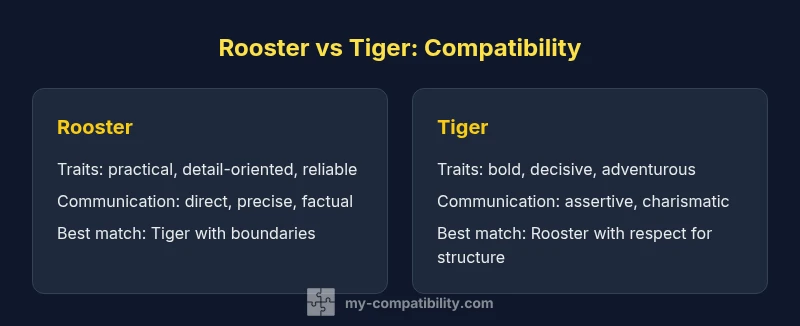
The Rooster tends to be precise, practical, and detail-oriented, with a preference for order and accountability. They value reliability, punctuality, and a clear plan. The Tiger, by contrast, is bold, independent, and action-oriented. Tigers are known for their courage, willingness to take calculated risks, and desire for autonomy. When we examine rooster and tiger compatibility through these lenses, the first distinction that stands out is pace: Roosters move carefully, while Tigers sprint toward deadlines. This mismatch can create friction if both parties are not explicit about expectations.
Yet there is room for synergy. The Rooster's sharp eye for flaws can help the Tiger avoid unnecessary missteps, while the Tiger's willingness to take risks can push the Rooster beyond incremental improvements toward meaningful progress. The key is to pair strengths with clearly defined boundaries and a shared objective. In long-term partnerships, Roosters benefit from feeling valued for their reliability, and Tigers benefit from feeling their energy is channeled toward tangible outcomes. The rooster and tiger compatibility improves as both signs learn to translate their differences into complementary skills rather than competing impulses. My Compatibility's analysis suggests emphasizing discipline, trust-building, and a shared cadence to unlock productive collaboration.
Communication Styles and Daily Interactions
Communication styles are where rooster and tiger compatibility often plays out most clearly. The Rooster typically communicates in a precise, evidence-backed manner, favoring concise updates, checklists, and documented plans. The Tiger communicates with conviction and speed, often preferring direct, high-energy exchanges and rapid decision-making. When these styles collide, the risk is misinterpretation or perceived inattentiveness. The remedy lies in establishing a shared communication protocol: set cadence (daily standups or weekly reviews), define decision-makers for each step, and agree on what constitutes a completed task. Practically, Roosters should give Tigers space to act quickly, while Tigers should slow down to present reasoning and data. The payoff is a smoother workflow, fewer misreads, and a sense of progress that both parties can feel—an essential aspect of rooster and tiger compatibility.
Romantic Relationships: Potential and Pitfalls
In romantic contexts, rooster and tiger compatibility can be energizing yet demanding. Tigers bring passion, novelty, and a willingness to take risks, which can excite a Rooster who often seeks novelty in the form of steady progress. Roosters contribute loyalty, reliability, and a practical framework that can stabilize the Tiger's more impulsive tendencies. The pitfalls often arise from pace mismatches and control dynamics. Tigers may push for fast commitment or rapid change, while Roosters may resist shifts that disrupt a carefully laid plan. To cultivate harmony, couples should negotiate shared goals, create rituals that honor both partners' needs, and continuously acknowledge each other’s contributions. Clear boundaries prevent boundary-crossing disputes, and mutual respect turns rooster and tiger compatibility into a durable bond.
Friends, Family, and Social Circles
Within social circles, Roosters and Tigers can form complementary networks. The Rooster's attention to detail and reliability benefits group planning, event coordination, and long-term projects. The Tiger's charisma and spontaneity can energize gatherings, attract new opportunities, and drive collective action. The main challenge is role clarity: who leads when enthusiasm runs high, and who grounds activities when energy wanes? By rotating leadership for different tasks and using structured planning tools, the duo can leverage each other's strengths to expand social and familial networks. The key to rooster and tiger compatibility here is social nuance: be adaptable, honor commitments, and celebrate successes together.
Career and Collaboration: When Teams Meet
In professional settings, this pairing thrives when tasks align with each sign's strengths. Tigers excel in roles that require bold vision, rapid execution, and risk assessment, while Roosters excel in roles that require meticulous planning, quality control, and process optimization. The most successful rooster-tiger collaborations assign clear ownership, set realistic timelines, and incorporate feedback loops. When conflicts arise, they often relate to pace or scope: the Tiger wants momentum, the Rooster wants refinement. The solution is a shared roadmap with milestone-based reviews, ensuring both energy and precision stay in alignment. In team projects, rooster and tiger compatibility flourishes when both voices are valued and decisions are made transparently.
Managing Conflicts: Triggers and Remedies
Conflicts often stem from differences in pace, autonomy, and interpretation of boundaries. The Tiger may view the Rooster as overly critical or slow, while the Rooster may see the Tiger as impulsive or reckless. Effective remedies include establishing a conflict-resolution protocol: agree on time-bound discussions, document decisions, and appoint a mediator if needed. Build rituals that acknowledge achievements and failures alike, so neither party feels undervalued. Practicing active listening, reframing criticisms as constructive feedback, and using neutral language reduces defensiveness. This approach supports healthier rooster and tiger compatibility over time and helps transform friction into productive momentum.
Practical Scenarios and Daily Life Tips
To translate theory into daily practice, consider concrete scenarios. For instance, when planning a major purchase, the Tiger should present the rationale and risks quickly, while the Rooster frames the plan with a detailed checklist and a timeline. In household management, assign the Tiger to high-energy tasks that benefit from quick action, and reserve routine chores for the Rooster. When integrating into a shared calendar, set shared deadlines and reminders to keep both parties aligned. These practical tips turn rooster and tiger compatibility into a living, breathing partnership rather than an abstract concept.
How to Assess Your Rooster-Tiger Pairing
A practical assessment asks: Do you share a common objective? Are you able to communicate a shared plan with clear responsibilities? Can you tolerate each other's preferred pace and decision-making style without resentment? A successful rooster-tiger pairing requires ongoing calibration: review goals, adjust boundaries as needed, and celebrate incremental progress. Use personality insights alongside real-world outcomes to determine whether rooster and tiger compatibility translates into a durable, collaborative relationship. If you find alignment here, the pairing is well-positioned to flourish over time.
Comparison
| Feature | Rooster | Tiger |
|---|---|---|
| Core Traits | Rooster: practical, detail-oriented, reliable | Tiger: bold, decisive, action-oriented |
| Communication Style | Rooster: direct, precise, factual | Tiger: assertive, charismatic |
| Conflict Approach | Rooster: seeks order, may critique | Tiger: confronts quickly, seeks rapid resolution |
| Romantic Potential | Rooster: steady, loyal, values routine | Tiger: passionate, adventurous, seeks excitement |
| Best Context | Rooster: stable partnerships with clear plans | Tiger: dynamic partnerships that welcome risk-taking |
| Harmony Remedies | Rooster: needs clear boundaries and praise | Tiger: needs space for bold moves and appreciation |
Positives
- Balanced energy when boundaries are clear
- Rooster brings discipline and Tiger brings momentum
- Mutual growth through respectful adaptation
- Strong potential in project-driven collaborations
Cons
- Potential clashes over pace and control
- Rooster's need for order may frustrate Tiger's spontaneity
- Miscommunication risk if assumptions run high
Moderate harmony with mindful boundaries
Rooster and Tiger can thrive when both parties align goals, respect pacing, and communicate clearly. Boundaries and mutual appreciation turn differences into complementary strengths.
Questions & Answers
Are Rooster and Tiger typically compatible in a relationship?
Rooster-Tiger pairings work best when both partners value clear boundaries and open dialogue. The Tiger's energy drives progress, while the Rooster provides structure and reliability. Misunderstandings can occur if pace and control aren't negotiated, but with consistent communication, harmony is achievable.
In a romantic match, Rooster's steadiness balances Tiger energy, but you need clear talks about pace and boundaries to avoid friction.
What should Rooster do to improve compatibility with Tiger?
Roosters should offer clear plans and timelines while acknowledging the Tiger's need for momentum. Providing space for bold ideas and giving timely praise helps maintain respect and reduces defensiveness. Precision in communication is the key.
Give the Tiger space for bold ideas, paired with clear plans and regular praise.
What should Tiger do to improve compatibility with Rooster?
Tigers should temper speed with patience and present rationale for decisions. Framing proposals with data and a path for execution helps the Rooster feel secure. Respect for routine and consistency also strengthens the relationship.
Explain decisions with a plan and respect the Rooster's need for routine.
Can Rooster and Tiger work well in friendship or professional settings?
Yes, Rooster and Tiger can form strong teams when roles are clear and goals are shared. The Tiger's drive combines with the Rooster's meticulousness to deliver efficient progress. Challenges arise if boundaries blur; establish a documented workflow.
They can be great teammates when roles are clear and goals are shared.
Which signs complement Rooster and Tiger most?
Signs that balance energy with steadiness—Earthy signs or other practical, organized signs—tend to balance the Rooster-Tiger pairing. Look for partners who value structure but also bring empathy and long-term planning.
Look for partners who blend energy with stability.
Highlights
- Define shared goals and roles early
- Balance Tiger spontaneity with Rooster planning
- Use written plans and regular check-ins
- Practice active listening to reduce misreads
- Celebrate progress, not just outcomes