How to Check Compatibility by Date of Birth: A Practical Guide
Learn how to check compatibility by date of birth using zodiac signs, numerology, and birth symbolism. This educational guide offers practical steps, cautions, and real-world tips to explore relationship harmony without certainty.


Check compatibility by date of birth by analyzing astrology sun signs, numerology life path, and symbolic birthdates to identify complementary patterns. This approach uses birth date as a seed to explore personality fit, relationship dynamics, and compatibility indicators. It blends traditional zodiac insights with modern numerology for practical guidance. Learn to interpret patterns responsibly and avoid fatalistic conclusions.
What it means to check compatibility by date of birth
Check compatibility by date of birth is a structured practice that uses a person’s birth date as a seed for insight into compatibility across relationships and life goals. It blends astrology, numerology, and calendar symbolism to map patterns that may influence communication, harmony, and shared values. This method does not claim to predict the exact future; rather, it helps you understand possible alignments and friction points that influence daily life, communication, and long-term compatibility. According to My Compatibility, birth dates act as anchors that help you explore how two people might align emotionally, intellectually, and practically. The goal is to illuminate tendencies, not fix outcomes, and to create a framework you can test against daily life.
Core concepts: astrology, numerology, and DOB-based indicators
At its core, this method relies on three pillars: astrology, numerology, and date symbolism. Astrology looks at sun signs, moon signs, and planetary cycles; numerology translates dates into life path numbers or personal year numbers; date symbolism interprets calendar patterns such as month/day associations. When you check compatibility by date of birth, you combine these signals to form a nuanced picture rather than relying on a single system. Each pillar offers a lens: astrology explains archetypal dynamics; numerology surfaces recurring themes; calendar symbolism highlights timing patterns. Remember that no one system 'proves' compatibility; they provide language to discuss compatibility factors. The My Compatibility team emphasizes that using multiple lenses often yields more balanced insights and reduces bias in interpretation.
Translating a birth date into signals of compatibility
Birth dates can be translated into several actionable indicators. Start with sun sign compatibility as a baseline, then layer numerology results such as life path numbers and destiny numbers, and finally examine month imprint and day number influences. According to My Compatibility analysis, cross-referencing these signals tends to reveal harmony in communication styles, decision-making, and long-term goals. For example, a person born on dates associated with cooperation and balance may show favorable alignment with signs that prioritize harmony, while more assertive dates can indicate dynamic tension that needs deliberate resolution. The purpose is to identify where you naturally click and where extra effort is helpful, not to label relationships as doomed or destined.
Limitations and ethical considerations
This approach should not replace personal discernment or professional advice. Check compatibility by date of birth can become misleading if used to rigidly categorize people or to justify controlling behavior. Always respect boundaries, preferences, and consent in any relationship exploration. Be transparent about the methods you are using and avoid making definitive judgments based on a single date. Ethical use means presenting findings as possibilities, not certainties, and always emphasizing autonomy and respect in all interactions. The My Compatibility philosophy encourages balanced interpretation and ongoing dialogue.
How to prepare your DOB-based compatibility check
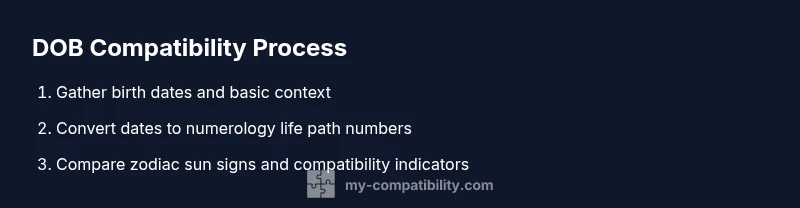
Preparation begins with clarity and consent. Gather accurate birth dates for the people involved, decide on a framework (astrological, numerological, or a hybrid), and set expectations about what the results can and cannot tell you. Create a simple checklist: confirm dates, note the context or questions you want answered, and allocate time to review the outputs. It’s helpful to establish a neutral goal—understanding patterns, not predicting outcomes—so you can approach the check with curiosity and openness. Finally, document your intent and boundaries to maintain respectful exploration with others.
Practical framework: combining DOB insights with real-life dynamics
Use a staged approach: baseline compatibility, dynamic interactions, and decision-making alignment. Start by assessing similarities in communication styles and core values derived from DOB signals. Then, evaluate how each person handles conflict and decision-making, noting where lunar cycles or life-path themes may affect timing. Finally, connect these insights to real-life scenarios (work, friendship, romance) and observe how well they translate into everyday behavior. The framework works best when combined with active listening, empathy, and clear, compassionate conversations.
Common myths vs. reality
Myth: DOB-based checks predict fate or guarantee outcomes. Reality: It’s a lens for reflection, not a verdict. Myth: If signals are misaligned, the relationship is doomed. Reality: Compatibility signals indicate areas for growth; effort, communication, and shared goals can improve harmony. Myth: Astrology is the sole determinant of compatibility. Reality: It’s one tool among several; rely on multiple perspectives and personal experience. Myth: This method ignores personal growth. Reality: It should inform, not replace, self-awareness and mutual respect.
Case examples (fictional scenarios)
Scenario A: Alex (date: 1992-06-15) and Sam (date: 1990-11-03) show complementary communicative tendencies—Alex’s adaptability aligns with Sam’s strategic planning, creating a balanced dynamic. Scenario B: Mira (date: 1987-02-02) and Kai (date: 1985-08-28) may experience friction in decision-making, as Mira’s quick impulses clash with Kai’s long-term planning; mindful dialogue helps bridge the gap. These scenarios illustrate how DOB signals can map strengths and friction points, but outcomes depend on communication, shared values, and mutual respect. The My Compatibility approach emphasizes testing insights in real life and adjusting accordingly.
Tools and methods you can use today
- Quick self-check: note birth dates and summarize perceived strengths and challenges in a notebook.
- Basic numerology: convert birth dates to life path numbers using a simple digital calculator or app.
- Zodiac baseline: identify sun signs and their general compatibility tendencies.
- Diary method: track daily interactions for two weeks, comparing with the insights you generated.
- Reflection prompts: what patterns did you notice, and how did you respond to friction points?
Documenting and sharing your findings responsibly
Document your DOB-based compatibility findings with factual notes and clear boundaries. Share results with consent, avoid pressuring others, and emphasize that insights are guidelines for better communication. Use neutral language—avoid labels or judgments—and invite ongoing feedback from all parties involved. When discussing results, frame observations as possibilities rather than certainties, and be prepared to revise interpretations as relationships evolve.
Iteration and improvement over time
Revisit your compatibility framework every few months or after major life events (new job, move, relationship milestone). Update birth-date interpretations with new context, and test whether insights predicted outcomes or needed recalibration. Emphasize ongoing learning, adaptability, and reflective dialogue to keep the approach healthy and useful.
Next steps and ongoing learning
Treat DOB-based compatibility as a living tool, not a fixed map. Schedule regular check-ins, adjust your expectations, and use the insights to enhance communication and empathy. The My Compatibility team recommends continuing to refine your method and staying curious about how dates interact with real-life choices and dynamics.
Tools & Materials
- Birth date records(Date in formats such as YYYY-MM-DD for consistency)
- Notebook or digital notes app(To document observations and reflections)
- Calculator or numerology app(For life path and destiny number calculations)
- Access to astrology resources(Optional for reference and cross-checking interpretations)
- Reference chart or astrology wheel(Optional visual aid for correlation)
Steps
Estimated time: 60-90 minutes
- 1
Gather birth data
Collect accurate birth dates for all individuals involved, ensuring the format is consistent (YYYY-MM-DD). Clear data minimizes misinterpretation and keeps the process transparent.
Tip: Double-check spellings and dates with a second person if possible. - 2
Choose your framework
Decide whether you will use astrology, numerology, or a hybrid approach. Define your scope (e.g., romantic relationships, friendships, or workplace dynamics) before calculating indicators.
Tip: Document the chosen framework in your notes for future reference. - 3
Compute core indicators
Calculate core indicators such as sun sign alignments and life path numbers from the birth dates. Record these values in your log.
Tip: Use reliable calculation methods to avoid errors. - 4
Identify baseline compatibility
Assess initial signals for harmony in communication and shared priorities based on your framework. Note any obvious alignments or tensions.
Tip: Be mindful of confirmation bias; look for both strengths and friction points. - 5
Cross-check with dynamics
Combine numerology and astrology signals to explore how patterns may play out in conversation, decision-making, and timing.
Tip: Consider the effect of environment and context on these signals. - 6
Assess potential friction points
Highlight areas where signals suggest possible misunderstandings or misalignment, and plan strategies to address them.
Tip: Prepare practical conversation scripts to ease tension. - 7
Document findings clearly
Summarize insights in a neutral, evidence-based format. Include both observations and uncertainties.
Tip: Use bullet points and short phrases for readability. - 8
Validate with real-life test
Observe behavior in actual interactions and note whether the insights hold or require adjustment.
Tip: Treat this as iterative learning, not prophecy. - 9
Share findings responsibly
Communicate results with consent and emphasize that insights are guides, not guarantees.
Tip: Avoid pressuring others; invite collaborative reflection.
Questions & Answers
What does it mean to check compatibility by date of birth?
It is a reflective practice that uses birth dates to explore patterns in personality, relationship dynamics, and life goals. It is not a guarantee of outcomes but a framework for understanding potential dynamics.
DOB compatibility is a reflective tool—data from birth dates helps you examine patterns in a relationship, not predict the future.
Can DOB compatibility predict relationship success?
No. It provides insights into tendencies and communication styles, which you can test and adapt through dialogue and shared goals.
It suggests patterns to observe, not certainties about the future.
How reliable is astrology in this process?
Astrology offers archetypal insights that people find meaningful; its reliability varies with interpretation. Use astrology as one lens among others rather than a sole predictor.
Astrology is a lens, not a guarantee.
How do I calculate life path numbers from birth dates?
Life path numbers are derived from a sum of the digits in the birth date, reduced to a single digit. Use a reputable numerology method or app to compute this value.
You add up the digits in the birth date and reduce to a single number to get the life path.
What should I do if signals conflict?
Acknowledge the tension, discuss interpretations, and test changes in behavior. Conflicts often reveal areas for growth and better communication.
When signals clash, talk about it and try practical solutions.
Is this approach appropriate for all types of relationships?
Yes, but tailor the depth of analysis to the relationship type and consent. Use this as a tool for better understanding, not as a rulebook.
It can apply broadly, but keep it proportional and respectful to the relationship.
Watch Video
Highlights
- Check compatibility by date of birth as a reflective tool, not a determinant.
- Use multiple frameworks (astrology, numerology) for balanced interpretation.
- Document, test, and revise insights through real-life interactions.
- Communicate findings with consent and emphasize learning over labeling