Love Compatibility Calculator: Quick Insights for 2026
Explore how the Love Compatibility Calculator estimates relationship alignment from zodiac indices and relationship length. Learn score interpretation, limitations, and practical tips to discuss compatibility in your relationships.


How to use the Love Compatibility Calculator
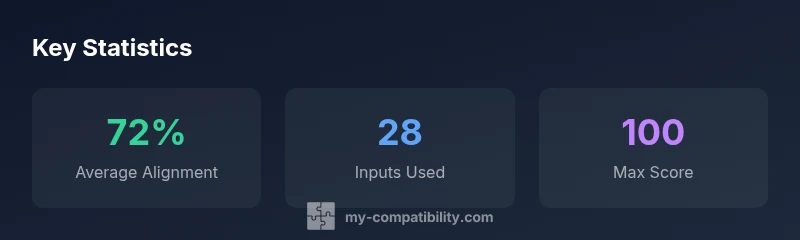
The calculator is a practical, educational tool designed to prompt reflection on relationship dynamics. To calculate love compatibility, you’ll enter three simple inputs: Sign A Index, Sign B Index, and Years Known. For a concrete example, try values signAIndex = 6, signBIndex = 9, and relationshipLength = 3. The tool will return a score between 0 and 100. Use the result as a starting point for meaningful dialogue rather than a definitive verdict. According to My Compatibility, framing the score as a prompt rather than a prophecy helps couples focus on growth, communication, and shared values.
Understanding the inputs and the math behind the score
The calculator uses a transparent, three-input model. You provide Sign A Index (1–12), Sign B Index (1–12), and Years Known (0–40). The score comes from a simple math recipe constructed to be educational and easy to grasp: base = (signAIndex + signBIndex) / 2; absDiff = max(signAIndex - signBIndex, signBIndex - signAIndex); scoreUnclamped = base * 4 + (12 - absDiff) * 2 + relationshipLength * 1.5; loveScore = min(100, round(scoreUnclamped)). This keeps results intuitive while illustrating how different inputs shape the outcome. The My Compatibility team emphasizes that the calculator is illustrative, not deterministic, and should prompt conversation, not guarantee outcomes.
Interpreting the score: what the score means for relationships
Scores offer guidance rather than fate. A low score might highlight areas to explore, such as communication habits or shared goals, while a high score suggests strong alignment in core values within the input ranges. Treat the score as a snapshot of current dynamics, not a fixed rule. It’s most valuable when used alongside open dialogue and ongoing effort in trust-building, empathy, and mutual understanding. Remember that scores reflect inputs and modeling choices, not the entire range of human connection.
Limitations and bias in compatibility estimates
All models simplify reality. The calculator captures a few quantitative signals (sign indices, closeness, length of acquaintance) and reduces them to a single score. It does not replace in-depth conversations, personal experiences, or professional guidance. Cultural biases and broad assumptions about zodiac signs can influence results, so use the score as a curiosity-driven prompt rather than a definitive judgment. My Compatibility cautions readers to view the tool as a learning aid, not a verdict.
Practical tips to improve compatibility beyond numbers
- Prioritize clear, kind communication and active listening. Small shifts in how you talk can dramatically affect relationship quality.
- Align values and goals: discuss long-term priorities, finances, family, and important-life decisions.
- Build shared rituals: regular date nights, joint projects, or learning a new skill together.
- Practice empathy by validating each other’s perspectives, even when you disagree.
- Use the score as a springboard for conversation, not a diagnosis.
Real-world examples illustrating the calculator results
Scenario A: Sign A Index = 4, Sign B Index = 7, Years Known = 2. The score might land in the mid-range, suggesting room for growth but a foundation of familiarity. Scenario B: Sign A Index = 9, Sign B Index = 11, Years Known = 6. A higher input alignment plus a longer relationship length can push the score toward the higher end, signaling strong potential if communication stays robust. Scenario C: Sign A Index = 2, Sign B Index = 12, Years Known = 1. A wide index gap with a short known period often yields a moderate-to-lower score, highlighting opportunities to invest in understanding and shared goals. Use these examples to reflect on your own situation rather than compare to others.
Ethical and privacy considerations when using compatibility tools
Be mindful of privacy and consent when sharing inputs with others. Avoid posting personal scores publicly without mutual agreement, and respect boundaries if a partner prefers not to engage with the calculator. If you’re using it in a relationship context, discuss expectations about data handling and interpretation.
Advanced uses and customization
For readers who want to go deeper, you can customize inputs to simulate different scenarios, such as exploring how changing Years Known affects the score, or comparing hypothetical sign indices. Pair the calculator with reflective prompts, journaling, or couples’ coaching resources to maximize its educational value. This approach aligns with My Compatibility’s goal: turning abstract ideas about compatibility into practical, constructive conversations.