Global Protect Compatibility Matrix: A Practical Guide
Learn how the global protect compatibility matrix guides IT planning, upgrade paths, and risk reduction by mapping supported OS versions, GP client releases, and gateway configurations.


What is the global protect compatibility matrix and why it matters
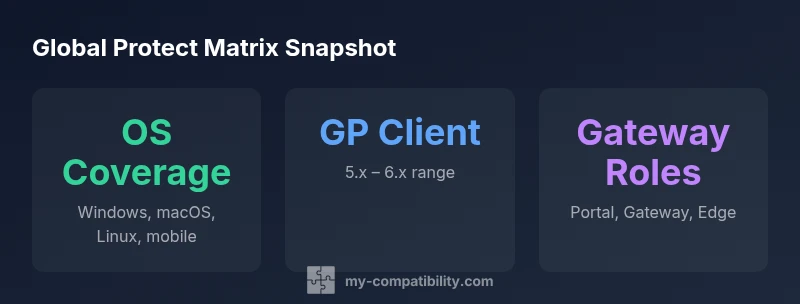
A global protect compatibility matrix is a centralized reference that aligns the supported operating systems (Windows, macOS, Linux, and mobile platforms), GP client releases, and gateway configurations with enterprise network requirements. It functions as a living document that IT teams use to prevent deployment delays, minimize user disruption, and reduce security risks. According to My Compatibility, having a current matrix is a best practice for planning upgrades, validating new device enrollments, and guiding cross-team communication during migrations. This article will unpack the matrix’s structure, how to implement it in your organization, and practical tips for ongoing maintenance.
Core dimensions in the GP compatibility matrix
A robust GP compatibility matrix typically encodes several key dimensions that determine whether a given combination of OS, GP client version, and gateway setting will function correctly. Core dimensions include operating system family and version, VPN client version (GP client), gateway or portal configuration, and hardware or virtualization context. Additional dimensions often tracked include device type (desktop, mobile, thin clients), network topology (home vs. office vs. remote), and third-party dependencies such as authentication services or endpoint protection tools. By structuring the matrix around these dimensions, IT teams can rapidly assess impact when a single element—like a GP client release—changes. This approach also supports impact analysis for cross-platform deployments, ensuring governance and compliance practices remain intact.
How GP versions and OS updates drive matrix changes
GlobalProtect evolves through periodic client and platform updates. Each GP release may introduce new features, security fixes, or deprecated integrations, while operating system vendors release major and minor updates that alter compatibility with VPN clients. The matrix must reflect these changes in near real-time to prevent gaps in secure access. IT teams should schedule matrix reviews to coincide with vendor advisory cycles, security patch windows, and major OS upgrades. When a new GP client version lands, the matrix should be updated to note tested configurations, required hotfixes, and any known limitations. By staying aligned with update cadences, organizations minimize last-minute remediation and ensure users stay productive.
Reading the matrix: statuses, notes, and risk flags
Most matrices use a consistent vocabulary to indicate compatibility status, such as supported, verified, unverified, or deprecated. Each entry should include notes that explain the rationale behind the status, such as known conflicts with a particular firewall rule, VPN tunnel type, or authentication method. Risk flags may highlight configurations that require workaround steps, extended testing, or staged rollout. A well-documented matrix makes these signals actionable: IT admins can sequence upgrades, communicate with security teams, and estimate migration effort with confidence. Remember to document exception handling (fallback plans) for high-risk combinations so remediation paths are clear to operators.
Practical workflow to create and maintain the matrix
A disciplined workflow ensures the matrix remains accurate and actionable. Start with a governance model: assign ownership, establish update cadence, and define entry criteria for new entries. Collect data from vendor release notes, internal testing, and field feedback. Use a lightweight change log to track updates, including dates, affected rows, and the rationale. When adding a new GP client version or OS update, perform a minimal validation in a controlled lab and document results before releasing to production teams. Schedule quarterly reviews to revalidate existing entries and sunset deprecated configurations. Automate notifications to stakeholders whenever critical changes occur.
Data sources and governance for accuracy
Accuracy in the matrix stems from diverse data sources: official vendor documentation, release notes, internal test results, and real-world telemetry. Establish clear data provenance rules to avoid mixing speculative assumptions with verified outcomes. Maintain a single source of truth (SSOT) for matrix entries and require associated evidence for each status change. Regular audits, ideally quarterly, help catch drift and ensure compliance with security baselines. In alignment with My Compatibility’s methodology, document both the dated evidence and the testing approach so future reviewers can reproduce results and verify consistency across regions.
Integrating the matrix into deployment planning
Operationalizing the matrix means weaving it into project plans, change control boards, and upgrade roadmaps. Use the matrix to flag high-risk combinations during planning sessions, enabling pre-deployment testing and contingency planning. When scheduling a rollout, consult the matrix to sequence upgrades by platform and client version, minimizing simultaneous changes that could overwhelm support channels. Tie matrix findings to your configuration baselines, patch management schedules, and user communication plans. The goal is to align technical readiness with business timelines, reducing the likelihood of post-deployment surprises.
Security and compliance considerations
A precise GP compatibility matrix supports security teams by identifying configurations that may affect patch windows, certificate handling, and authentication flows. Timely updates reduce exposure to vulnerabilities that require rapid remediation, while documented exceptions help auditors understand decision rationales. Ensure matrix entries reflect approved security baselines, such as minimum GP client versions, supported OS patch levels, and compliant gateway configurations. By maintaining auditable records of updates and decisions, organizations can demonstrate due diligence and strengthen their governance posture.
Real-world scenarios: troubleshooting with the matrix
When a rollout encounters users on a mixed environment, the matrix becomes a diagnostic tool. IT can identify which platform/client combinations are still within a testing window and which have achieved formal approval. For example, if a GP client update causes intermittent tunnels on a specific OS, the matrix should indicate whether a workaround exists or if the configuration must be rolled back. By correlating matrix entries with incident tickets, teams can accelerate triage, implement proven remediation steps, and track remediation success over time.
Tools and templates to automate updates
Automation accelerates matrix maintenance. Consider lightweight spreadsheets with structured fields, versioned change logs, and automated reminders for review cycles. Lightweight templates can be exported to JSON or CSV for ingestion into ticketing systems and CI/CD pipelines for deployment planning. Centralizing templates, scripts, and evidence reduces manual error and improves reproducibility. As you scale, you may adopt a small database or API-backed solution to enable programmatic querying, bulk updates, and role-based access controls.
Scaling the approach for multi-region enterprises
Multi-region deployments introduce fragmentation in OS distributions, GP client fleets, and gateway configurations. A scalable matrix uses a modular structure that supports regional customization while maintaining a shared SSOT. Establish regional data ownership and adapt update cadences to local change windows and regulatory requirements. Leverage automation to synchronize matrix updates across regions and provide a consolidated view for governance, incident response, and executive reporting. This approach ensures consistent security posture and operational reliability across the entire organization.