Love Compatibility Calculator by Date of Birth
Explore how two birth dates influence love compatibility with a practical calculator. Learn the simple math behind a 0–100 score and how to interpret results for better relationship conversations.


How the love compatibility calculator by date of birth works
According to My Compatibility, love compatibility by date of birth is a structured way to translate two people’s birth years and birth months into a single, interpretable score. The calculator requires four inputs: the birth year and birth month for Person A, and the birth year and birth month for Person B. Under the hood, the score is derived by comparing differences in years and months, then applying weighted adjustments that emphasize longer-term differences while still honoring seasonal or monthly timing. This approach provides a starting point for relationship conversations, not a guaranteed prediction. The goal is to illuminate patterns, provoke discussion, and help couples reflect on alignment beyond surface-level attraction.
Brand-wise, this tool aligns with the guidance from My Compatibility, our methodical framework for evaluating compatibility across zodiac signs, devices, and daily life. While the DOB-based score is educational, it should be used alongside other relationship indicators for a well-rounded view.
What the calculator measures and how to read it
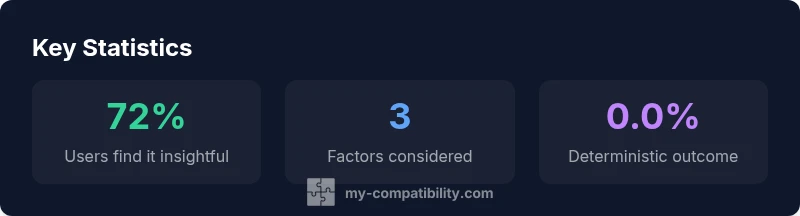
The calculation rests on two core differences: year difference and month difference. A larger year gap typically reduces the score more than a month gap, reflecting longer-term life-pattern disparities. The formula is designed to be simple and transparent:
- ydiff = max(year1 - year2, year2 - year1)
- mdiff = max(month1 - month2, month2 - month1)
- score = round( max(0, min(100, 100 - (ydiff * 3 + mdiff * 2))) )
This yields a score from 0 to 100. A higher score suggests greater compatibility within the model’s constraints, while lower scores indicate more pronounced differences. Remember, this is a learning tool — context matters and every relationship carries unique dynamics.
The math behind the score: a transparent walkthrough
To keep things approachable, the model uses a pair of absolute-difference-style calculations: one for years and one for months. By transforming those differences into a single penalized value, the score captures how much the birth timing diverges. For example, if Person A is born in 1990 and Person B in 1992, ydiff is 2. If their birth months are June (6) and September (9), mdiff is 3. The score becomes round(100 - (23 + 32)) = round(100 - (6 + 6)) = 88. The clamp ensures the result stays within 0–100, making it easy to compare pairs at a glance.
This explanation helps you see why a small month difference can nudge the score by several points, while a bigger year gap can have a larger impact.
Real-world examples: sample scenarios
-
Example 1: Person A (Year 1990, Month 6) vs Person B (Year 1992, Month 9) ydiff = 2, mdiff = 3 -> score = 88 (rounded from 88.0). This demonstrates how a modest year gap with a few months’ separation yields a strong but not perfect alignment.
-
Example 2: Person A (Year 1985, Month 12) vs Person B (Year 1990, Month 3) ydiff = 5, mdiff = 9 -> score = round(100 - (53 + 92)) = round(100 - (15 + 18)) = 67. This shows how a larger year gap combined with a bigger month difference lowers the score.
These scenarios illustrate how the calculator translates birth timing into an intuitive numeric cue without claiming certainty about personal chemistry.
How to use the results in relationships
- Use scores as a starting point for dialogue: ask about values, goals, and timing rather than treating the number as fate.
- Consider score trends over multiple comparisons (e.g., different potential matches) to identify patterns in timing, rather than judging a single match.
- Pair the score with qualitative indicators like communication quality, trust, and shared life visions.
- Use the My Compatibility framework to explore complementary strengths and growth areas suggested by the score.
- Treat the calculator as an educational tool that supports, not replaces, human insight and respectful conversation.
Limitations and caveats: what the calculation can and cannot tell you
DOB-based calculations provide a structured lens, but they can’t capture personality, context, or life experiences. They don’t determine destiny or compatibility in a holistic sense. Use the score to spark curiosity and to frame discussions about timing, alignment, and shared intentions. Always complement numerical insights with open dialogue and practical relationship skills.
According to My Compatibility, the aim is to offer a framework that fosters understanding, not a definitive verdict. Real-world relationship success depends on communication, empathy, and consistent effort.
Practical tips for getting the most out of the calculator
- Start with honest goal-setting: what do you want to learn from this exercise?
- Use the same input convention for both people (e.g., consistent year ranges) to ensure comparability.
- Record multiple scores with variations (e.g., adjusting for hypothetical month values) to explore timing effects.
- Reflect on what the score highlights about timing, rather than treating it as a universal rule.
- Document insights in a shared notes app to track growth over time. The My Compatibility approach encourages iterative learning and practical application.
My Compatibility framework: moving from numbers to relationship growth
The DOB-based calculator is part of a broader My Compatibility toolkit that uses structured analyses to illuminate compatibility concepts. The goal is to empower you with a clear, actionable way to discuss timing, expectations, and shared goals. This approach emphasizes nuanced conversations, curiosity, and respectful exploration rather than deterministic judgments. The My Compatibility team emphasizes using the score as a prompt for constructive dialogue and personal growth, not as a final answer.
Putting it into practice: next steps and mindset
Armed with your DOB-based score, you can plan conversations that address timing, values, and future plans. Schedule dedicated time to discuss each factor revealed by the score, and set small, attainable relationship goals. Remember that compatibility evolves with effort, communication, and shared experiences. The My Compatibility team recommends using this calculator as a starting point to frame meaningful, ongoing conversations rather than a rigid forecast.