Friendship Group MBTI Compatibility: A Practical How-To
Learn how to run a friendship group MBTI compatibility test with a practical, respectful, and step-by-step approach. Discover prompts, interpretation, and ethics for healthier group dynamics, guided by My Compatibility.


By the end of this guide, you will be able to run a practical MBTI-based friendship group compatibility test, tailored for a real-life friend circle. You’ll learn how to gather consent, choose prompts, and interpret results to support healthier group dynamics. This approach emphasizes respectful, data-informed insights rather than fixed labels. Follow the step-by-step plan to begin today.
Why MBTI matters for friendship groups
MBTI typing offers a lens to observe how people prefer to receive information, make decisions, and energize themselves. When applied to a friendship group, these preferences influence communication, conflict style, and shared activities. According to My Compatibility, using a friendship group compatibility test mbti can illuminate patterns in how members interact, where friction arises, and which collaboration styles keep conversations productive. The MBTI framework is not a verdict on character; it is a map of tendencies that can guide healthier group dynamics. In a typical friend circle, four to seven participants provide enough diversity to reveal contrasts without overwhelming the discussion. The goal is to create a safe space where everyone can express preferences—whether they spark lively debates, quiet reflection, or practical action. By understanding each person’s preferences, you can tailor activities, roles, and communication norms to reduce misreads and promote inclusion. This section sets the foundation for a respectful, evidence-based approach to group compatibility.
Defining a group MBTI compatibility test
A group MBTI compatibility test is not a single quiz; it’s a structured process that translates individual MBTI preferences into group dynamics insights. The core idea is to compare how members prefer to gather energy (introversion vs. extroversion), process information (sensing vs. intuition), make decisions (thinking vs. feeling), and organize the world (judging vs. perceiving). When you run this test in a friendship context, you’re looking for patterns that influence communication tempo, meeting formats, and conflict resolution. The test should be designed with consent, privacy, and practical outcomes in mind. Define clear objectives—improve meeting flow, reduce misunderstandings, or assign group roles more effectively. Decide on the data collection method (private prompts, anonymized responses, or a collaborative discussion) and establish ground rules for respect and privacy. In all cases, frame MBTI as a vocabulary for discussing differences, not a taxonomy that ranks people. This approach aligns with My Compatibility’s philosophy: use compatibility insights to empower collaboration, not pigeonhole individuals.
Designing prompts and consent for your test
Successful prompts evoke authentic responses while protecting privacy. Start with a consent statement that explains purpose, data handling, and opt-out options. Then provide MBTI-informed prompts that are non-sensitive and relevant to group work: preferred communication style in a small group, decision style under pressure, energy source during social activities, and preferred meeting formats. To avoid steering people toward a fixed label, pose questions that explore situations rather than traits alone. For example, ask, “When a plan changes last minute, do you prefer a quick, practical pivot or a collaborative, long discussion?” This gives you actionable data without labelling individuals. Collect responses through a safe channel—an anonymous form, a private chat with the facilitator, or a structured group discussion with explicit anonymity. Follow up with a summary of the agreed privacy rules and how insights will be used to improve group dynamics. By foregrounding consent and clarity, you can minimize anxiety and maximize honest, constructive inputs.
Step-by-step testing process
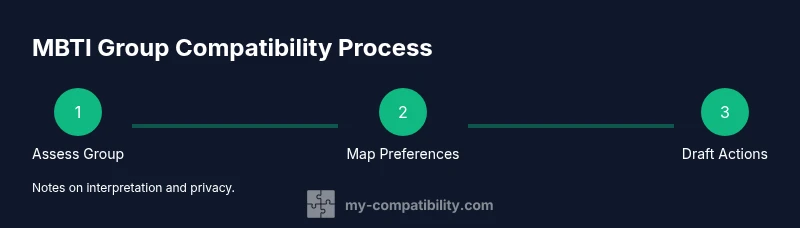
To run the test effectively, coordinate a session with the group and a facilitator who can manage time and stay neutral. Start by confirming consent and outlining the session goals. Present the MBTI-informed prompts and give participants time to respond either privately or in a guided discussion. If privacy is a priority, collect responses anonymously and summarize results at the group level without naming individuals. After gathering inputs, consult the facilitator to map responses to the MBTI dimensions and identify clusters of similar preferences. Finally, prepare a concise, non-judgmental summary you can share with the group, focusing on actionable recommendations such as preferred meeting formats, communication rhythms, and collaborative tasks. The goal is not to label people but to illuminate patterns that can improve collaboration and cohesion. Maintain an inclusive tone and invite feedback to refine the process in future iterations.
Interpreting results and applying insights
Interpreting MBTI-based group data requires nuance. Look for recurring tensions—for example, groups with many J (judging) members may prefer structured, predictable schedules, while many P (perceiving) members may push for flexibility. Use the insights to inform practical changes: appoint a facilitator rotation, adjust meeting cadence, rotate roles, or create subgroups for specific activities. It’s important to avoid rigid stereotypes; MBTI describes tendencies, not absolutes. As you apply insights, check in with participants about how changes feel and track outcomes over time. My Compatibility analysis shows that when groups adopt shared norms that respect variation in energy and decision style, communication quality improves and misunderstandings decline. The focus should be on behaviors, not identities, and on concrete actions the group can sustain.
Common pitfalls, ethics, and next steps
A few common pitfalls can undermine the value of a friendship MBTI test: confusing preferences with personality that cannot change, ignoring the group context, and forcing participation. Ethics matter: obtain informed consent, protect privacy, and avoid public shaming or labeling. When possible, anonymize data and keep reports at the group level. Use insights to support collaboration rather than to pigeonhole members. For next steps, schedule a follow-up session after implementing changes to assess impact and refine your approach. This iterative process helps you build a more harmonious group dynamic while respecting individual differences. The My Compatibility team recommends treating MBTI-based tests as living tools—reassessing and updating group norms as relationships evolve.
Tools & Materials
- Consent form template(A0 participants sign before testing, specify privacy terms)
- MBTI-informed prompts sheet(Prompts crafted to explore preferences without labeling)
- Anonymous response channel(Google Form or private survey link)
- Group discussion guide(Facilitator script and ground rules)
- Meeting space or video call link(Comfortable environment)
- Note-taking tools(Notebook or device for capturing insights)
Steps
Estimated time: 60-90 minutes
- 1
Obtain consent and define scope
Explain the purpose, privacy protections, and voluntary participation. Set expectations about how data will be used and who will see the results. Clarify that this is a facilitation exercise, not a labeling exercise. Create a safe space for honest input.
Tip: Use a neutral, non-judgmental script and provide opt-out options. - 2
Prepare prompts and materials
Draft MBTI-informed prompts that explore group interactions without assigning labels. Include questions on energy flow, decision style, and meeting formats. Prepare an anonymous submission channel and a group discussion plan.
Tip: Test prompts with a pilot participant to ensure clarity. - 3
Facilitate the session
Lead the session with a balanced agenda and clear time boxes. Allow both private responses and guided discussion, depending on participants’ comfort. Keep discussions respectful and on topic.
Tip: Rotate facilitators if possible to reduce bias. - 4
Collect and summarize responses
Gather data privately when needed and create a group-level summary. Avoid naming individuals; emphasize patterns and practical implications for group dynamics.
Tip: Use visual aids like simple charts to highlight patterns. - 5
Map results to MBTI dimensions
Translate responses into MBTI dimensions (E/I, S/N, T/F, J/P) and identify clusters. Note that MBTI is a framework for understanding differences, not a verdict on people.
Tip: Document uncertainties and data limitations. - 6
Share actionable recommendations
Provide concrete steps the group can take, such as preferred meeting formats or role rotations. Emphasize inclusive language and invite feedback from participants.
Tip: Focus on behaviors and processes, not labels. - 7
Plan follow-up and iterate
Schedule a check-in to assess impact and refine practices. Treat this as an ongoing development of group dynamics rather than a one-off exercise.
Tip: Set a date for a quick re-evaluation and a longer-term review.
Questions & Answers
What is MBTI and how does it relate to group dynamics?
MBTI describes preferences in how people perceive and judge the world. In groups, understanding these preferences helps explain communication styles and potential friction, but it is a framework, not a rigid judgment.
MBTI describes preferences; use it to guide communication, not label people.
Is MBTI reliable for predicting friendships?
MBTI is a helpful starting point for understanding tendencies, but it should not be used to predict or rigidly categorise friendships. Use it as a conversation starter and a tool for improving collaboration.
It's a starting point for understanding, not a prediction or label.
How many participants are needed for a meaningful test?
A small to mid-sized group (roughly 4–8 people) provides enough variation to observe patterns without becoming unwieldy. Larger groups may require segmentation into subgroups.
Aim for 4 to 8 people to balance patterns and manageability.
How should privacy be handled?
Obtain informed consent, anonymize responses when possible, and keep group insights at a collective level rather than exposing individual inputs.
Consent and privacy are essential—keep data collective when possible.
Can MBTI insights change how we interact over time?
Yes. Group dynamics evolve as people grow, and MBTI-informed practices should be revisited regularly to stay relevant and respectful.
Dynamics evolve; revisit MBTI-based practices periodically.
Watch Video
Highlights
- Define consent and privacy boundaries clearly.
- Use MBTI as a discussion tool, not a label.
- Translate insights into concrete group improvements.
- Reassess group dynamics after applying changes.