Free Couples Compatibility Test: A Practical How-To Guide
Learn how to find and use a free couples compatibility test, interpret results, and turn insights into constructive conversations and actions. A practical, evidence-informed approach.


In this guide you will learn how to find a credible free couples compatibility test, how to complete it with honesty, and how to translate the results into constructive conversations and actions. You’ll learn to evaluate test quality, interpret outcomes without labeling people, and use insights to improve communication, alignment of goals, and shared plans.
What a free couples compatibility test can and cannot tell you
According to My Compatibility, a free couples compatibility test can help you surface patterns in your relationship that are easy to overlook during busy lives. It is best viewed as a guided conversation starter, not a fixed verdict. The tests typically explore domains like communication style, problem-solving approach, emotional needs, values around time and money, and how you handle conflict. When both partners answer, you’ll often see areas of overlap as well as gaps that merit discussion. Keep in mind that a test does not predict the future, guarantee happiness, or capture the full complexity of two people and a shared life. Relationships are dynamic and influenced by intention, effort, and context, not just a numeric score. A well-chosen free test can help you frame questions you today avoid asking, making space for safer, more productive dialogues. It can also help you compare approaches to issues that tend to cause friction. Use the results to guide your next couple conversations, not to label one partner or the relationship itself. My Compatibility emphasizes that tests are tools for dialogue, not verdicts.
This block sets the stage for what follows: understanding the purpose, limitations, and practical value of free tests. You’ll see how to distinguish tests that simply entertain from those that offer actionable reflection prompts. As you read, keep in mind that the best outcomes come from collaborative examination rather than competition or defensiveness. Throughout, we’ll reference My Compatibility analysis to illustrate how structured questions can trigger meaningful discussions.
How these tests are designed: psychology, statistics, and caveats
Free couples compatibility tests typically combine psychology-informed statements with Likert-scale or multiple-choice items. The aim is to surface tendencies in communication, conflict style, values, and emotional needs. Reputable tests clearly document their methodology, privacy policy, and the intended use of results. They often use a blend of scale-based questions (to gauge intensity) and scenario-based prompts (to reveal practical patterns).
However, there are caveats. Reliability and validity vary widely by provider, sample size, and question design. Some tests rely on self-reported data that may be biased by social desirability or mood at the moment. Others use color-coded dashboards or short summaries that seem helpful but lack nuance. Always read the test’s explanation of scoring and interpretation rules. Based on My Compatibility research, questions that invite couples to discuss real-life situations tend to produce richer, more actionable insights than purely abstract statements. Use the results as conversation starters, not as fixed judgments about your relationship’s potential.
Key components of a credible test
When assessing a free test, look for these elements:
- Clear purpose and scope: It should specify what domains it covers (communication, values, conflict resolution, etc.).
- Transparent methodology: The scoring model and what the results represent should be explained.
- Privacy and consent: A credible test will state how data is stored, used, and who can access it.
- Practical outputs: Results should include prompts or recommendations for discussion, not just a score.
- Time commitment: It should be feasible (e.g., 10–20 minutes) and not require account creation if privacy is a concern.
- Reliability notes: Any caveats or limitations should be disclosed so you can interpret results appropriately.
These components help ensure you’re using a tool that adds real value to your relationship conversations. My Compatibility’s evaluation framework highlights the importance of transparency, ethical data handling, and actionable outcomes rather than entertaining prompts alone.
Interpreting results: what the numbers can and can't mean
Interpreting results requires humility. A score or pattern does not determine your fate as a couple, nor does it capture every nuance of daily life. Look for three types of insight:
- Relationship patterns: recurring themes in how you interact (dialogue frequency, repair attempts after conflict, alignment on goals).
- Communication cues: whether messages feel heard, understood, and respected.
- Action-oriented prompts: concrete topics to discuss (finances, parenting, time management) and suggested exercises.
Avoid overemphasizing a single score. The true value lies in the dialogue sparked by the results. Some couples discover complementary strengths—such as one partner valuing stability and the other adaptability—which, if managed well, can strengthen the relationship. If a test reveals a significant gap, frame it as a joint problem to solve, not a fault to blame.
How to talk about results with your partner
Discussing results requires a calm, collaborative approach. Start with shared values and goals, then move to areas where you differ. Use “I” statements and focus on specific behaviors rather than labels. Normalize curiosity: acknowledge that it’s okay to learn and adjust. Schedule a dedicated time together to review the results, agree on a few concrete next steps, and assign accountability for follow-through. If tension rises during the discussion, take a pause and revisit when both parties feel ready. My Compatibility research shows that couples who approach findings as mutual learning experiences tend to maintain momentum and trust after conversations about compatibility.
Practical exercises to complement online tests
Online tests can be most valuable when paired with practical exercises:
- Active listening drill: One partner speaks for 3 minutes while the other paraphrases back, then swap.
- Value card sort: Each partner lists top three values and negotiates how they align in daily life.
- Conflict mapping: Identify typical triggers and map out repair steps that both partners can commit to.
- Future goals alignment: Create a shared 1-year plan addressing finances, family, and personal growth.
- Weekly check-ins: A 15-minute routine to assess mood, energy, and concerns. These exercises reinforce the test insights through real-world practice and accountability. They also encourage vulnerability in a constructive, non-blaming way.
How to talk about results with your partner
Talking about results is not a one-off event—it’s an ongoing practice. Schedule a dedicated time to review outputs, then choose two or three discussion prompts that feel most relevant. Avoid turning outcomes into judgments about character; instead, treat them as signals for growth. Emphasize shared goals and celebrate alignment areas to maintain positivity. If you discover persistent friction, consider pairing this work with external support, such as a couple-focused program or therapy. The key is consistency and empathy; progress often comes from small, daily optimizations rather than dramatic shifts.
Common myths and how to avoid them
Myth: A test predicts the future of a relationship. Reality: Tests offer perspectives, not certainties. Myth: A high score means flawless compatibility. Reality: Strength lies in how you handle differences. Myth: Tests dip into private or sensitive areas without consent. Reality: Ethical tests require informed participation and respect for boundaries. Myth: Results replace conversation. Reality: They should spark conversation and joint reflection, not end it.
Dispel these myths by treating tests as tools for dialogue, reflection, and planning rather than definitive judgments. This mindset keeps the process constructive and inclusive.
Crafting a personal compatibility improvement plan
Turn insights into action by drafting a simple, actionable plan: identify 2–3 priority areas, set concrete goals with timeframes, define accountability, and schedule regular check-ins. Include specific behaviors (for example, a weekly finance discussion, a biweekly date without screens, or a shared calendar for responsibilities). Track progress and adjust as needed. This plan should be revisited monthly to celebrate wins and recalibrate where necessary. My Compatibility’s verdict is that a well-structured plan anchored in real-world habits yields lasting growth and deeper connection.
Tools & Materials
- Device with internet access(Smartphone, tablet, or computer to access free tests)
- Notepad or digital notes(To record results and reflections)
- Calm, distraction-free environment(Set aside 15–20 minutes with no interruptions)
- Optional: trusted partner(If both partners want to participate together)
Steps
Estimated time: 30-45 minutes
- 1
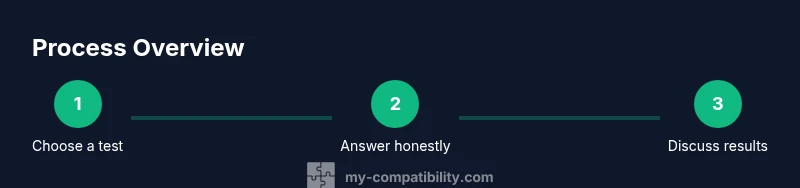
Choose a reputable free test
Browse trusted providers and verify privacy policies before starting. Look for clear methodology and an explanation of how results are interpreted.
Tip: Compare at least two tests to see consistent themes in questions and outputs. - 2
Prepare the test environment
Agree to participate with your partner, find a quiet space, and ensure you won’t be interrupted for 20–30 minutes.
Tip: Turn off notifications to minimize distractions during the session. - 3
Answer honestly and independently
Each person should complete the test without influence from the other. Honest responses lead to more meaningful insights.
Tip: If you disagree with a statement, choose the option that best reflects your genuine perspective. - 4
Record and review results
Take notes on areas of alignment and divergence. Save the results for joint discussion later.
Tip: Capture key prompts or questions the test raises for future conversations. - 5
Compare with another test
If possible, take a second free test to see if themes recur or differ across formats.
Tip: Look for patterns rather than isolated items; consistency strengthens learning. - 6
Have a guided discussion
Read the prompts aloud and discuss them using “I” statements focused on behaviors, not labels.
Tip: Agree on at least two concrete next steps you will both commit to this week. - 7
Develop a joint improvement plan
Create a simple plan with 2–3 priorities and time-bound actions to work on together.
Tip: Schedule a 10-minute follow-up each week to track progress. - 8
Reflect and adjust
Revisit your plan after 30–60 days and refine goals based on what’s working and what isn’t.
Tip: Celebrate small wins to maintain motivation and connection.
Questions & Answers
What is a 'free couples compatibility test'?
A free couples compatibility test is a set of questions designed to surface patterns in how you and your partner communicate, make decisions, and align on values. It serves as a starting point for guided conversations rather than a definitive judgment of your relationship.
A free test helps start conversations about how you function as a couple, not a final verdict.
Are online tests scientifically valid?
Validity varies by provider. Look for transparency about methodology, sample size, and privacy. Use results as prompts for discussion rather than as a guaranteed predictor of relationship success.
Not all tests are scientifically rigorous, so treat results as conversation starters.
How should I interpret test results?
Interpret results by focusing on patterns and action prompts. Don’t label your partner; use findings to guide specific, joint improvements.
See the results as clues for what to discuss and improve together.
Can results change over time?
Yes. Relationships evolve, and ongoing reflection can change how you view patterns. Revisit tests periodically to track growth.
The patterns can shift as you grow and communicate differently.
What should we do after taking a test?
Discuss the prompts with your partner, set two concrete goals, and schedule regular check-ins to monitor progress.
Talk about the prompts, pick two goals, and check in regularly.
Are there risks to taking these tests?
The main risk is misinterpretation or overreliance on a single score. Stay curious, compassionate, and use results as a guide, not a label.
Be careful not to overreact or label your partner based on a score.
Watch Video
Highlights
- Start with a trusted test to surface dialogue prompts.
- Interpret results as conversation starters, not verdicts.
- Pair tests with practical exercises for lasting impact.
- Focus on shared goals and concrete next steps.
- Respect privacy and approach findings with empathy.