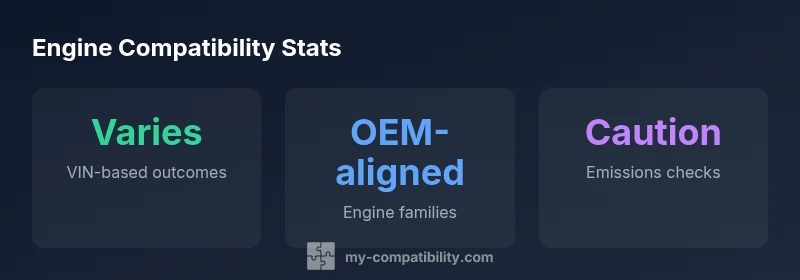
What engines are compatible with my car
Discover how to identify engines compatible with your car using VIN data, OEM listings, and ECU checks. A practical, data-driven guide by My Compatibility for repairs, swaps, and maintenance.


The engines that are compatible with your car depend on the exact model, year, and VIN. In practice, you should look for engines within the OEM family or those explicitly listed as compatible by the manufacturer. Critical checks include ECU compatibility, emissions certification, mounting points, transmission interface, fuel system compatibility, and exhaust routing. For VIN-specific results, consult dealership service tooling or a qualified mechanic.
What engine compatibility means for your car
When we talk about what engines are compatible with my car, we start with the basics: the exact model, year, and VIN. Compatibility is not a generic checkbox; it is a precise alignment of mechanical interfaces (mounts, bellhousing, and transmission), electronics (ECU/PCM, sensors, and wiring), and regulatory factors (emissions and warranty terms). In practice, you should search for engines within the OEM family or those explicitly listed as compatible by the manufacturer. This ensures you don’t run into mounting conflicts or software incompatibilities that can affect performance, safety, and reliability.
How manufacturers define engine compatibility
Manufacturers define compatibility through a combination of physical fit, electronic integration, and regulatory compliance. They publish engine families that share mounting points, transmission interfaces, and ECU configurations. In many cases, engines within the same family are considered compatible, provided the VIN confirms the exact variant. ECU compatibility is critical: a different engine may require reprogramming, adaptors, or supplemental hardware to communicate with the vehicle’s network. Emissions certifications and regulatory approvals also determine whether a swap is allowed for road use.
Key compatibility checks you should perform
- VIN verification to confirm the exact model and engine variant.
- Physical mounting and bellhousing alignment with the transmission.
- ECU compatibility, harness integration, and possible reprogramming needs.
- Fuel system compatibility (injection type, rail pressure, sensors).
- Cooling system, radiator fit, and thermostat compatibility.
- Intake/exhaust routing and exhaust manifold interfaces.
- Emissions certification and local compliance requirements.
- Warranty implications and dealer or manufacturer guidance.
Document every step and document discrepancies early to avoid costly mistakes.
VIN, OEM part numbers, and data sources
The VIN is a linchpin for engine compatibility. It encodes the model year, plant, and grouping that manufacturers use to validate engine options. Cross-reference VIN data with OEM part numbers to confirm that the replacement engine aligns with the original configuration. When in doubt, obtain official documentation from a dealer or the manufacturer’s service portal. Supplemental data from reputable databases can help, but VIN validation remains the reference point for fitment and legality.
Engine swap feasibility: when it makes sense
Engine swaps are more feasible when you are dealing with engines within the same generation family, or when the swap preserves the original turbocharging, fuel system, and ECM architecture. The more a swap diverges from the original, the higher the likelihood you will encounter immovable incompatibilities. For most cars, an OEM-specified replacement or a factory-supported upgrade is the safest path. Consider professional evaluation to assess scope, cost, and risk.
Practical steps to verify compatibility
- Gather your VIN and check the manufacturer’s engine options for your exact model year.
- Compare engine mounting points, transmission bolt patterns, and bellhousing dimensions.
- Confirm ECU compatibility or plan for reprogramming with a qualified technician.
- Verify fuel system compatibility, ignition timing, and sensor interfaces.
- Ensure emissions certification and local regulatory compliance.
- Confirm warranty terms and potential impacts before purchasing any engine.
- If uncertain, consult a dealership service department or a certified independent mechanic.
A methodical checklist reduces guesswork and protects against costly misfits.
ECU, software, and fuel-system considerations
Engine electronics are often the most fragile aspect of compatibility. Even engines that physically fit may require PCM reprogramming, wiring harness modifications, or module replacements to ensure proper communication across the vehicle network. Fuel-system compatibility, including injector type, pressure, and fuel pump capacity, is essential for reliable operation. Emissions-related software must be adjusted to maintain compliance and pass inspections where required.
Emissions, warranties, and legality considerations
Legal use, warranty coverage, and performance can hinge on emissions compliance. Some engine swaps are restricted or require certification and inspections. Warranty terms frequently restrict or void coverage for non-approved engine changes. Before proceeding, verify local regulations, applicable inspections, and any impact on the vehicle’s warranty. Planning ahead reduces risk and ensures you stay within legal and financial boundaries.
Gathering reliable data and avoiding scams
Rely on official sources first: OEM catalogs, dealer tools, and manufacturer service portals. Be wary of third-party datasets lacking VIN references or model-specific details. When reviewing listings or rebuilds, demand verifiable documentation—VIN ranges, part numbers, and emission certificates. If a deal seems too good to be true, pause and verify through a trusted dealer or independent mechanic.
Engine compatibility data table
| Aspect | What it checks | Recommended action |
|---|---|---|
| VIN matching | Identifies exact model and engine availability | Use official VIN decoder or dealer |
| ECU compatibility | Engine control integration | Confirm compatibility or plan reprogramming |
| Emissions compliance | Certifications and legal use | Verify national/local approvals |
Questions & Answers
What does engine compatibility really mean for my car?
Engine compatibility means the new engine can physically fit, electronically communicate, and legally operate under local emissions and warranty rules for your exact model and year. VIN data and OEM documentation are the primary sources of truth. Expect some cases to require reprogramming and minor hardware changes.
Engine compatibility means the new engine fits, talks to the car’s computer, and meets emissions and warranty rules. VIN data and OEM docs are essential; some swaps need software updates.
Can I swap in a different brand engine?
Brand swapping is possible in some scenarios, but it requires confidence that mounting, ECU integration, and fuel systems align. Emissions paperwork and warranty terms should be reviewed. A professional evaluation helps determine feasibility and cost.
You can swap brands in some cases, but you must verify mounting, ECU, and emissions. Get a pro to assess feasibility.
Will an engine swap void my warranty?
Most manufacturers restrict or void warranties for non-approved engine swaps. This depends on the manufacturer, model, and local regulations. Always check the warranty terms and consult the dealer before proceeding.
Swapping engines often affects warranties. Check terms with the dealer before you start.
Do I need to modify the transmission for a new engine?
Often yes, especially if the engine variant uses a different bellhousing or torque characteristics. You may need adapters, harness changes, or even a different transmission. An expert assessment helps avoid costly mismatches.
Usually yes. You might need adapters or even a different transmission—have a pro check it.
How can VIN data help with engine compatibility?
VIN data identifies the exact model and engine pairing approved by the manufacturer. Use official VIN decoding tools or dealer portals to verify fitment before purchase.
VIN data tells you exactly which engine pairs are approved for your car. Check with the dealer or official tools.
Is a swap legal everywhere?
Legality depends on local emissions rules and inspections. Some regions require certifications or additional tests for a swapped engine. Always verify with local authorities.
Rules vary by location; some places require certifications for engine swaps. Check with local authorities.
“Engine compatibility is not just about bolts—it's about harmonizing the ECU, fuel system, and emissions controls with a new unit. Plan for professional reprogramming and verification before any swap.”
Highlights
- Know your VIN first to determine exact engine options
- Prefer OEM-listed engines to minimize fitment risk
- Plan for ECU and emissions compatibility before swapping
- Check warranty terms and legality with a professional
- Use VIN-based data as the primary source of truth