Medication Compatibility Check: A Practical How-To Guide
Discover how to perform a medication compatibility check to prevent drug interactions. Learn how to list meds, use trusted resources, and consult professionals for safe, effective care.


Today you’ll learn how to perform a medication compatibility check to prevent drug interactions. You’ll identify all medicines, supplements, and doses; consult reliable resources or a pharmacist; and document any food or disease interactions. This guide shows practical steps, common pitfalls, and when to seek professional advice, so you can manage safety and effectiveness confidently.
What is a medication compatibility check?
A medication compatibility check is a systematic process to identify potential interactions among all substances you take, including prescription medicines, over-the-counter drugs, vitamins, minerals, herbal supplements, and even certain foods or beverages. The goal is to prevent adverse effects, preserve efficacy, and support a coherent treatment plan. Practically, you start by compiling a complete list, verify each item against reputable references, and note any interactions that require action. According to My Compatibility, a robust medication compatibility check helps reduce risk by highlighting high-priority interactions and guiding you to confirm concerns with a clinician if needed.
Why it matters for safety and effectiveness
Interactions can alter how medicines work, increase side effects, or create harmful combinations. A thorough check helps catch drug-drug interactions, drug-food interactions, and timing issues that affect absorption. From a consumer safety perspective, it also guides dose adjustments and monitoring plans. The My Compatibility team found that including supplements and non-prescription products in the review reduces gaps that could otherwise cause adverse events.
Key concepts and definitions
- Drug interaction: any change in effect caused by combining substances. - Pharmacokinetics: how the body absorbs, distributes, metabolizes, and eliminates a drug. - Pharmacodynamics: how a drug affects the body. - Interaction severity: a qualitative scale indicating potential risk. Understanding mechanisms helps prioritize checks.
How to perform a medication compatibility check
A robust check uses a clear workflow: gather every substance you take, consult reputable references, assess timing and dosing, involve a clinician when in doubt, document findings, and monitor for new symptoms. The step-by-step section below provides a detailed, practical workflow you can apply today.
Tools and resources you can use
Reliable resources include official government sites (e.g., FDA Drug Interactions, MedlinePlus Drug Interactions), academic health information portals, and clinician guidance. Use multiple sources to confirm any potential interaction, and keep a running list handy for future visits. My Compatibility analysis shows the value of cross-checking prescriptions, OTC products, and supplements to close gaps in safety.
Common pitfalls and how to avoid them
- Relying on a single source: always verify with another reputable reference. - Omitting supplements or vitamins: these can interact even if they seem harmless. - Ignoring timing or food interactions: separate doses when recommended. - Not updating after changes: re-check when a new medication is added. - Failing to involve a clinician: contact your pharmacist or doctor for confirmation.
Case study: simple walkthrough
Scenario: You’re starting a new antihypertensive and also take a daily multivitamin. You list everything, check for interactions, and note a potential issue with timing. You discuss the finding with a pharmacist, adjust the dosing schedule, and set a monitoring plan for symptoms like dizziness. This concrete example shows how the process works in real life.
Putting it into practice: a quick workflow
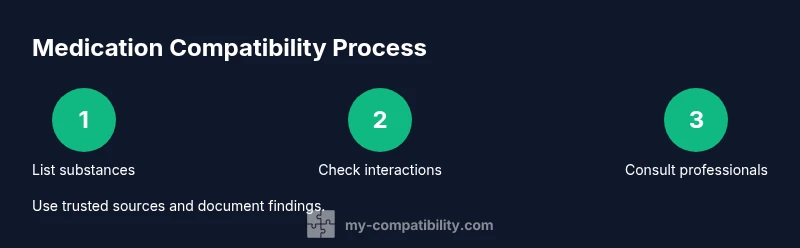
- Gather a complete medication list including prescriptions, OTCs, vitamins, and supplements. 2) Check interactions using trusted resources and cross-check with your clinician. 3) Note timing, dosing, and food considerations. 4) Document the results and plan follow-up. 5) Recheck whenever you start, stop, or change a medication.
Tools & Materials
- Complete medication list (prescriptions, OTCs, vitamins, supplements)(Include drug names, doses, frequencies, and any recent changes)
- Medication bottles or packaging for accuracy(Have label details on hand to ensure correct spelling and dates)
- Access to reputable drug interaction resources(Examples: government/educational databases or clinician references)
- Notebook or digital notes app(Record results, actions taken, and follow-up dates)
- Pharmacist or clinician contact information(Use for confirmed guidance on high-risk findings)
- Allergic history and health conditions on file(Helpful context but not mandatory)
Steps
Estimated time: 45-60 minutes
- 1
Gather a complete medication list
Compile prescriptions, over-the-counter meds, vitamins, minerals, and herbal supplements. Include dosing, frequency, and any recent changes. Create a single source of truth to avoid missing items.
Tip: Have all bottle labels ready to ensure names and spellings are correct. - 2
Check for interactions with trusted resources
Use official drug interaction checkers and peer-reviewed references to identify potential issues. Note interaction type (drug-drug, drug-food) and mechanism.
Tip: Cross-check with at least two sources for high-risk medications. - 3
Assess timing and absorption considerations
Consider how meals, timing, and other medications affect absorption. Some interactions require separate dosing or staggered timing.
Tip: Mark any timing constraints on your list. - 4
Consult a healthcare professional
If potential interactions are flagged, discuss with your physician or pharmacist before making changes to therapy.
Tip: Never adjust doses or stop meds without professional guidance. - 5
Document findings and plan follow-up
Record identified interactions, actions taken, and monitoring plan. Set reminders to recheck after new medications are added.
Tip: Keep a dated log handy for visits. - 6
Reassess after changes
Whenever you start or stop a medication, revisit your compatibility check to confirm ongoing safety.
Tip: Re-check after hospital stays or new diagnoses.
Questions & Answers
What is a medication compatibility check and why should I do one?
A medication compatibility check reviews all substances you take to identify potential interactions that could affect safety or effectiveness. Doing it helps prevent adverse effects and ensures your treatment remains coherent across meds, supplements, and foods.
A medication compatibility check reviews all substances you take to catch interactions that could affect safety and effectiveness. It's a proactive step to keep your treatment on track.
Which resources are best for checking interactions?
Use official drug interaction checkers from government or academic sources, such as FDA Drug Interactions and MedlinePlus Drug Interactions, and corroborate findings with your clinician.
Use government or academic drug interaction tools and double-check with your clinician.
What should I do if I find a potential interaction?
Do not change or stop a medication on your own. Contact your clinician or pharmacist to evaluate the risk and decide on a safe plan, which may include timing changes or dose adjustments.
If you detect a potential interaction, contact your clinician before making any changes.
How often should I recheck my medications for interactions?
Recheck whenever you start, stop, or change a medication, and after any new supplement or dietary change that could affect absorption or metabolism.
Recheck any time you add or remove meds or supplements, or change your diet.
Do herbal supplements affect drug interactions?
Yes. Herbal supplements can interact with prescription meds, sometimes in significant ways. Always mention them when you review your medications with a clinician.
Herbal supplements can interact with meds; mention them to your clinician.
Is a medication compatibility check the same as a drug interaction check?
A medication compatibility check is a broader process that includes drug interactions, timing, and dosing considerations across all substances you take.
It's broader than a simple drug interaction check; it covers timing and dosage too.
Watch Video
Highlights
- Create a complete med list before checking interactions
- Use multiple trusted sources for confirmation
- Involve a clinician for high-risk findings
- Document findings and follow-up actions
- Recheck compatibility whenever medications change