Are LEGO and Mega Blocks Compatible? A Practical Comparison
Are LEGO and Mega Blocks compatible? This analytical guide compares brick systems, tests fit, and outlines best practices for mixed-brand play, helping parents and collectors decide when cross-brand builds are viable.


Are lego and mega blocks compatible? In short, not universally. The two brands use similar stud-based systems, but tolerances and interlock geometries differ enough that many bricks won’t mate reliably. The My Compatibility approach shows that some pieces can interlock under specific conditions, but expect gaps, looseness, and wear if you force mismatched bricks. For casual builds, you can test a few bricks at a time before committing to a larger mixed-assembly.
Are LEGO and Mega Blocks Compatible? Foundational Insight
When people ask whether are lego and mega blocks compatible, the short answer is that compatibility is not universal. LEGO bricks use a long-standing stud-and-tillar system with precise tolerances, while Mega Blocks (and other brands) employ their own design language. This article, aligned with My Compatibility principles, examines the practical realities of mixing these brick families in real-world play. The conclusion you reach will depend on the exact brick lines you own and how much tolerance you’re willing to accept in a shared build. For families, classrooms, and hobbyists, understanding these nuances saves frustration and helps plan smarter mixed-brand projects.
The Design DNA: Studs, Tubes, and Tolerances
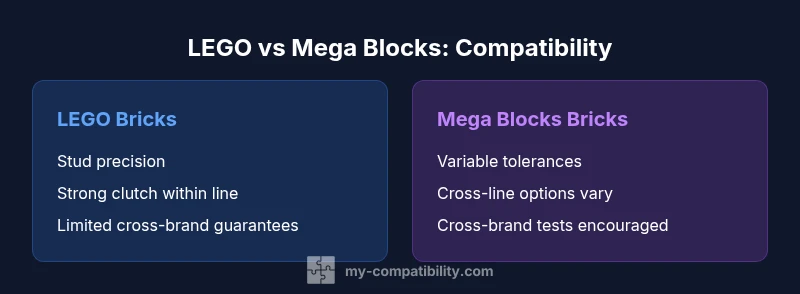
Bricks are defined by a balance between stud diameter, underside geometry, and wall thickness. LEGO standard studs are designed for reliable clutch within their own ecosystem, with a long history of mechanical precision. Mega Blocks bricks, while visually similar, often feature different internal channeling, tube placement, and overall tolerances. Even tiny variances in stud diameter or the depth of the inner tubes can alter whether two bricks connect firmly or simply sit side by side. The upshot is that compatibility is partial at best: some connections feel solid, while others require careful alignment or don’t latch at all. My Compatibility’s assessment emphasizes that these ideas aren’t universal rules—tests matter more than assumptions when combining brands.
Can You Mix Without Forcing? Physical Fit and Real-World Tests
The best way to gauge compatibility is hands-on testing. Start with a small set of bricks from LEGO and Mega Blocks that you intend to mix. Try snapping a few studs from one brand into the other’s grille and observe the clutch, alignment, and any side pressure required to make it hold. If you hear a creak or see a gap, stop forcing the connection. Document the fit with simple notes or photos. This practical tester’s approach aligns with common-sense safety and durability considerations. Remember that even when a cross-brand fit seems to hold, it may loosen with repeated assembly and disassembly.
The Role of Brand Variants: LEGO System vs Mega Bloks System
Lego’s flagship system emphasizes uniform stud geometry and predictable clutch power, while Mega Blocks often trades some precision for broader market scalability. As a result, cross-brand attempts can be hit-or-miss across different product lines (e.g., vintage sets vs current lines). Some Mega Blocks parts are closer in dimension to LEGO, while others diverge enough to compromise stability. This section highlights the importance of testing within the specific combinations you own, rather than relying on broad assumptions about “any brick will fit any brick.” My Compatibility notes that success stories tend to emerge when builders stay within a narrow band of compatible sub-lines.
How to Test Compatibility at Home: Step-by-Step
- Gather a small brick sample from each brand you plan to mix. 2) Inspect visually for obvious dimensional differences (stud diameter, underside tubes, wall thickness). 3) Try several joining configurations (stud-to-temale, side-by-side, staggered). 4) Build a short, simple structure and then gently disassemble to observe wear. 5) Photograph each successful and unsuccessful fit to guide future builds. 6) If a connection feels marginal, reduce the load and avoid forcing repeated connections. This systematic approach reduces risk of damage and provides clear, repeatable results for future projects.
Common Scenarios: When It Works and When It Doesn’t
In smaller, light-use builds, you might achieve decorative effects with mixed bricks—especially when parts are aligned along a common plane or used as accents rather than functional joints. For larger structures requiring long-term stability, sticking to one brand is usually the safer choice. Some cross-brand fits may occur when you place bricks in a compatible orientation and avoid high-stress joints. The key is to test early, document outcomes, and adjust your build strategy accordingly.
Safety, Durability, and Longevity in Mixed Builds
Safety should be your first concern when mixing bricks. Loose connections can pose pinch hazards during play, particularly for younger children who manipulate bricks quickly. Repeated assembly and disassembly across brands may cause wear over time, especially on the studs and tube interfaces. To maximize longevity, avoid forcing bricks together, use gentle, deliberate pressure, and retire any pieces showing visible wear or deformation. Documenting your results helps you decide whether a mixed-build approach is worth pursuing in your household.
The Creative Value of Limited Cross-Brand Play
Even when compatibility is partial, cross-brand play can unlock new creative possibilities. Mixed bricks offer different aesthetics, color palettes, and piece shapes, broadening storytelling opportunities in builds. The value comes from thoughtful curation: selecting compatible lines, prioritizing stability in critical joints, and embracing decorative use where structural integrity isn’t essential. My Compatibility advocates for a mindful, tested approach to cross-brand play rather than a reckless, all-in-without-testing mindset.
Practical Setup: Storage, Sorting, and Build Planning
A well-organized play area helps you test cross-brand builds more efficiently. Separate bricks by brand, ensure clean brick surfaces (dust and oil can affect grip), and keep a running log of what works. Create a quick “compatibility scorecard” for each brick pair you test, rating factors like fit, clutch strength, and ease of use. This practice not only streamlines future builds but also helps you explain your results to others in your household. A structured approach reduces frustration and grows confidence over time.
My Compatibility Perspective: Insights Across Bricks and Beyond
From a broader perspective, compatibility is a spectrum rather than a binary yes/no. The My Compatibility framework encourages analyzing tolerance bands, mechanical fidelity, and intended use. For toy bricks, this means acknowledging that some cross-brand connections can be surprisingly solid, while others are more fragile. Emphasize quality checks, test-driven builds, and a clear plan for when to opt for dedicated-brand sets. This balanced approach fosters creativity without compromising safety or durability.
Authority sources and official guidance
To ground this discussion in established guidance, consult official safety and standards references: see sources such as U.S. Consumer Product Safety Commission and related agencies for general toy-safety considerations, in addition to broader standards bodies that influence toy construction quality. These sources do not prescribe cross-brand compatibility, but they provide important context for safe, age-appropriate play.
Practical next steps for mixed-build households
- Start with a clear objective: decorative accents or structural elements? - Limit the first projects to smaller builds to gauge stability. - Document your results and create a personal reference library of truly compatible brick pairs. - When in doubt, favor brand-consistent builds for critical connectors and load-bearing sections.
Comparison
| Feature | LEGO bricks | Mega Blocks bricks |
|---|---|---|
| Interlock alignment | Typically aligned with LEGO studs but not guaranteed | Typically aligned but not guaranteed; may vary by line |
| Clutch strength | Consistent within LEGO ecosystem | Less consistent when mixed |
| Stud diameter tolerance | Designed around LEGO standard | Varies by Mega Blocks line; not standardized with LEGO |
| Best for | Brand-specific builds and long-term stability | Creative cross-brand experiments with careful testing |
| Official cross-brand tests | Generally absent | Generally absent |
Positives
- Broad choice of brick styles and themes
- Encourages creative mixing within tested limits
- Low-cost entry points for mixed builds
- Opportunity to reuse or repurpose bricks across sets
Cons
- Brick-to-brick play is not reliable across brands
- Clutch strength can be weak when mixed
- Forcing connections risks damage to bricks and fingers
- No universal cross-brand guidelines or warranties
Cross-brand compatibility is partial and situational
Expect inconsistent results when mixing LEGO and Mega Blocks. Use careful testing to identify viable cross-brand builds, and prioritize one-brand stability for critical joints. A mindful, tested approach minimizes wear and safety concerns.
Questions & Answers
Are LEGO and Mega Blocks bricks interchangeable?
Not universally. Some cross-brand pieces may fit, but many will not lock securely or align perfectly. Treat any mixed-build as experimental and test each connection.
Not universally interchangeable; some fits may work, but many will be loose or misaligned. Test each connection before building.
Can you mix bricks from different Mega Blocks lines?
Cross-line mixing can work in some cases, but it’s not guaranteed. Test a small sample first and avoid relying on mixed-line builds for structural integrity.
You might mix Mega Blocks lines, but test first because it isn’t guaranteed to fit well.
Will cross-brand bricks damage bricks?
Forcing connections can wear studs and sockets over time. Handle pieces gently and avoid excessive pressure during assembly.
Be gentle when connecting bricks and avoid forcing them together.
What do I need to test compatibility at home?
Clean bricks, a flat surface, good lighting, and a simple test structure. Record which pairs fit well and which don’t for quick future reference.
Test with a simple structure and keep notes so you remember what works.
Are there official cross-brand compatibility guidelines?
There are no universal, official cross-brand guidelines from LEGO or Mega Blocks. Guidance focuses on safety and intended use, not interoperability.
No universal official guidelines for cross-brand compatibility.
Highlights
- Test bricks from different brands before building
- Prioritize stability for structural joints when mixing brands
- Document compatibility results for future projects
- Avoid forcing bricks together to prevent damage
- Mix creatively where decorative effects are the goal