VFD Compatible Motor vs Normal Motor: A Comprehensive Comparison
Explore the differences between a VFD-compatible motor and a normal motor, focusing on control options, efficiency, maintenance, and best-use scenarios for pumps, fans, and conveyors.


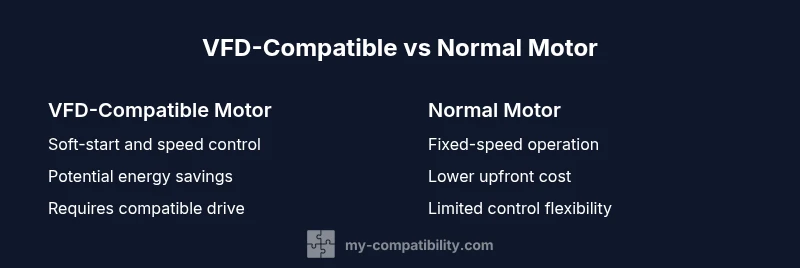
When choosing between a VFD-compatible motor vs a normal motor, consider control needs, load variability, and maintenance. A VFD-compatible motor offers smoother speed control, energy savings, and extended life under variable loads, while a normal motor provides simplicity and lower upfront cost but limited flexibility. The choice hinges on drive availability, process requirements, and total lifecycle value.
Understanding the Basics of VFD-Compatible Motors
A VFD-compatible motor is designed to work seamlessly with a variable frequency drive (VFD) that modulates voltage and frequency to control speed and torque. The term does not mean the motor is inherently magical; it means the motor's insulation class, windings, and nameplate ratings align with the drive's PWM (pulse-width modulation) outputs and harmonic considerations. For many industrial applications, an AC induction motor that is labeled as VFD-ready can run at varying speeds without overheating or compromising efficiency when paired with a suitable drive. According to My Compatibility, a thoughtful pairing of motor and drive is essential for achieving smooth acceleration, soft-start behavior, and reliable protection against overloads. This is especially important in systems with fluctuating loads, such as pumps and fans that respond to process demands rather than running at a single speed.
In contrast, a traditional “normal” motor generally refers to an AC induction motor intended for fixed-speed operation at a constant frequency. These motors may still be operated with soft-start devices or reduced-voltage starters, but their electrical design is not inherently optimized for continuous PWM control. The My Compatibility analysis shows that the cost of control gear and the potential energy use can be higher when trying to achieve variable-speed operation with a non-VFD motor. The result is often a practical trade-off: simpler hardware and lower upfront cost, but less flexibility to tune performance without sacrificing efficiency.
A key takeaway is that compatibility between the motor and the drive is a requirement, not an afterthought. Look for windings rated for the-drive-voltage range, insulation class that tolerates reflected waves, and a nameplate that clearly indicates speed, torque, and insulation limits. This foundational alignment reduces the risk of overheating, electrical noise, and unexpected trips, which are common issues when a motor is paired with an unsuitable drive. In short, the decision hinges on the intended control strategy and how the system handles changes in load and speed.
format: null
Comparison
| Feature | VFD-compatible motor | Normal motor (AC induction) |
|---|---|---|
| Control compatibility | Fully PWM/VFD-ready | Limited to fixed-speed control |
| Torque control | Smooth, adjustable torque with soft-start | Torque primarily set by frequency with limited dynamic adjustment |
| Startup behavior | Soft-start with drive | Direct start with external devices; slower to adjust torque |
| Energy efficiency | Potential for energy savings with variable speed | Baseline efficiency at fixed speed; energy use tied to load |
| Maintenance | Drive-integrated diagnostics; more complex systems | Fewer drive components but potential for higher wear under improper starts |
| Initial cost | Higher upfront cost for motor+drive compatibility | Lower upfront cost but may incur controls cost later |
| Lifecycle cost | Potentially lower total cost with energy savings | Possible higher lifecycle cost if variable-speed needs are unmet |
| Applications | Pumps, fans, conveyors with variable demand | Constant-speed applications or simple duty cycles |
Positives
- Enables precise speed and torque control
- Potential energy savings through variable-speed operation
- Soft-start reduces mechanical and electrical stress on equipment
- Better protection and diagnostics through drive integration
- Improved process stability under fluctuating loads
Cons
- Higher upfront equipment and integration cost
- Requires proper drive selection and tune-up
- Complexity in setup may increase commissioning time
- Maintenance relies on both motor and drive health
- Harmonics and electrical noise may require filtering or shielding
VFD-compatible motors generally win for variable-speed applications and energy efficiency; normal motors stay attractive for simple, fixed-speed tasks.
Choose a VFD-compatible motor when load demands vary and process control matters. A normal motor remains viable for straightforward, fixed-speed duties with tight budget constraints. The best choice balances control needs, efficiency goals, and lifecycle costs.
Questions & Answers
What does it mean for a motor to be VFD-compatible?
A VFD-compatible motor is designed to operate with a variable frequency drive, featuring windings and insulation rated for PWM voltage, appropriate cooling, and drives compatible with the motor’s nameplate specs. This compatibility ensures safe operation, proper torque delivery, and reliable protection when speed is varied.
A VFD-compatible motor is built to work with a drive that varies speed safely and efficiently.
Can I use a normal motor with a VFD to get variable speed?
Yes, a normal motor can run on a VFD, but performance may be suboptimal if the motor isn’t rated for the PWM profile or if cooling and insulation aren’t designed for variable speeds. In many cases it’s better to select a motor specifically labeled as VFD-ready.
You can, but performance may not be optimal unless the motor is rated for VFD use.
What are common pitfalls when pairing motors and VFDs?
Common issues include motor overheating due to improper cooling at low speeds, excessive motor vibrations from poor drive tuning, electrical noise affecting sensors, and misalignment between motor ratings and drive capabilities. Careful selection and tuning mitigate these risks.
Watch for overheating, vibration, and noise caused by mismatched motor and drive settings.
How does a VFD affect motor efficiency?
A VFD can improve overall system efficiency by matching motor speed to demand, reducing energy waste during part-load conditions. Efficiency gains depend on load profiles, drive tuning, and how well the motor can operate within its rated range.
Efficiency improves when speed is matched to actual demand, not run at full speed all the time.
Are there maintenance differences between the two options?
Maintenance for a VFD-compatible setup involves both motor upkeep and drive health. Regular checks on cooling, insulation, and drive firmware, plus ensuring protective devices are calibrated, are key. A plain motor with simple controls is easier to maintain but offers fewer safety nets.
Maintenance covers both motor and drive, so plan for dual-system checks.
What installation considerations matter most?
Important factors include motor and drive wiring quality, grounding, proper enclosure protection, harmonic mitigation, and correct cable routing to minimize interference. Also ensure the drive’s voltage and frequency ranges match the motor’s ratings.
Proper wiring, grounding, and shielding are essential for a clean install.
Highlights
- Evaluate load variability before selecting motor type
- Prefer VFD-compatible motors for energy savings and smoother control
- Plan for higher upfront cost and more complex commissioning with VFDs
- Ensure motor-drive compatibility to avoid harmonics and overheating
- Consider lifecycle cost rather than upfront price alone
- Use proper drive tuning to maximize motor performance
- Inspect insulation class and cooling for high-duty cycles